
Why Choosing a Presby Certified Installer Matters for Your Indiana Property
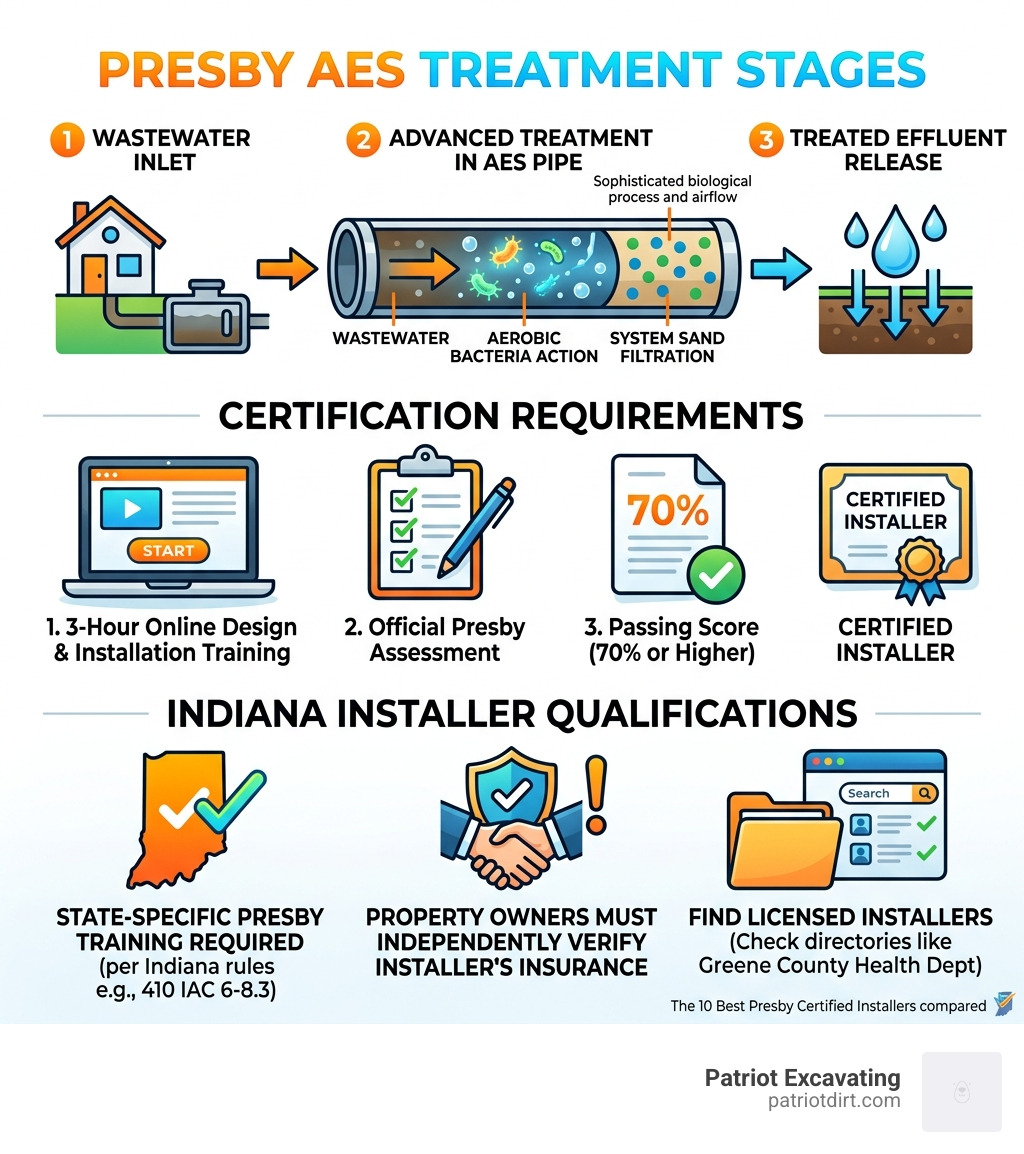
A Presby certified installer is a specialized contractor who has successfully completed the rigorous official training provided through Presby Environmental’s Advanced Enviro-Septic (AES) Design and Installation Certification Class. This certification is not merely an attendance certificate; it requires passing a comprehensive assessment with a score of 70% or higher, ensuring the professional understands the intricate biological and physical requirements of these advanced systems. For property owners in Central Indiana, this certification is the primary safeguard for ensuring a long-lasting onsite sewage system (OSS).
Here’s a detailed summary of what that means for Indiana property owners:
| What You Need to Know | Key Details |
|---|---|
| What they’re certified for | Designing and installing AES, Enviro-Septic, and Simple-Septic systems |
| How they get certified | Intensive training + state-specific assessment (70% passing score) |
| Is it required in Indiana? | Yes — state-specific Presby training is mandatory under Indiana law |
| Is insurance required for certification? | No — property owners must verify insurance independently |
| How to find one in Indiana | Contact local Health Departments or check the licensed installer directory |
| Additional certifications to look for | IOWPA Installer Certificate, ATL, Eljen, and excavation experience |
If you’re planning a new residential build or replacing a failing septic system in Central Indiana, getting this right is paramount. Indiana requires state-specific Presby certification under rules like 410 IAC 6-8.3. Hiring an uncertified contractor can derail septic system installation approvals, trigger failed health department inspections, and increase the risk of system malfunction. In counties like Hamilton, Marion, Hendricks, and Morgan, the local health departments are strict about these requirements to protect the local groundwater and public health.
The Greene County Licensed Installers directory alone lists over 50 contractors certified for Presby systems, but having a name on a list is only the beginning of the evaluation process. Not all certified installers carry the necessary insurance, hold additional credentials like the IOWPA (Indiana Onsite Wastewater Professionals Association) certificate, or possess the heavy excavation experience required to handle the complex soil conditions found in our region.
I’m Clay Hamilton, President of Patriot Excavating and a proud Presby certified installer. With over two decades of hands-on experience in excavation and site development across Indianapolis and the surrounding counties, I’ve seen firsthand how the right Presby certified installer can ensure the long-term viability of a property. In this guide, I’ll walk you through everything you need to evaluate your options with confidence and ensure your site is prepared correctly from the first scoop of dirt.
The Role of a Presby Certified Installer in Modern Wastewater Management
In the evolution of onsite sewage systems (OSS), we have moved significantly beyond the traditional “stone and pipe” methods that were common decades ago. Modern technologies like Advanced Enviro-Septic (AES) have revolutionized how we manage domestic wastewater. These systems are highly sophisticated; they do not simply disperse waste into the ground—they actively treat it through a combination of physical filtration and biological processes. Because these systems rely on specific airflow patterns and bacterial colonies to function, the margin for error during the installation phase is incredibly slim.
In Indiana, a Presby certified installer is required when the design specifies Presby AES/ES/SS technology, and certification is a key compliance checkpoint during permitting. The certification ensures the professional understands the unique physics of the AES technology. This includes how the pipe is wrapped in specialized non-woven geo-textile fabric, how the system sand must meet exact specifications to facilitate treatment, and how the venting system must be configured to pull air through the pipes to support aerobic bacteria. Without this specific knowledge, a contractor might install the system at an incorrect depth or use improper sand, which can suffocate the bacteria and lead to system failure.
In Indiana, these requirements are strictly enforced. They are integrated into the state’s administrative code, specifically 410 IAC 6-8.3, which governs the design, construction, and installation of residential onsite sewage systems. By hiring a certified professional from Patriot Excavating, you ensure that your property remains in full compliance with state law. This compliance is vital for maintaining your property value and ensuring that your home passes all necessary health department inspections during the permitting and final sign-off stages.
At Patriot Excavating, we recognize that a septic system is the most critical “invisible” infrastructure of your home. We specialize in the complex site work and utility services required to get these systems in the ground correctly, regardless of the terrain. If you are dealing with a challenging lot in a place like Boone County or a system replacement in Johnson County, contact us for expert sewer and water services to ensure your project starts on a solid foundation and meets every regulatory standard.
Essential Qualifications for Indiana Onsite Sewage Systems
Finding a name in a directory is a simple task, but finding a qualified partner for your site development is more involved. In Central Indiana—from the growing suburbs of Noblesville down to the rural landscapes of Morgan County—the gold standard for a contractor is a combination of product-specific certification (like Presby) and industry-wide credentials. This dual-layered expertise ensures that the installer understands both the specific product and the broader environmental context of Indiana’s unique soil profiles.
One of the most important secondary credentials to look for is the IOWPA (Indiana Onsite Wastewater Professionals Association) Installer Certificate. While Presby training teaches a contractor how to install one specific brand of technology, IOWPA provides a broader education on Indiana soil types, state regulations, and general installation best practices. This is particularly important in our region, where heavy clay soils can make drainage a significant challenge.
Key facts about Indiana qualifications:
- IOWPA Requirements: To maintain an IOWPA certificate, an installer must complete 20 hours of continuing education every three years, ensuring they stay updated on the latest environmental health standards.
- The Greene County Directory: As of April 2026, the Greene County Licensed Installer Directory serves as a reference for contractors who have met minimum local requirements. However, the health department notes that being on this list is not a warranty of quality; property owners must still perform their own due diligence.
- Multi-Certification: Top-tier installers in Central Indiana often hold certifications for multiple systems, including ATL (Advanced Tertiary Treatment) and Eljen. This versatility indicates a contractor who is committed to staying at the forefront of wastewater technology.
Before you schedule septic system installation, verify your Presby certified installer can provide the certification number required for permits. A septic system is only as effective as the excavation and grading beneath and around it. Whether you are building in Hamilton County or Shelby County, we recommend you Schedule a consultation for site excavation with a team that understands the local soil profiles and the nuances of proper drainage.
Training Requirements for a Presby Certified Installer
Becoming a Presby certified installer requires a genuine commitment to learning the science of wastewater treatment. Presby Environmental requires product-specific training for professionals who design or install AES/ES/SS technology; requirements vary by state. This training ensures that every installer understands that they are not just laying pipe, but building a biological treatment plant.
The certification process involves:
- Required Reading: Installers must study state-specific manuals that detail Indiana’s specific soil requirements and climate considerations.
- Online Training: A multi-hour intensive course covering design criteria, installation techniques, and troubleshooting specific site challenges.
- The Assessment: A rigorous test where the installer must demonstrate their ability to calculate slope, venting requirements, and sand depths accurately.
This training is vital because Presby systems are “passive” aerobic systems. They do not use electricity or mechanical aerators; instead, they use a clever design to pull air through the pipes naturally. If an installer misses a single detail about the venting or the sand quality, the treatment process can be compromised. For official Presby guidance and state documentation, reference Indiana’s Presby approval materials and applicable code.
Verifying the Credentials of a Presby Certified Installer
We always advise our clients in the Indianapolis area to verify all credentials before work begins. A professional contractor will be happy to provide proof of their expertise and legal standing.
Here is your checklist for verification:
- Ask for the Certification Number: Every Presby certified installer is assigned a unique number upon passing their exam. This number is often required for the permit application.
- Check Insurance: This is a critical step. State and local health departments do not always require proof of insurance to be listed in their directories. Ask your Presby certified installer for a current COI showing General Liability and Workers’ Compensation coverage.
- Referral Database: You can contact the manufacturer directly to see if a contractor is in their authorized referral database, ensuring they are recognized by the company that produces the system components.
Hiring an unverified individual puts the integrity of your property at risk. If you’re a builder or developer looking for a reliable partner who handles everything from the initial site clearing to the final utility hookup, you should Request an estimate for builder services from a family-owned company that prioritizes transparency, compliance, and professional excellence.
Comparing Installation Standards: Presby vs. Traditional Systems
In the varied terrain of Central Indiana, we encounter a wide range of soil conditions. Traditional septic systems—the kind utilizing heavy gravel trenches—have been the standard for many years. However, Presby AES systems offer significant advantages in modern site development, provided they are installed by a certified professional who understands the technology.
| Feature | Traditional Stone & Pipe | Presby AES System |
|---|---|---|
| Footprint | Large; requires significant yard space | Up to 60% smaller footprint |
| Treatment Level | Primary treatment (mostly dispersal) | Secondary & Tertiary (high-level treatment) |
| Media | Washed stone/gravel | Specialized “System Sand” (ASTM C-33) |
| Venting | Usually not required | Mandatory high/low vents for airflow |
| Lifespan | 15-25 years (avg) | Potentially indefinite with proper care |
The most striking difference we see during site preparation is the “footprint reduction.” Because the AES pipe has a much higher surface area for beneficial bacteria to grow, you can fit a much more powerful treatment system into a smaller area. This is a significant benefit for smaller lots in places like Carmel, Fishers, or Zionsville, where space is at a premium and property owners want to maximize their usable yard space.
However, the “System Sand” is the most critical component of the installation. Traditional systems are somewhat forgiving with the type of gravel used. Presby AES installations depend on specified sand gradation; incorrect material can restrict airflow and reduce treatment performance. The sand must meet strict ASTM C-33 specifications with a limited percentage of “fines” (dust). If the sand has too much dust, it will clog and prevent the system from breathing. If it is too coarse, the wastewater will pass through too quickly to be treated. A Presby certified installer knows exactly how to source and verify the sand quality before it is ever placed on your site.

Maintenance Protocols for Certified Onsite Systems
A common misconception in the excavation and home-building world is that once a septic system is buried, it requires no further attention. To ensure the longevity of your investment and the health of your property, a proactive maintenance approach is essential. While Presby systems are “passive” and have no moving parts, they still require specific care to function for decades.
1. Regular Inspections A Presby certified installer (or qualified onsite professional) should inspect vents and field conditions periodically to confirm airflow and drainage performance. We are not just looking for physical damage; we are checking the integrity of the venting system. If the vents become obstructed by debris or landscaping, the airflow stops. Without air, the aerobic bacteria cannot survive, and the system will lose its ability to treat waste effectively.
2. Septic Tank Management Even the most advanced Presby system relies on a properly functioning septic tank to settle out solids. Your tank must be pumped regularly based on your household size and usage. If solids are allowed to escape the tank and enter the Presby pipes, they can clog the specialized fabric wrap. This type of maintenance is the best way to prevent the need for a full system remediation.
3. Protecting the Drainage Field The area over your Presby system should be kept clear of heavy structures, vehicles, and deep-rooted plants. Compaction of the soil or the intrusion of roots can interfere with the system’s ability to process water. Additionally, ensure that the vents are never covered by decorative items that do not allow for free airflow.
If you’re upgrading your property and need to move utility lines or ensure your underground infrastructure does not interfere with your drainage field, Get professional help with underground power installation to make sure your various site systems are integrated correctly and safely.
Frequently Asked Questions about Presby Systems
We receive many questions at our job sites in places like Mooresville, Greenwood, and Franklin regarding how these systems function and what the local regulations require. Here are the most common inquiries we address for Central Indiana property owners.
Is Presby certification mandatory in Indiana?
Yes, for the specific products manufactured by Presby Environmental. If your site design calls for an Advanced Enviro-Septic (AES), Enviro-Septic (ES), or Simple-Septic (SS) system, both the designer and the installer must hold a current Presby certification. Local health departments across Central Indiana will not issue a permit or provide a final sign-off on an installation unless the contractor’s valid certification number is provided for their records.
How often do Presby systems require professional check-ups?
While specific county requirements may vary, we recommend a professional inspection at least once every few years. During these visits, the professional will monitor the sludge levels in the septic tank, verify that the vent pipes are clear and providing proper airflow, and check the surface of the field for any signs of saturation. Early detection of a venting or drainage issue is the key to maintaining the system’s health.
What is the difference between IOWPA and Presby certification?
It is helpful to think of IOWPA as a general professional license that proves a contractor understands the broad rules and soil science of Indiana (specifically 410 IAC 6-8.3). Presby certification is a specialized endorsement that proves the contractor has mastered the proprietary technology of the AES system. The most qualified contractors in the Indianapolis region hold both, ensuring they can handle the complexities of the local soil while installing the advanced technology correctly.
Can a Presby system be installed on a sloped lot?
Yes, one of the advantages of the Presby AES system is its flexibility. Because it is a modular system, a Presby certified installer can design and install it on various terrains, including slopes that might be challenging for traditional systems. This makes it an excellent choice for the rolling hills found in parts of Morgan and Johnson counties.
Conclusion
Choosing the right Presby certified installer is about more than just meeting a regulatory requirement; it is about protecting your home, your environment, and your long-term property value. A system that is installed incorrectly in the heavy clay soils of Central Indiana can lead to backups, odors, and a complete failure of the drainage field. By prioritizing certification and experience, you ensure that your onsite sewage system will serve your home reliably for many years to come.
When you look for an installer, seek out a partner who understands the entire scope of site development. At Patriot Excavating, we do more than just dig; we prepare your entire site for a successful future. From the initial clearing and grading to the precise installation of sewer, water, and drainage systems, we bring a family-owned commitment to every project we undertake across the Indianapolis area.
Whether you are in Zionsville, Franklin, or right here in Indianapolis, our team is ready to help you navigate the complexities of onsite sewage and site preparation. We pride ourselves on our technical expertise and our deep understanding of Indiana’s local regulations and soil conditions. Don’t leave your property’s most critical infrastructure to chance.
Ready to get your project moving with a team you can trust? Contact Patriot Excavating, a certified Presby septic system installer, for comprehensive site development, and let’s make sure your installation is handled with the professional care it deserves.