
Navigating Sanitary Sewer Installation for Indianapolis Commercial and Residential Builds
Regulatory Framework and Sewer Line Installation Services in Municipal Rights-of-Way
Installing underground sanitary infrastructure requires navigating local municipal codes, utility rights-of-way, and dedicated easements. In Central Indiana communities such as Marion County, Hamilton County, Hendricks County, and Johnson County, municipal authorities establish clear guidelines to protect underground assets and ensure long-term public health. When a sanitary sewer lateral extends from a building foundation out toward the municipal main line, it frequently traverses both private real estate and public rights-of-way.
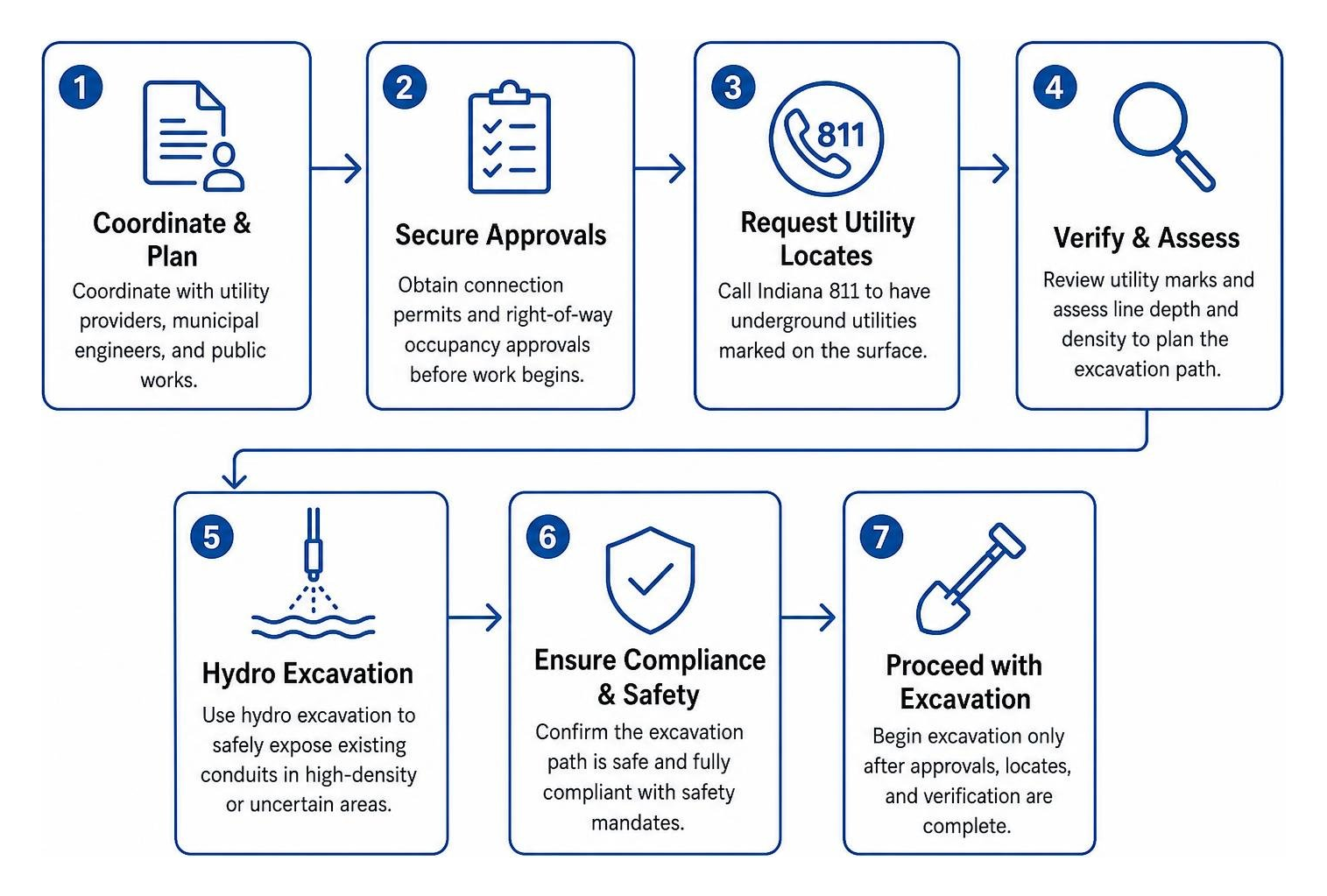
Connecting to a public utility main requires strict alignment with municipal engineering standards. Our team at Patriot Excavating coordinates directly with regional utility providers, municipal engineers, and public works departments to secure connection permits and right-of-way occupancy approvals before cutting pavement or moving earth. We manage every phase of the permitting and compliance workflow to prevent unnecessary regulatory interruptions during project execution.
A central part of this preparation is the Indiana 811 locate process. Underground corridors in metropolitan areas like Indianapolis, Greenwood, Carmel, and Fishers contain high-pressure gas mains, fiber optic communication bundles, primary power feeds, and stormwater conduits. Calling for utility locates allows technicians to mark these public assets on the surface. Where utility density is high or line depths are uncertain, we deploy non-destructive hydro excavation to safely expose existing conduits without damaging fragile infrastructure. This hands-on site coordination guarantees that the excavation path remains completely compliant with regional safety mandates.
Verifying Property Easements Before Beginning Sewer Line Installation Services
Before breaking ground on any residential addition, commercial development, or sewer replacement, verifying dedicated property easements is essential. A sanitary sewer easement grants municipal entities or utility operators the legal right to access, maintain, repair, and replace underground infrastructure across a designated strip of private land. If an installation accidentally strays outside the dedicated utility easement or encroaches on structural setbacks, property owners face severe project delays, future legal disputes, or mandatory line relocations.
Examining property deeds, subdivision plats, and professional title records confirms exact lot boundaries, building setback lines, and easement dimensions. Typical residential sewer easements range from ten to twenty feet wide, running parallel to lot lines or road frontages. Reviewing official recorded plats reveals the location of existing utility corridors, drainage paths, and access easements across the parcel.
Our comprehensive site evaluation identifies these legal boundaries relative to the proposed pipe path. By confirming right-of-way limits and underground paths ahead of time, we help developers and homeowners avoid common sewer line installation mistakes. This thorough upfront review ensures every trench, tap, and cleanout sits squarely within approved legal parameters across Central Indiana job sites.
Resolving Municipal Ordinances and Easement Abandonment Procedures
When properties undergo redevelopment, building expansion, or major utility realignments, existing recorded easements may no longer fit the new site design. In such cases, property owners and developers must work through local municipal ordinances to formally vacate or abandon outdated easements before new construction proceeds.
In Central Indiana municipalities like Noblesville, Westfield, Plainfield, and Franklin, an easement vacation begins by submitting a formal petition to the local city council, town council, or board of public works. The process typically includes:
- Resolution of Intention: The municipal board introduces a preliminary resolution outlining the proposed easement abandonment and its impact on public services.
- Technical Review: Public works, engineering, and fire departments review utility maps to confirm that abandoned lines will not compromise neighborhood sewer capacity or emergency access.
- Public Hearing: A public notice is published, and a formal hearing is conducted to allow adjacent property owners and utility operators to voice concerns or support.
- Final Ordinance Adoption: If approved, the board passes a binding ordinance vacating the easement, which is formally recorded with the county recorder’s office.
Securing these approvals before bringing heavy machinery to the site prevents regulatory stoppages. Patriot Excavating coordinates closely with general contractors, civil engineers, and local building authorities to ensure all required approvals, permit authorizations, and legal abandonments are completely settled before excavation begins. For broader context on how municipal utilities are managed across the United States, the Sanitary sewer overview provides useful background on public sewer systems and their role in community infrastructure.
Groundwork, Trenching, and Integration with Public Works Projects
Proper sewer installation relies on meticulous groundwork. Unlike pressurized water distribution systems, gravity-fed sanitary sewer lines require precise elevation drops along every foot of pipe. A sewer pipe must maintain a steady downward grade to transport solid waste and wastewater efficiently without pooling, sediment accumulation, or backflow.
Achieving the correct grade requires disciplined earthmoving coordination. In Central Indiana, regional frost line depth requires water services to sit at a minimum of 42 to 48 inches below the surface, while gravity sewer laterals often run anywhere from six to twelve feet deep at the municipal connection point. Excavating to these depths requires stabilizing the trench walls with protective trench boxes, managing groundwater intrusion with professional dewatering equipment, and meticulously preparing the pipe foundation.
Integrating sanitary sewer runs with other infrastructure is a primary concern on modern construction sites. When a site undergoes broader grading, roadway paving, or utility additions, sewer trenching must coordinate smoothly with comprehensive sewer water and drainage infrastructure to prevent cross-contamination, foundation compromise, and long-term soil settlement.
Aligning Sewer Lateral Depths with Stormwater and Paving Standards
Underground utilities must operate together within shared road corridors and utility easements. Sanitary laterals, storm sewer catch basins, and stormwater collection mains often cross paths between the building foundation and the street. To prevent physical collisions and adhere to local environmental health standards, sanitary sewer pipes must maintain mandatory vertical and horizontal separation distances from clean potable water lines and storm drain conduits.
Coordination between sewer excavation and site paving schedules is critical for overall site stability. When utility contractors dig a deep trench across a proposed parking lot, driveway, or public street, improper backfilling can cause soil settlement months down the road. To prevent asphalt cracking, trench sinking, and road failure, our operators adhere to established storm sewer pipe installation standards and groundwork practices.
We place backfill in thin, uniform lifts, mechanically compacting each layer with specialized vibratory equipment to achieve required soil densities. By combining sewer excavation, stormwater management, and comprehensive erosion control into a single cohesive workflow, Patriot Excavating delivers stable site foundations that support long-term pavement durability across residential and commercial developments.
Structural Bedding and Foundation Support Beneath Slabs
Installing sewer pipes beneath or immediately adjacent to heavy concrete slabs introduces significant structural challenges. When heavy commercial structures or residential slabs sit above a sewer line, any ground settlement beneath the pipe can lead to pipe shearing, bell joint separation, or reverse grading that disrupts gravity flow.
To create a stable base, our team excavates the trench bottom below the final pipe elevation, replacing native loose soil or unstable clay with crushed stone or washed granular bedding. This granular material distributes the structural load evenly along the entire barrel of the pipe, eliminating localized pressure points that could cause premature failure.
For high-durability installations, heavy-duty SDR-35 PVC pipe is the standard choice throughout Central Indiana due to its structural strength, smooth interior walls, and root-resistant gasketed joints. Maintaining a consistent downward slope, typically one-eighth to one-fourth of an inch per linear foot depending on pipe diameter and local plumbing code, guarantees reliable gravity flow. When projects require installing a sewer line under a concrete slab, our crew applies specialized excavation, soil stabilization, and sewer installation techniques to protect both the building foundation and the underground utility line.
| Installation Feature | Open-Trench Excavation | Trenchless Pipe Installation |
|---|---|---|
| Primary Methodology | Continuous mechanical trenching and aggregate bedding | Hydraulic pipe bursting or horizontal directional boring |
| Surface Impact | Full surface excavation along pipe path | Minimal surface cuts limited to entry and exit pits |
| Grade Control | Complete visual and laser grade adjustment | Dependent on existing pipe path or boring navigation |
| Best Application | New builds, complex utility crossings, septic conversions | Pipe replacement beneath established driveways and landscapes |
| Site Restoration | Backfill compaction, grading, and surface restoration | Small pit backfills and targeted surface patching |
Modern Methods for Residential and Commercial Utility Connection
Selecting the right installation method depends on property layout, soil conditions, pipe condition, and existing surface improvements. Open-trench excavation remains the benchmark for new residential and commercial construction where raw land is being developed, new foundations are poured, and site grades are established. This traditional method gives operators direct visual access to inspect soil stability, establish precise pipe slopes using dual-slope laser levels, and properly pack aggregate bedding around pipe joints.
For existing properties with paved parking lots, mature trees, or structural additions, trenchless methods provide an efficient alternative. Rather than opening a continuous trench across an entire property, trenchless techniques utilize small entry and exit pits to install or replace pipe runs. Patriot Excavating evaluates every commercial and residential site across Indianapolis and surrounding counties to determine whether open trenching, directional boring, or pipe bursting is the safest, most reliable path forward.
Choosing Advanced Sewer Line Installation Services for Difficult Terrains
Commercial corridors and densely developed residential neighborhoods in areas like Speedway, Beech Grove, Lawrence, and downtown Indianapolis often feature narrow utility easements packed with existing electrical cables, gas mains, and communication lines. Navigating these tight spaces requires precise utility installation methods and experienced operators.
When an old sewer pipe has suffered severe structural decay, root infiltration, or partial collapse, trenchless pipe bursting offers a minimally invasive solution. During this process, a specialized bursting head is pulled through the damaged host pipe, breaking it apart and outward into the surrounding soil while simultaneously pulling a continuous run of durable High-Density Polyethylene (HDPE) pipe into place. Homeowners and commercial property managers evaluating this approach can explore pipe bursting sewer line replacement to preserve valuable surface improvements like concrete patios, retaining walls, and asphalt driveways.
When underground obstacles require customized excavation, understanding how excavation services help fix common sewer problems ensures that complex repairs and utility crossings maintain full hydraulic integrity without disrupting adjacent utility conduits.
Managing Septic to Municipal Sewer Conversions
As municipal sewer infrastructure expands into suburban and semi-rural areas across Central Indiana, many property owners are transitioning from private septic systems to municipal sewer service. Connecting to a public sewer eliminates drain field failures, reduces ongoing maintenance concerns, and enhances overall property functionality.
A successful septic-to-sewer conversion requires several coordinated steps:
- Verifying the location and depth of the municipal sewer main tap or stub along the street frontage.
- Securing municipal connection permits and submitting required local utility documentation.
- Trenching a new private sanitary lateral from the building’s main drain exit to the municipal sewer tie-in.
- Rerouting internal plumbing lines to bypass the old septic tank connection entirely.
- Decommissioning and abandoning the old septic tank in full compliance with local health department environmental regulations, which involves pumping out waste, crushing or removing the tank lid, and filling the void with compacted sand or gravel.
Property owners planning this transition can rely on experienced sewer installers in Marion County and surrounding areas to manage the entire conversion, from initial trenching to final health department sign-off.
Frequently Asked Questions About Sanitary Sewer Installation
What types of easements are required for installing a sewer line on private property?
Installing a sanitary sewer lateral across private real estate typically requires a dedicated public utility easement or a private drainage and utility easement. These legal agreements define a specific strip of land, usually between ten and twenty feet wide, where municipal utility providers and authorized contractors have the right to access, excavate, install, and maintain underground sewer lines.
If a sewer lateral must cross an adjacent neighbor’s property to reach the municipal main in the street, a private off-site utility easement must be formally surveyed, drafted by legal counsel, signed by the property owner, and recorded with the county recorder before any work begins. Patriot Excavating reviews site plans and recorded plats during our site evaluation process to ensure that all planned sewer runs fall strictly within approved utility corridors.
How do Indianapolis-area planning boards approve public sewer line improvements?
Public sewer main extensions, system capital improvements, and major infrastructure upgrades move through a formal municipal approval process. Local planning commissions, city councils, and boards of public works evaluate proposed sewer improvements through public engineering reviews. The process often begins with a resolution of intention, which officially registers the municipality’s plan to install or upgrade sanitary utilities across designated public rights-of-way.
Municipal engineers assess utility maps, environmental impacts, and stormwater integration before opening the floor to public hearings. Once the board adopts a final ordinance, detailed construction plans and easements are officially approved. Patriot Excavating works directly with general contractors and engineering teams to coordinate work schedules with these municipal approvals, ensuring projects meet local standards.
What steps verify that a sewer lateral does not encroach on neighboring utility lines?
Preventing utility encroachment requires subsurface utility verification before and during excavation. The first step is submitting a locate ticket through Indiana 811, which alerts public utility providers to mark buried gas, electric, water, and communication lines on the property surface.
To confirm the exact depth, alignment, and clearance of these utilities, our team performs physical site surveys and utilizes hydro excavation. Hydro excavation uses pressurized water and vacuum suction to safely uncover buried lines without the strike risk of mechanical backhoe buckets. This verification ensures our sanitary sewer lateral maintains required vertical and horizontal clearance distances from neighboring utilities, preventing accidental utility strikes and code violations.
Ensuring Long-Term System Reliability with Professional Site Work
A well-installed sanitary sewer system is built to provide decades of maintenance-free service. Achieving that reliability requires meticulous attention to detail at every phase of the project, including initial plan review, easement verification, precision trenching, laser-calibrated grading, aggregate bedding, and backfill compaction.

Cutting corners on trench preparation or rushing the backfill process can lead to pipe sagging, joint separation, soil erosion, and structural failure. When you choose Patriot Excavating, our experienced team manages the entire process from initial site excavation to final grade stabilization and erosion control. We coordinate directly with local building inspectors to secure final sign-offs, ensuring your sanitary sewer line complies with all regional engineering standards across Central Indiana.
Whether you are breaking ground on a new commercial development, building a custom home, or converting an aging septic system to municipal sewer, our family-owned team delivers dependable site-development solutions tailored to your property. To discuss your upcoming project and request a comprehensive site assessment, explore our underground utility services or contact our commercial site excavation contractors today to schedule an on-site consultation and receive an accurate project estimate.