
Your First Response to a Sewer Line Crisis
When you’re facing an emergency sewer line replacement, every second counts. A sudden backup, an unmistakable odor, or a soggy patch in your yard isn’t just an inconvenience—it’s a critical infrastructure failure that threatens your property’s safety, your family’s health, and the integrity of your home’s plumbing system. In Central Indiana, where homes range from historic properties with aging clay pipes to newer constructions subject to ground settlement, these emergencies can strike without warning. The key to mitigating the damage is a swift, decisive, and professional response.
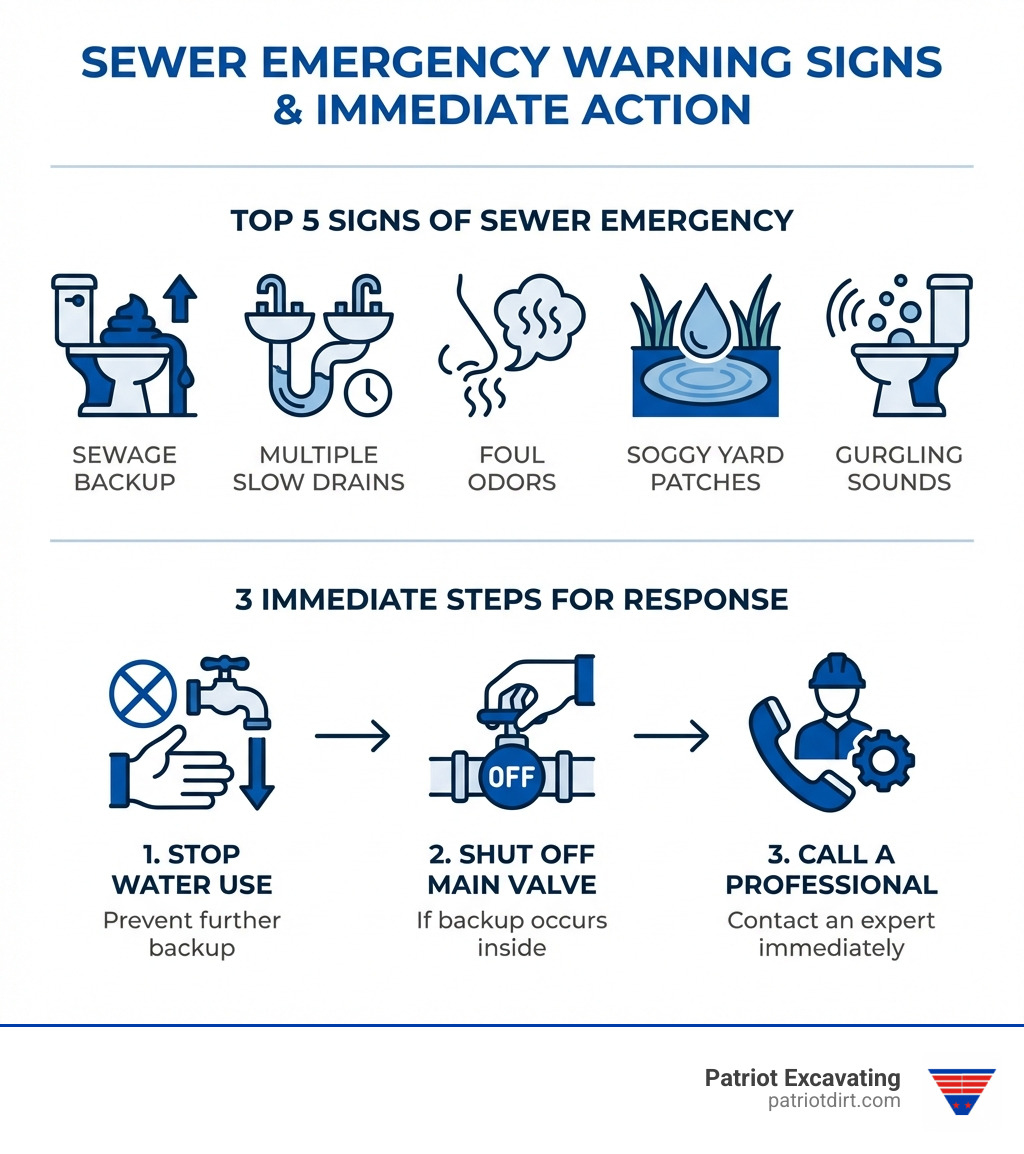
Here’s what you must do immediately when you suspect a sewer line emergency:
Key Steps for a Sewer Line Emergency:
- Stop using all water in your home immediately. This includes flushing toilets, running faucets, showering, and using appliances like dishwashers or washing machines. Every gallon adds to the backup.
- Shut off the main water valve to your house. This is a critical step to prevent any more water from entering your plumbing system, which can worsen indoor flooding and property damage.
- Call Patriot Excavating right away. A sewer line emergency is not a DIY project. It requires specialized equipment, safety protocols, and expertise to diagnose and resolve correctly. Our team is on standby to provide rapid, professional assistance.
- Keep everyone safe. Evacuate the area if necessary, especially if there is standing sewage. Raw sewage contains harmful pathogens and gases. Keep children and pets far away from the affected areas.
- Document the damage. Once it is safe to do so, take clear photos and videos of any backups, water damage, or visible issues in your yard. This documentation is crucial for any potential insurance claims.
Common Signs You Need Emergency Replacement:
- Multiple drains backing up simultaneously
- A strong, persistent sewage odor inside or outside your home
- Unexplained soggy patches, indentations, or sinkholes in your yard
- Loud gurgling sounds from toilets and drains
- Visible sewage pooling in your basement, crawl space, or near your foundation
A sewer line emergency doesn’t operate on a convenient schedule. One moment, your plumbing system is functioning perfectly; the next, you’re facing a crisis that can cause extensive and lasting damage. A collapsed, burst, or severely blocked sewer line is fundamentally different from a simple clog. It demands immediate, expert intervention to protect your property from contamination and limit the spread of damage by acting quickly.
Research confirms that exposure to raw sewage is a significant health hazard, as it contains a host of dangerous bacteria, viruses, and parasites. If not addressed immediately, a failing sewer line can saturate and destabilize the soil supporting your home’s foundation, leading to catastrophic structural damage. It can also contaminate the local groundwater, impacting the environment beyond your property line. Delayed action often expands the affected area and increases the scope of cleanup and restoration work.
Fortunately, modern sewer line replacement has evolved far beyond the disruptive, large-scale trenching of the past. As a leading excavation and utility contractor in Central Indiana, Patriot Excavating is equipped to handle emergency replacements using both traditional open-trench excavation and advanced, minimally invasive trenchless technologies. The best method for your property depends on critical factors such as the nature and extent of the damage, the location and depth of the pipe, soil conditions, and the layout of your property. Understanding these options is key to making a calm, informed decision during a stressful time.
This guide covers emergency sewer line replacement, including the most common signs of sewer line replacement, what to do immediately, and how professionals diagnose and replace failing lines. We’ll cover how to recognize the critical warning signs, what steps to take immediately, the advanced methods we use for diagnosis and repair, and how to work with our team to ensure a swift and effective resolution. Our goal is to not only fix the immediate problem but also to provide a long-term solution that protects your home’s vital plumbing infrastructure for years to come.
I’m Clay Hamilton, President of Patriot Excavating. For over two decades, my team and I have been on the front lines, helping homeowners across the Indianapolis area navigate the complexities of emergency sewer line replacement. We’ve seen firsthand how a rapid response and the right technical approach can turn a potential disaster into a manageable problem. Our deep experience with both traditional and trenchless methods, combined with our understanding of Central Indiana’s unique geological and infrastructural challenges, allows us to provide solutions that are not just fast, but also durable and reliable. We’re here to restore your peace of mind.
Navigating an Emergency Sewer Line Replacement
When a sewer line fails, you need a clear plan and a trusted partner. This section provides a detailed roadmap for navigating the crisis, from accurately identifying the problem to understanding the professional repair process. We will explore the definitive warning signs, the immediate actions you must take, the severe risks of any delay, and the modern solutions Patriot Excavating employs to resolve your sewer line emergency with precision and efficiency.
Critical Signs You Need an Emergency Sewer Line Replacement
Recognizing a sewer line emergency early is crucial. While a catastrophic failure is obvious, many problems begin with more subtle clues. Recognizing these signs of sewer line replacement early helps you act decisively and reduce exposure to contamination. If you notice any of the following, it’s time to call for professional help immediately.
- Sewage Backups: This is the most urgent and unmistakable sign. If you see raw sewage or wastewater coming back up through toilets, floor drains, or showers—particularly on the lowest level of your home—it’s a clear indication that your main sewer line is blocked or has collapsed. The wastewater from your entire home has nowhere to go and is being forced back inside. This is a biohazard and requires immediate professional attention.
- Multiple Slow Drains: A single clogged sink is usually a minor issue. However, if you notice that drains in multiple rooms (e.g., a kitchen sink, a downstairs bathroom, and a laundry drain) are all draining slowly, the problem is not with individual fixtures. This points to a systemic issue in your main sewer line, which is struggling to carry away the combined wastewater from your home.
- Gurgling Toilets or Drains: When you flush a toilet, does another drain in the house gurgle? When the washing machine drains, do you hear bubbling sounds from a nearby toilet? These noises are caused by trapped air being displaced in the sewer line due to a partial or full blockage. As water tries to flow past the obstruction, it forces air back up the line, creating the gurgling sound—a classic symptom of a developing sewer emergency.
- Foul Odors: Your plumbing system is designed with traps and vents to keep sewer gas out of your home. If you smell a persistent odor of raw sewage inside your house or in your yard, it’s a serious red flag. This indicates a breach in the line—a crack, break, or separated joint—that is allowing noxious and potentially harmful gases to escape.
- Soggy Patches or Sinkholes in Your Yard: A broken sewer line will continuously leak water and waste into the surrounding soil. This saturation can lead to several tell-tale signs in your yard, often along the path of the underground pipe. You might notice isolated patches of unusually green and lush grass, perpetually damp or marshy areas, or, more seriously, indentations or sinkholes forming as the soil erodes and collapses from beneath the surface.
- Foundation Cracks or Settling: This is one of the most destructive consequences of an unaddressed sewer leak. In Central Indiana, many homes are built on clay-based soils that expand and contract dramatically with changes in moisture content. A leaking sewer line super-saturates the soil around your foundation, turning it into a soft, unstable slurry. This can cause the foundation to shift, settle, or crack, leading to severe structural damage throughout your home, including cracked walls and uneven floors.
- Pest Infestation: A sudden and unexplained increase in rodents (like rats) or insects (like cockroaches and sewer flies) can be linked to a break in your sewer line. Damaged pipes provide pests with a source of moisture and a direct, sheltered highway from the main city sewer into your property and even your home.
- Frequent Blockages: If you find yourself constantly battling clogs and backups, it’s a strong sign that you’re treating symptoms, not the root cause. Recurring issues often point to a more significant problem within the main line itself, such as severe tree root intrusion, a misaligned or “bellied” pipe section that collects solids, or extensive pipe corrosion and deterioration.
If you’re experiencing any of these critical signs, don’t wait. Contact Patriot Excavating immediately for an expert diagnosis.
Your Immediate Action Plan: What to Do Right Now
In a sewer line emergency, your actions in the first few minutes can significantly limit the extent of the damage. Follow this professional action plan to protect your property and ensure safety while our team is on the way.
- Stop Water Use Immediately: This is the absolute first and most critical step. Cease all water usage in the house. Inform everyone in the household not to flush toilets, take showers, run sinks, or use any water-dependent appliances. Every gallon of water sent down the drain will add to the backup, increasing the volume of sewage overflowing into your home or yard.
- Shut Off Your Main Water Valve: To completely prevent any accidental water use and stop the flow into your plumbing system, locate and turn off your home’s main water supply valve. This is typically located where the water line enters your house, often in a basement, crawl space, or utility closet. Turning it off stops the pressure that can force more water into an already overwhelmed system.
- Call a Professional Excavation Company: Call a licensed excavation contractor equipped for sewer replacement work. Patriot Excavating uses camera inspection and safe excavation practices to resolve emergencies efficiently. Call Patriot Excavating immediately. Our team serves the entire Indianapolis, Greenwood, and Central Indiana region and is equipped to handle these emergencies safely and efficiently.
- Avoid Chemical Drain Cleaners: Do not pour chemical drain cleaners down your drains. They are ineffective against major blockages like tree roots or a collapsed pipe. Furthermore, these harsh chemicals can damage your plumbing and create a hazardous situation for our technicians who will be working on the line.
- Document the Damage: For insurance purposes, it is vital to document the situation thoroughly. From a safe distance, take clear photographs and videos of all affected areas, including any sewage backup, water damage to floors and walls, and any visible issues in your yard like sinkholes or pooling water.
- Ensure Safety and Ventilate: Raw sewage is a serious health hazard. Keep all family members and pets away from the contaminated area. If the backup is indoors, wear waterproof boots and gloves if you must enter the area. Open windows to help ventilate the space and dissipate harmful sewer gases. Do not use any open flames or create sparks, as sewer gas can be flammable.
By following these steps, you can help control the situation until our professional crew arrives. Your safety and the protection of your property are the top priorities.
The Dangers of Delay: Risks and Consequences
Delaying an emergency sewer line replacement can transform a manageable crisis into a catastrophic event. The consequences extend far beyond inconvenience, posing severe risks to your health, your home’s structural integrity, and your finances. Understanding these dangers underscores the urgency of immediate professional intervention.
- Serious Health Hazards: Raw sewage is a toxic cocktail of waste, water, and a host of dangerous microorganisms. It can contain bacteria like E. coli, Salmonella, and Shigella, as well as viruses such as Hepatitis A and Norovirus. Direct contact with contaminated water can cause severe gastrointestinal illness, skin infections, and other diseases. Even more dangerous is the potential for these pathogens to become airborne in water droplets when a toilet is flushed during a backup, allowing them to be inhaled. The health risks are especially high for children, the elderly, and individuals with compromised immune systems.
- Toxic Sewer Gas Exposure: A broken sewer line allows sewer gas to escape from the plumbing system and enter your home or accumulate in your yard. This gas is a mixture of several compounds, but the most dangerous is hydrogen sulfide (H₂S), recognizable by its “rotten egg” smell. At low concentrations, it causes nausea, headaches, and eye irritation. At higher concentrations, which can quickly build up in an enclosed space like a basement, it is highly toxic, can deaden the sense of smell, and can lead to respiratory failure, coma, and even death. Methane, another component, is an asphyxiant and is highly flammable, creating a risk of fire or explosion.
- Catastrophic Property Damage:
- Foundation and Structural Failure: This is one of the most severe long-term risks. Leaking sewage saturates the soil around and under your home’s foundation. In Central Indiana, the prevalent clay soil acts like a sponge, swelling when wet and shrinking when dry. This constant expansion and contraction, known as soil heave, exerts immense pressure on your foundation, leading to cracks, shifting, and uneven settling. Over time, this can compromise the entire structural integrity of your house, requiring incredibly extensive and costly repairs.
- Widespread Mold and Mildew Growth: The moisture from a sewage backup creates the perfect breeding ground for toxic black mold (Stachybotrys chartarum) and other fungi. Moisture from a sewage backup can quickly create conditions that support mold growth. Prioritize ventilation and professional cleanup guidance for contaminated areas.
- Destruction of Landscaping and Hardscaping: A persistent sewer leak will poison your yard. The over-saturation and contaminants will kill grass, shrubs, and even mature trees. The soil erosion can also undermine and crack driveways, walkways, and patios, requiring complete replacement.
- Environmental Contamination: A leaking sewer line doesn’t just affect your property. The untreated wastewater seeps into the ground, contaminating the soil and potentially reaching the local groundwater table. This can pollute nearby streams, rivers (like the White River), and aquifers, posing a threat to the local ecosystem and potentially affecting community water sources.
- Escalating Restoration Costs: The financial impact of delaying repairs grows exponentially. What might have been a straightforward pipe replacement can quickly balloon into a project that includes water extraction, sanitation, mold remediation, foundation repair, structural engineering assessments, and complete landscape restoration. Acting swiftly with an emergency sewer line replacement is the most effective way to protect your health, your home, and your financial well-being.
Understanding Replacement Methods: Excavation vs. Trenchless
When you call Patriot Excavating for an emergency sewer line replacement, our first step is a thorough diagnosis. We use a specialized sewer camera to inspect the entire length of the pipe from an accessible cleanout. This allows us to pinpoint the exact location and nature of the problem—whether it’s a collapse, severe root intrusion, a significant break, or a bellied pipe. This crucial diagnostic step ensures we recommend the most effective and efficient solution for your specific situation. Based on our findings, we will propose one of two primary methods: traditional excavation or modern trenchless replacement.
| Feature | Traditional Excavation (Open-Trench) | Trenchless Methods (Pipe Bursting/Lining) |
|---|---|---|
| Process | A trench is dug along the entire length of the damaged pipe. The old pipe is removed and a new one is installed. | Small access points are dug at the ends of the pipe. The new pipe or liner is pulled or inserted through the existing pipe. |
| Property Disruption | High. Requires extensive digging, which disrupts landscaping, driveways, and patios. | Minimal. Only one or two small access pits are needed, preserving most of your yard and hardscaping. |
| Time to Complete | Typically takes several days, depending on the length and depth of the pipe. | Often completed in a single day, minimizing disruption to your home and routine. |
| Best For | Completely collapsed or back-pitched pipes; situations where the pipe needs to be rerouted. | Cracked, leaking, or root-infested pipes that are still structurally intact enough to host a new pipe or liner. |
| Restoration | Requires significant restoration of the excavated area, including backfilling, soil compaction, and replanting or repaving. | Requires only minor restoration of the small access points. |
Traditional Excavation: The Time-Tested Method
Traditional open-trench excavation is the conventional method of sewer line replacement. It involves using an excavator to dig a trench that exposes the entire length of the damaged sewer pipe.
The Process:
- Utility Location: Before any digging begins, we contact 811 to have all underground utility lines (gas, electric, water, cable) professionally marked to ensure a safe excavation.
- Excavation: Our skilled operators carefully dig a trench along the path of the old sewer line, taking care to protect your property as much as possible.
- Pipe Removal and Replacement: The old, damaged pipe is removed from the trench. We then lay a new, high-quality PVC or HDPE pipe, ensuring it has the correct slope (or “grade”) for proper drainage.
- Inspection and Backfilling: The new line is connected and inspected to ensure it is functioning perfectly. The trench is then carefully backfilled with soil, which is compacted in layers to prevent future settling.
While more disruptive, traditional excavation is sometimes the only viable option, especially for pipes that have completely collapsed, are severely back-pitched (sloped the wrong way), or need to be rerouted entirely.
Trenchless Technology: The Modern, Minimally Invasive Solution
For many emergency situations in the Indianapolis area, trenchless technology is a superior alternative. It allows us to replace your sewer line with minimal digging, preserving your lawn, garden, driveway, and patio. Patriot Excavating specializes in two primary trenchless methods:
- Pipe Bursting: This method replaces the old pipe with a brand-new one of the same or even larger diameter.
- How it works: We dig two small access pits at either end of the damaged pipe section. A powerful hydraulic machine pulls a new, high-density polyethylene (HDPE) pipe through the old line. A cone-shaped “bursting head” is attached to the front of the new pipe. As it’s pulled through, it shatters the old pipe (whether clay, cast iron, or PVC) outward into the surrounding soil, simultaneously pulling the new, seamless pipe into place behind it. The result is a brand-new, joint-free pipe that is highly resistant to roots and leaks.
- Cured-in-Place Pipe (CIPP) Lining: This method essentially creates a new, structural pipe inside the old one. It’s an excellent solution for pipes with cracks, holes, or root intrusion, but that have not completely collapsed.
- How it works: First, the existing pipe is thoroughly cleaned of all roots and debris. Then, a flexible, resin-saturated felt liner is inserted into the old pipe from a single access point. An internal bladder is inflated, pressing the liner firmly against the walls of the host pipe. We then use hot water or steam to cure the resin, causing it to harden into a smooth, seamless, and incredibly durable new pipe. Once cured, the bladder is removed, leaving behind a fully functional, joint-free pipe within the old one.
Choosing the right method is a critical decision. The team at Patriot Excavating will provide a clear explanation of our camera inspection findings and recommend the best approach for your home, your budget, and your long-term peace of mind. Whether it requires a full excavation or a state-of-the-art trenchless solution, our priority is to resolve your emergency quickly, effectively, and with the highest standards of quality.
If you’re seeing signs of sewer line replacement, backups, odors, gurgling drains, or soggy ground, don’t wait. For emergency sewer line replacement in Central Indiana, Contact Patriot Excavating for fast diagnosis and a durable replacement plan.