
Understanding Foundation Cracks: From Harmless to Hazardous
A cracked concrete foundation can be alarming, but not every crack signals disaster. Understanding the difference between normal settling and a true structural threat can save you thousands in unnecessary repairs.
Quick Assessment Guide for Foundation Cracks:
- Hairline cracks (< 1/8 inch): Usually normal concrete shrinkage.
- Vertical cracks: Often harmless settling; monitor for growth.
- Horizontal cracks: Serious concern indicating soil pressure.
- Stair-step cracks: Major structural issue needing immediate evaluation.
- Cracks > 1/4 inch: Professional assessment needed.
- Water seepage: Address immediately, regardless of size.
As Clay Hamilton, President of Patriot Excavating, notes, “With over two decades of experience in Central Indiana’s challenging soil, I’ve seen how proper site preparation prevents most foundation issues. Addressing the root cause—poor drainage and inadequate soil preparation—is far more effective than treating symptoms after they appear.”
Common Causes of Foundation Cracks
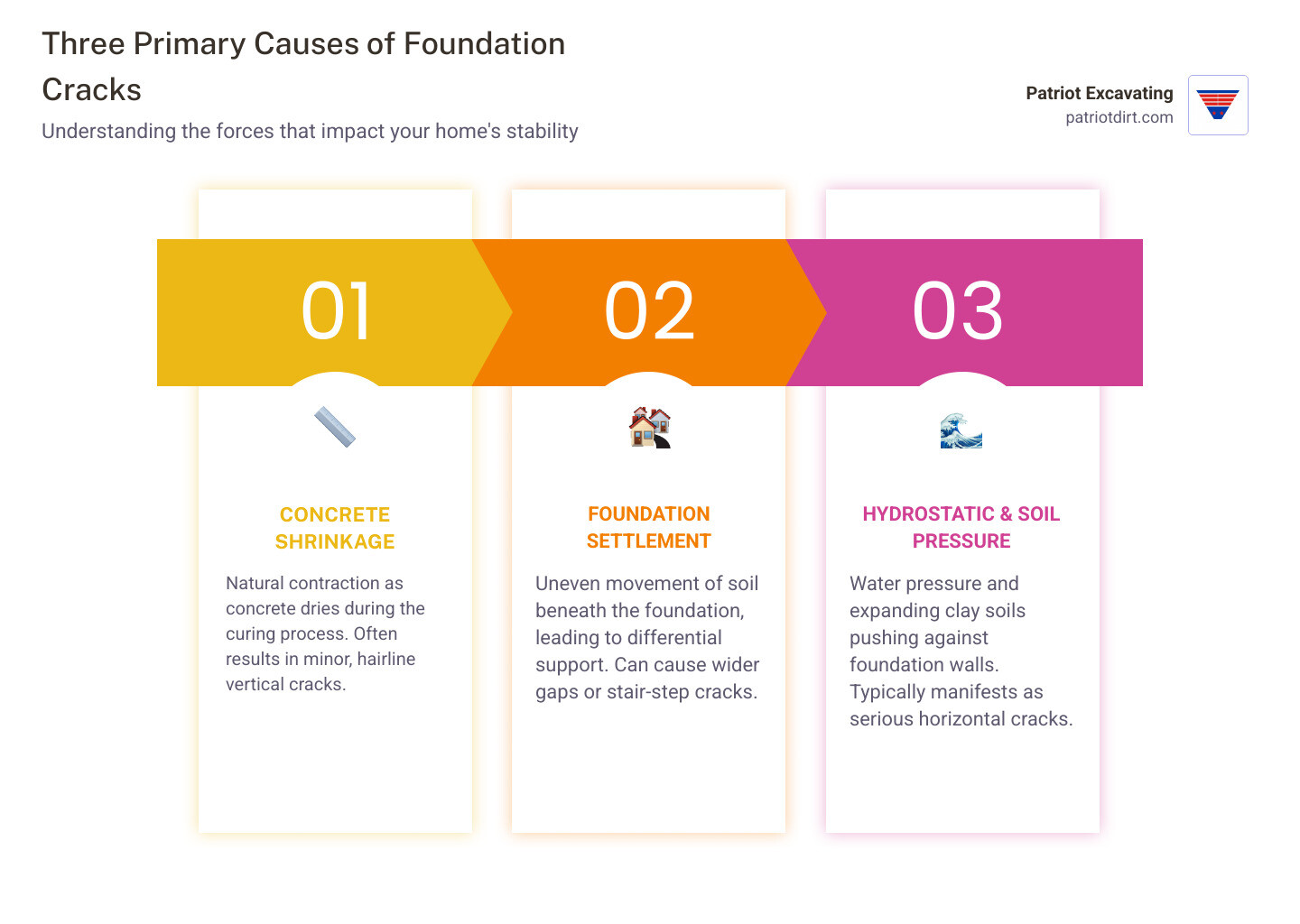
Understanding what causes a cracked concrete foundation is the first step toward a real solution. In Central Indiana, we see three primary culprits:
- Concrete Shrinkage: As new concrete cures, it loses moisture and contracts, which can create small, harmless hairline cracks (typically < 1/16 inch). This is a normal part of the process, especially within the first year.
- Foundation Settlement: This occurs when the ground beneath the foundation shifts. If the soil wasn’t uniformly compacted during construction, different parts of the structure can settle at different rates (differential settlement), stressing the concrete and causing cracks.
- Soil & Water Pressure: Central Indiana’s clay-rich soils expand when wet and shrink when dry. This cycle exerts immense pressure on foundation walls. When combined with water buildup from improper site grading or poor drainage, this hydrostatic pressure can cause walls to bow and crack. Managing water is critical, as we explain in our guide on The Crucial Role of Proper Drainage: Safeguarding Your Your Property Against Erosion and Damage.
Identifying Different Types of Foundation Cracks
Not all cracks are created equal. Their direction and size tell a story about their severity.

- Vertical and Hairline Cracks: Vertical cracks are often the least concerning, resulting from concrete curing or minor settlement. Hairline cracks (less than 1/8 inch) are very common and usually not a structural threat. It’s wise to seal them to prevent moisture entry, but they typically only require monitoring.
- Horizontal Cracks: These are a major red flag. Running parallel to the floor, they almost always indicate serious structural stress from external soil and water pressure. Horizontal cracks, especially with wall bowing, require immediate professional evaluation.
- Stair-Step Cracks: Common in block or brick foundations, these zigzag cracks follow the mortar lines. They signal differential settlement or lateral soil pressure and can seriously compromise structural integrity.
- Diagonal Cracks: Running at an angle (usually up to 30 degrees from vertical), these can be from shrinkage but may also indicate uneven settling if they are wide or growing.
A simple rule is the quarter test: if you can fit a quarter into a crack, it’s time to call a professional. For any crack you’re unsure about, crack monitoring (marking the ends and dating them) can help you determine if it’s actively growing—a clear warning sign.
How to Assess a Cracked Concrete Foundation and When to Act
Finding a cracked concrete foundation requires a calm assessment, not panic. The goal is to evaluate the structural integrity of your foundation by looking for genuine warning signs and understanding the underlying site conditions. Effective prevention strategies start with proper site work, as the quality of your initial excavation and grading directly impacts your foundation’s long-term health. As we explain in our guide on Why Excavation is Important for Home Building or Renovation Projects, a solid start is everything.
A thorough site evaluation looks beyond the crack to the entire property, as most foundation issues stem from water management problems.
Differentiating Minor vs. Serious Cracks
The difference between a cosmetic flaw and a structural crisis comes down to a few key characteristics.
| Characteristic | Non-Structural (Minor) Cracks | Structural (Serious) Cracks |
|---|---|---|
| Width | Less than 1/8 inch (e.g., hairline, under 3mm) | Greater than 1/4 inch (e.g., a quarter fits, over 6mm) |
| Direction | Usually vertical or random, often near corners or openings | Often horizontal, stair-step, or diagonal (especially if wide and growing) |
| Water Entry | Minimal or none, sometimes minor dampness | Frequent water intrusion, active leaks, dampness, mold/odor |
| Growth | Stable, doesn’t widen over time | Widening, lengthening, or showing vertical/horizontal displacement |
| Cause | Concrete curing shrinkage, minor settlement, temperature fluctuations | Differential settlement, hydrostatic pressure, expansive soils, construction defects |
| Associated Damage | None, or isolated cosmetic issues | Sticking doors/windows, sloping floors, bowing walls, gaps in finishes |
This table is your primary guide. Crack width is the first clue; if a quarter fits, it’s time for a professional opinion. The crack direction reveals the forces at play—vertical cracks often mean minor settlement, while horizontal cracks signal dangerous soil pressure.
Crucially, any water intrusion needs to be addressed, as moisture leads to mold and air quality issues. Finally, distinguish between active vs. dormant cracks. An active, growing crack is a clear sign of an ongoing problem, whereas a dormant one is stable.
Warning Signs Beyond the Crack Itself
Sometimes the most telling signs of foundation trouble appear elsewhere in your home, indicating the problem is affecting the entire structure.
Sticking doors and jammed windows are classic clues. When frames twist out of square, it means your home’s structure is shifting.
Sloping floors or a feeling of unevenness underfoot suggest your foundation has experienced significant settlement, stressing the entire frame.
Gaps between walls and ceilings or near baseboards show that structural components are pulling apart. These gaps tend to grow as foundation movement continues.
Bowing basement walls are one of the most serious warnings. Inward-curving walls are fighting immense pressure from soil and water, a condition that can lead to wall failure if not addressed.
Your Guide to Prevention and Site Solutions
The best approach to a cracked concrete foundation is root cause analysis. Most foundation failures trace back to preventable site preparation issues, especially in the clay-heavy soils of the Indianapolis area.
- Prevention Through Proper Site Work: This starts with managing water. Our local soils expand and shrink dramatically, stressing foundations. Proper grading and drainage are non-negotiable.
- Correct Soil Compaction: Uncompacted soil will settle for years, causing the differential settlement that cracks foundations. Our Foundation Preparation Services Indianapolis focus on achieving the right compaction from day one.
- Professional Drainage and Grading: A well-designed system moves water away from your foundation. Understanding the difference between grading and leveling, as explained in our guide Land Grading vs. Land Leveling: Key Differences Explained, is key to creating long-term stability.
Addressing these root causes is a permanent solution. Instead of repeatedly patching cracks, proper site work prevents them from forming in the first place, protecting your home’s structural integrity for decades.
Securing Your Home’s Future: The Foundation of a Solid Investment
Your home is likely your most significant financial investment. When you find a cracked concrete foundation, you’re looking at a problem that will not fix itself and can seriously impact your property’s long-term stability and value.
An untreated crack is an open invitation for water intrusion, leading to mold, musty odors, and damaged belongings. Over time, as the foundation’s integrity is compromised, you’ll notice the effects throughout the house: sloping floors, sticking doors, and gaps in walls. These issues not only affect your daily comfort but also diminish your home’s property value.
This is why proactive measures and root cause solutions are so critical. Addressing foundation issues early by tackling the underlying problems is the only way to protect your investment for the long term. As experienced Excavation and Grading Contractors, we at Patriot Excavating specialize in the professional site work that prevents these issues from ever starting.
The Critical Role of Expert Site Preparation for a Cracked Concrete Foundation
When dealing with a cracked concrete foundation, the real solution is often outside the foundation walls. Our experience across Indianapolis, Greenwood, and Central Indiana has shown that most failures stem from poor drainage, improper grading, or inadequate soil compaction.
Our expertise in comprehensive site development means we don’t just look at the crack; we analyze your entire property to diagnose the root cause. If water pressure is the culprit, simply filling the crack is a temporary fix. The real solution is creating stable ground by installing proper drainage systems and ensuring professional grading directs water away from your home.
This approach provides long-term prevention. By ensuring your foundation is supported by properly compacted soil and protected by an effective drainage plan, you prevent the cycle of stress and cracking from repeating. We’ve seen too many homeowners waste money on temporary repairs. Our goal is to deliver a permanent solution that ensures your investment in foundation health pays dividends for years.
If you’re seeing signs of foundation distress, don’t wait for the problem to get worse. Early intervention is always more cost-effective.
Contact our team to ensure your project starts on solid ground. Let us put our decades of site development expertise to work protecting your family’s most important investment.