
Why Professional Water Line Locating is Essential for Project Integrity
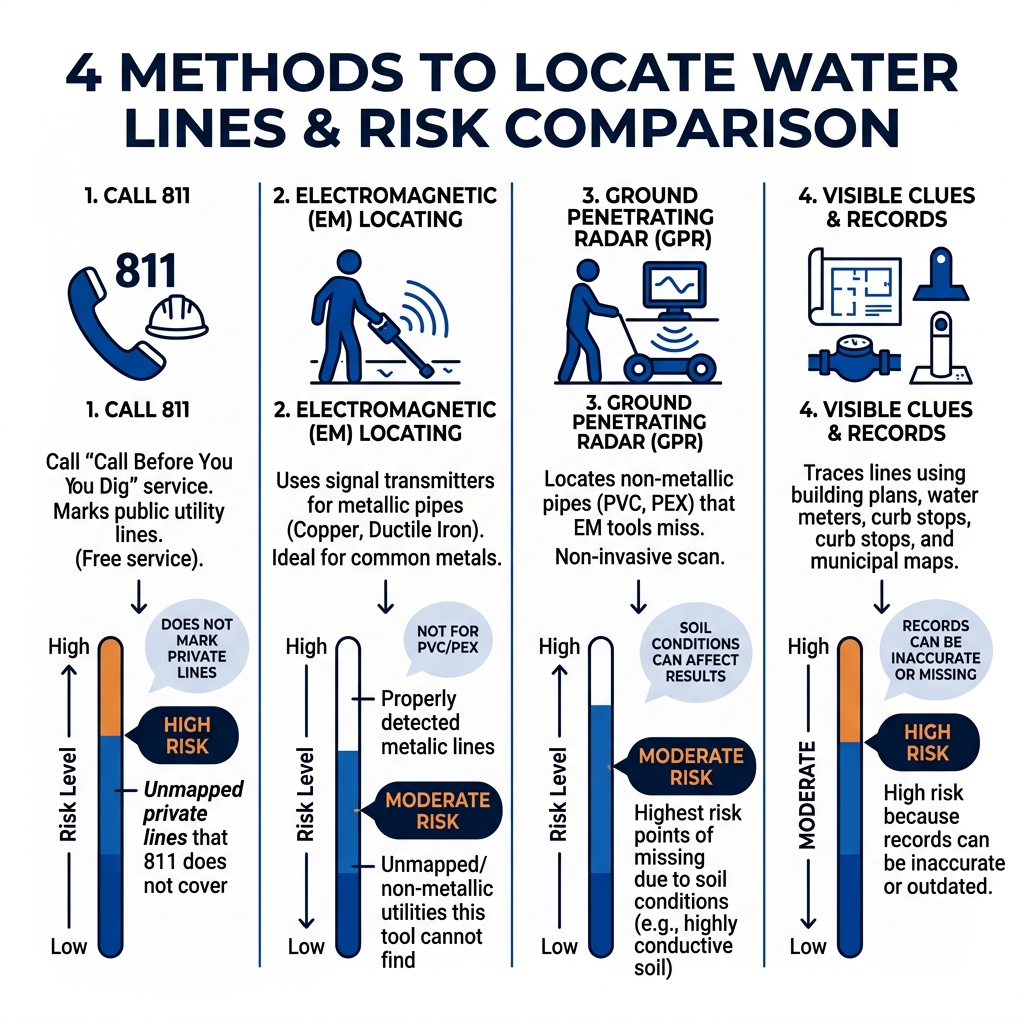
Knowing how to locate water lines before any ground-breaking activity is the most critical phase of modern excavation, landscaping, and large-scale construction projects. In the greater Indianapolis area, the subsurface environment is a complex tapestry of historical and modern engineering. Our local infrastructure ranges from century-old cast iron mains in the historic districts of Meridian-Kessler to the advanced PEX and high-density polyethylene (HDPE) systems found in the rapidly expanding suburbs of Hamilton County. The complexity of what lies beneath the surface in Central Indiana cannot be overstated, and identifying these assets requires a sophisticated, multi-layered approach. At Patriot Excavating, we utilize the following professional methodologies to ensure site safety:
- Regulatory Coordination via 811 – We manage the mandatory “Call Before You Dig” process to ensure all public utility assets are identified and marked by the appropriate authorities.
- Electromagnetic (EM) Locating – Our team employs signal transmitters to detect conductive metallic pipes, including copper, galvanized steel, and ductile iron.
- Ground Penetrating Radar (GPR) – We utilize high-frequency radar to identify non-metallic assets like PVC and PEX that traditional electromagnetic tools cannot perceive.
- Physical Site Assessment and Record Verification – We cross-reference municipal maps, building blueprints, and visible surface indicators like curb stops and meter pits to verify the trajectory of the line.
Striking a buried water line can halt work immediately and create serious safety and site-stability risks. In Central Indiana, where soil conditions fluctuate between the heavy, moisture-retaining clay of Johnson County and the loamy, glacial deposits of the White River valley, a utility strike can lead to immediate soil liquefaction. This instability endangers workers, equipment, and the foundations of nearby structures. Many buried lines on a property are privately owned, which means they may not be included in standard public utility marking. This means the standard 811 service will not identify the majority of the lines on a private development or residential property. Patriot Excavating specializes in filling this critical gap, providing comprehensive private locating services that ensure every inch of your site is mapped. Contact Patriot Excavating today to secure a professional site assessment for your next project.
The Critical First Step: Regulatory Compliance and Private Infrastructure Mapping
Before Patriot Excavating deploys heavy machinery to a site in Greenwood, Carmel, or downtown Indianapolis, we initiate a rigorous utility verification protocol. The foundational element of this process is contacting Indiana 811. This is the state-mandated “Call Before You Dig” system that coordinates with public utility providers to mark the location of their buried assets. In Indiana, you must contact Indiana 811 at least two full working days before excavation so utilities can mark lines. Our team manages this timeline to ensure your project remains in full regulatory compliance from day one.
When the 811 process is initiated, public utility locators mark their lines using the standardized color-coding system established by the Common Ground Alliance. For water infrastructure, safety blue paint and flags are used to indicate the approximate location of the utility’s assets. In Indiana, treat the marked line plus the surrounding tolerance zone as a no-guesswork area and use careful exposure methods before digging. However, relying solely on these markings is a significant risk for any developer or property owner in Central Indiana. As we have noted when exploring underground mysteries, the vast majority of buried infrastructure is not covered by public utility markings.
Distinguishing Between Public and Private Water Infrastructure
Understanding the demarcation point between public responsibility and private ownership is vital for successful site development. Generally, the public utility is responsible for the water main and the service lateral up to the water meter or the property line, often indicated by a curb stop. Every foot of piping from that point toward the primary structure or secondary buildings is considered private infrastructure. If you are planning a water-line-repair or a new commercial addition, the 811 service will not provide the location of these critical private lines.
This is why Patriot Excavating’s private locating services are indispensable. Whether you are installing a complex irrigation system in Fishers or a new utility run in Noblesville, our team identifies the lines that municipal locators are not authorized to mark. We bridge the gap between the street and the structure, ensuring that your entire dig zone is safe and fully mapped. To ensure your project adheres to all safety and regulatory standards, contact Patriot Excavating for a comprehensive utility consultation.
How to Locate Water Lines Using Advanced Subsurface Technology
At Patriot Excavating, we move beyond basic surface indicators by employing advanced Subsurface Utility Engineering (SUE) technology. The geological diversity of Central Indiana—from the dense clays of the south side to the sandy pockets of the northern suburbs—requires a sophisticated toolkit to improve locating reliability across changing soil conditions. We do not rely on guesswork; we rely on physics and precision-engineered sensors to visualize the underground environment.
For metallic infrastructure, such as the copper and ductile iron pipes common in the older neighborhoods of Beech Grove and Southport, we utilize Electromagnetic (EM) induction. This process involves applying a specific electromagnetic frequency to a conductive pipe via a transmitter. Our technicians then use a high-sensitivity receiver to trace the signal from the surface. This method is highly effective for distinguishing water lines from other nearby metallic utilities. We apply similar precision during underground-power-installation, where frequency calibration is essential to avoid signal interference and ensure the highest level of mapping accuracy.
Advanced Detection for PVC and PEX Infrastructure
The challenge of utility locating has evolved with the widespread adoption of non-metallic materials like PVC and PEX. These materials are favored for their corrosion resistance, but they are invisible to traditional electromagnetic tools unless a tracer wire was installed during the original burial. To solve this, Patriot Excavating utilizes Ground Penetrating Radar (GPR). GPR technology emits high-frequency radar pulses into the soil. These waves reflect off any subsurface object—regardless of material composition—and return to the receiver. By interpreting reflected signals, our technicians can estimate depth and map the most likely path of the line for safer excavation planning.
GPR is a cornerstone of our trenchless-water-line-repair services because it provides a real-time visual map of the soil density. For our clients in Zionsville and Brownsburg, this technology allows us to navigate around obstacles like large boulders or buried debris that could otherwise derail a project. Our technicians are specifically trained to interpret complex GPR data in Indiana’s unique soil profiles, ensuring that we can distinguish a water line from a tree root or a change in soil compaction.
Acoustic and Thermal Diagnostic Methods
In addition to radar and electromagnetics, Patriot Excavating employs acoustic pipe detection. When a pressurized water line is active, the movement of water creates specific sonic vibrations. Using electronic ground microphones and specialized headphones, our team can pinpoint the exact path of a pipe by listening for these frequencies. This is particularly useful when identifying 8-signs-you-need-water-line-repair, as it allows us to locate both the line and any potential points of failure simultaneously. We also utilize high-resolution thermal imaging to detect temperature variances in the soil, which can indicate the presence of a buried line or a subsurface leak. This multimodal approach ensures that no utility remains hidden. Contact Patriot Excavating today to leverage our advanced technology for your next excavation project.
Identifying Physical Indicators and Historical Property Records
While advanced technology is the backbone of our operations, Patriot Excavating also performs a meticulous physical survey of every site. Our professionals are trained to identify subtle surface clues that indicate the trajectory of buried water lines. This initial assessment is a vital component of our comprehensive site development strategy, allowing us to cross-reference physical evidence with electronic data.
The primary point of reference is the water meter box, typically located near the curb or sidewalk in a concrete or cast-iron housing. Once the meter is located, our team identifies the water main entry point into the structure, which is usually found in a utility room, crawlspace, or basement. By establishing these two endpoints, we can begin to map the most likely path of the service lateral. Our team also searches for:
- Curb Stops: These are small metal caps, often flush with the ground, that house the shut-off valve for the property. In older Indianapolis neighborhoods, these may be buried under layers of thatch or soil, requiring specialized metal detection to uncover.
- Foundation Sleeves: We inspect the point where the utility physically penetrates the concrete foundation. The angle and depth of this entry provide critical data regarding the pipe’s trajectory.
- Municipal and Property Records: We frequently coordinate with planning departments in Hendricks, Morgan, and Marion Counties to obtain as-built drawings and municipal utility maps. These records provide a historical blueprint of the intended utility layout.
Tracing the Trajectory from Street to Structure
Water service line depths vary by location, era of installation, and site conditions; professionals verify depth before mechanical excavation. This depth is required to ensure the line remains below the frost line during Indiana’s severe winter months. However, Patriot Excavating often encounters lines in older parts of the city that were installed at non-standard depths or have shifted due to decades of soil erosion and frost heave. We look for topographical markers, such as slight depressions in the earth or localized changes in vegetation health, which can indicate the presence of a buried utility or a slow-seeping leak.
Our team utilizes professional probing equipment to gently verify the pipe’s location in high-risk areas, though this is always performed with extreme caution to prevent any impact on the infrastructure. This combination of historical research, visual inspection, and physical verification ensures that Patriot Excavating has a complete and accurate understanding of the subsurface environment before any mechanical excavation begins. To ensure your site is properly surveyed by local experts, contact Patriot Excavating for a professional consultation.
Professional Utility Locating and Site Preparation in Central Indiana
At Patriot Excavating, we believe that precision site preparation is the foundation of every successful construction project. Whether we are managing commercial site development in Plainfield or utility trenching in Lawrence, our approach is centered on safety and the protection of existing infrastructure. We do not simply dig; we manage the entire subsurface environment to ensure the long-term stability of your project. Our team is equipped to handle the most challenging environments, providing a level of detail that mitigates risk and ensures project continuity.
One of our most effective tools for safely locating and exposing water lines is hydro excavation. This process uses high-pressure water to break up the soil, which is then removed by a high-powered vacuum system. Hydro excavation is the industry’s gold standard for “soft digging,” allowing us to visually verify the exact depth, material, and condition of a water line without the risk of mechanical damage associated with traditional backhoes or hand-shoveling. This is particularly critical in high-density utility corridors where multiple lines are buried in close proximity.
To assist in project planning, we utilize the following comparison of our primary professional locating methods:
| Feature | Electromagnetic (EM) Locating | Ground Penetrating Radar (GPR) |
|---|---|---|
| Primary Application | Metallic pipes (Copper, Iron, Steel) | Non-metallic (PVC, PEX, Concrete) |
| Depth Verification | Calculated via signal attenuation | Real-time visual cross-section |
| Environmental Factors | Effective in most soil types | Optimized for Indiana clay/loam |
| Operational Speed | Rapid for long-distance tracing | Methodical grid-based scanning |
Our team is uniquely qualified to navigate the specific soil conditions of Central Indiana. We understand that the high clay content in Johnson County requires different GPR frequency settings than the more porous soils found in Hamilton County. We also maintain expertise in winter-maintenance-for-underground-electrical-infrastructure, ensuring that we can accurately locate and service utilities even when the ground is frozen. This regional expertise allows Patriot Excavating to maintain strict project timelines regardless of the season. Contact Patriot Excavating today to discuss the best locating technology for your specific site conditions.
Frequently Asked Questions about Professional Water Line Location
What is the standard burial depth for water lines in Indiana?
In the Central Indiana region, the frost line is the primary factor determining utility depth. Most water lines are installed at a minimum depth of 36 inches to prevent freezing during the winter. However, Patriot Excavating frequently encounters variations due to historical installation practices or significant changes in site grading over time. When we evaluate the benefits of underground power lines, we always integrate these depth requirements into our comprehensive site plan to ensure all utilities are protected from environmental stress. Our GPR equipment provides real-time depth verification to ensure safe clearance for all excavation activities.
Can standard metal detectors identify all water pipes?
No. While a consumer-grade metal detector may identify copper or galvanized steel pipes at shallow depths, it is incapable of detecting modern PVC or PEX infrastructure. Furthermore, these devices are often compromised by metallic mineral deposits and “trash” in the soil, which are common in Indiana’s clay-heavy environment. For professional-grade results that guarantee the safety of your project, specialized EM locators and GPR systems operated by the experienced technicians at Patriot Excavating are required. We provide the precision necessary to map all utility types, regardless of material.
What is the protocol if a water line is compromised during excavation?
If a utility strike occurs, Patriot Excavating follows a strict emergency response protocol. Safety is the immediate priority, which includes evacuating the area if soil instability is detected. We immediately locate and engage the emergency shut-off valve at the meter or curb stop to halt the flow of water. We then notify the appropriate utility authorities if a public line is involved and begin the process of a professional, permanent repair. Our repairs are engineered to withstand Indiana’s intense freeze-thaw cycles, utilizing high-pressure couplings and rigorous testing. To prevent these incidents from occurring, contact Patriot Excavating for professional utility mapping before you begin your project.
Conclusion: Partnering with Patriot Excavating for Subsurface Safety
Knowing how to locate water lines is a fundamental safety step in underground utility installation and site preparation. Whether you are a homeowner in Southport or a commercial developer in Whitestown, the risks associated with unmapped utilities are too significant to ignore. By initiating the 811 process, understanding the limitations of public markings, and employing the advanced technology provided by Patriot Excavating, you can ensure that your project proceeds on a foundation of accuracy and safety.
Patriot Excavating is a family-owned business deeply rooted in the Indianapolis community. We specialize in comprehensive site-work, including expert utility locating, water and sewer services, and precision demolition. Our team possesses the advanced tools, the decades of hands-on experience, and the specific local knowledge required to navigate the complexities of Central Indiana’s underground infrastructure. From the initial site assessment to the final grading, we provide the precision and peace of mind that only a professional excavation partner can offer.
Do not leave the success of your project to chance. The subsurface environment is too complex for anything less than professional-grade mapping and excavation. If you need to locate water lines or are preparing for a major site development project in Central Indiana, contact Patriot Excavating today. Let our team of experts manage the complexities of the underground so you can focus on the successful completion of your project above ground.