
The Foundation of Every Great Project
What is land grading is the process of reshaping and leveling ground to create proper slopes and elevations for construction, drainage, and landscaping projects. Land grading involves moving soil from higher areas to lower areas to achieve specific grades that direct water away from structures and provide stable foundations.
Key aspects of land grading include:
- Purpose: Create proper drainage slopes and stable building foundations
- Process: Moving dirt from high spots to low areas using heavy equipment
- Result: Level or sloped surfaces that prevent water damage and structural issues
- Applications: New construction, landscaping, drainage solutions, and site preparation
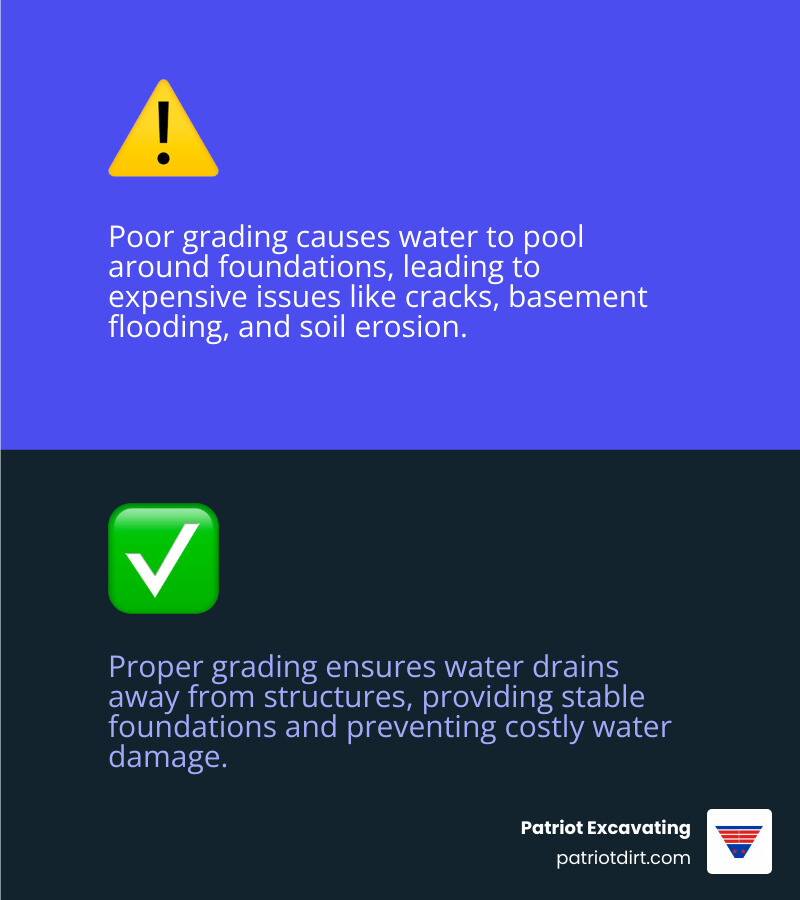
Whether you’re planning a new home, commercial building, or major landscaping project in the Indianapolis area, proper grading forms the critical first step. Poor grading leads to costly problems like foundation damage, basement flooding, and soil erosion that can plague properties for years.
The difference between a successful project and a maintenance nightmare often comes down to getting the grading right from the start. Professional grading ensures water flows away from structures, creates stable surfaces for construction, and prevents the settling and shifting that destroys foundations.
As Clay Hamilton, President of Patriot Excavating with over two decades of excavation and site preparation experience in Central Indiana, I’ve seen how understanding what is land grading can save property owners from substantial future repairs. My team and I have helped countless Indianapolis-area developers and homeowners achieve proper site preparation that stands the test of time.
What is Land Grading and Why is it Essential?
Understanding what is land grading means recognizing it as far more than simply moving dirt from one spot to another. It’s the careful art and science of reshaping the earth’s surface to create the perfect foundation for whatever you’re planning to build or landscape.
Think of land grading as giving your property the right bones before adding the muscle and skin. Without proper grading, even the most beautiful home or well-designed commercial building will face problems that could have been easily prevented.
The Core Purpose: More Than Just Moving Dirt
When we grade land properly, we’re solving multiple problems at once. Foundation stability sits at the heart of everything we do. Your building needs solid, level ground that won’t shift or settle over time. Unstable soil is like trying to build a house of cards on a wobbly table – it’s just not going to end well.
Drainage control is equally critical here in Central Indiana, where we see our fair share of rain and snow. Proper grading creates slopes that guide water away from structures, preventing the pooling that leads to basement flooding and foundation damage. We typically aim for at least a 2% slope away from buildings – that’s about a quarter-inch drop per foot, which might not look like much but makes all the difference.
Erosion prevention protects your investment long-term. When water flows properly across graded surfaces, it won’t carve channels through your landscape or wash away valuable topsoil. This is especially important on larger properties where uncontrolled water flow can create serious drainage issues.
The grading process also serves as essential construction preparation. Heavy equipment needs stable, properly sloped surfaces to operate safely and efficiently. Poor site preparation can delay projects and increase costs when contractors have to work around drainage problems or unstable ground.
For landscaping preparation, grading creates the canvas for your outdoor vision. Whether you’re planning gardens, patios, or recreational areas, the right foundation makes installation easier and ensures better long-term results.
Our team has seen how proper planning at this stage prevents headaches later. That’s why we put together our guide on Essential Grade Level Tips for Builders to help contractors and property owners understand these fundamentals.
Grading vs. Leveling: A Crucial Distinction
Many people use “grading” and “leveling” interchangeably, but they’re actually quite different processes with distinct goals. Understanding this difference helps you communicate exactly what your project needs.
Grading focuses on creating specific slopes that direct water flow and provide proper drainage. When we grade a site, we’re engineering the terrain to achieve precise contours and gradients. This might mean creating gentle slopes away from buildings, forming swales to channel stormwater, or shaping the land for aesthetic purposes.
Leveling aims for flatness – creating uniformly flat surfaces with minimal elevation changes. You’ll see this more in agricultural applications where farmers need perfectly even fields for irrigation, or in creating large flat areas like sports fields.
Construction applications typically require grading rather than leveling. Building sites need controlled slopes for drainage while maintaining stable foundations. Roads need specific grades for proper water runoff and safe driving conditions.
Agricultural uses often call for leveling to ensure even water distribution across crops, though some farming applications do require grading for drainage purposes.
| Feature | Land Leveling | Land Grading |
|---|---|---|
| Purpose | Create uniformly flat surfaces | Shape land to specific slopes and contours |
| End Result | Flat plane with minimal elevation changes | Engineered slopes and varied contours |
| Common Use | Agricultural fields, sports fields, large flat areas | Construction sites, drainage solutions, landscaping |
The complexity of grading work – with its need for precise slopes and drainage patterns – typically requires more planning and expertise than simple leveling projects. For a deeper understanding of these differences, you can learn more about the key differences between grading and leveling.
The Dangers of Improper Grading
We’ve seen enough problem properties to know that cutting corners on grading always comes back to haunt property owners. The consequences of poor grading aren’t just inconvenient – they can be downright expensive and sometimes dangerous.

Foundation damage tops our list of grading disasters. When water pools around foundations instead of flowing away, it creates constant pressure against basement walls. Here in Indianapolis, our freeze-thaw cycles make this even worse – water seeps into small cracks, freezes, expands, and turns minor issues into major structural problems.
Water pooling creates immediate headaches and long-term damage. We’ve walked properties where poor grading turned every rainstorm into a crisis. Water sits against foundations, seeps into basements, and creates perfect conditions for mold and mildew. Nobody wants to deal with flooded basements or musty odors that never quite go away.
Basement flooding often stems from grading that slopes toward the house instead of away from it. When storm water has nowhere to go except toward your foundation, it will find a way inside. The cleanup costs and property damage from flooding can be extensive.
Soil erosion becomes a serious problem when water isn’t properly controlled. Unmanaged runoff carves channels through landscapes, washes away topsoil, and can even undermine foundations over time. We’ve seen beautiful yards turned into muddy messes after just a few heavy rains.
Structural shifting happens when saturated soil loses its ability to support the weight of buildings. Foundations can settle unevenly, causing cracks in walls, uneven floors, and doors that won’t close properly. These aren’t just cosmetic issues – they’re signs of serious structural problems that are expensive to fix.
The truth is, addressing these problems after construction costs far more than doing the grading right from the start. Prevention is always cheaper than repairs, especially when it comes to foundation work.
The Professional Grading Process and Strategy
Every successful grading project starts with understanding that what is land grading truly means in practice. At Patriot Excavating, we’ve refined our approach over two decades of working across Central Indiana, developing a systematic process that transforms raw land into perfectly prepared building sites.
Key Stages of a Grading Project
The journey from untouched land to construction-ready site follows a carefully orchestrated sequence that we’ve perfected through countless Indianapolis-area projects. Each stage builds upon the previous one, creating a foundation of success that will support your vision for years to come.
Site evaluation and planning marks the beginning of every project. We walk your property with experienced eyes, studying the natural contours, existing drainage patterns, and unique characteristics that make your land special. During this phase, we’re looking for opportunities and challenges—perhaps there’s a natural slope we can improve for better drainage, or maybe there are areas where the soil composition will require special attention. This isn’t just about moving dirt; it’s about understanding how your land wants to work and designing a plan that works with nature, not against it.
Soil analysis comes next, and it’s where science meets practical experience. Different soil types behave differently under pressure and moisture, and Central Indiana’s clay-heavy soils present their own unique characteristics. We test for composition, drainage capacity, and stability because what lies beneath the surface determines how we approach every subsequent step. Organic material hiding below grade gets flagged for removal—we’ve learned that decomposing roots and vegetation can cause settling problems years down the road.
The grading plan development phase brings everything together on paper before we fire up a single machine. Sometimes this involves working with civil engineers to create detailed specifications, especially for complex commercial projects or challenging residential sites. We create a roadmap that accounts for final elevations, drainage requirements, and the specific needs of whatever you’re planning to build.
Rough grading is where the change becomes visible. Our skilled operators use bulldozers and excavators to move soil from high areas to low areas, establishing the basic contours your property needs. This stage addresses major drainage issues and creates the foundation for everything that follows. It’s satisfying work—watching a problematic slope become a perfectly graded building pad never gets old.
Soil compaction might not look like much is happening, but it’s absolutely critical. We use heavy rollers and specialized compactors to increase soil density, creating a stable base that won’t settle or shift over time. Proper compaction prevents those heartbreaking foundation problems that can plague a property for decades.
Finish grading puts the final touches on our work, refining surfaces to exact specifications. For construction projects, this creates the precise elevations needed for foundations and concrete work. For landscaping projects, finish grading happens right before planting, creating the ideal canvas for your outdoor vision.

Each stage flows naturally into the next, creating a comprehensive site preparation that sets your project up for long-term success. When you’re ready to begin, Our foundation preparation services ensure a perfect start to your construction journey.
What is land grading equipment and when is the best time to grade?
The right equipment makes all the difference between a mediocre grading job and exceptional results. At Patriot Excavating, we maintain a fleet of specialized machinery that allows us to tackle any challenge Central Indiana can throw at us.
Bulldozers serve as our workhorses for moving large volumes of earth and establishing initial grades. These powerful machines excel at pushing soil where it needs to go, breaking through tough clay, and handling the heavy lifting of rough grading. Excavators bring precision to the process, allowing us to dig, load, and shape terrain with remarkable accuracy. When we need to create detailed contours or work in tighter spaces, excavators give us the control we need.
For achieving those perfectly smooth, precisely sloped surfaces, motor graders are irreplaceable. These machines feature long, adjustable blades that can create the exact grades required for driveways, building pads, and drainage swales. Compactors and rollers ensure every square foot of graded soil meets our density standards, preventing future settling that could compromise your project.
Timing your grading project correctly can mean the difference between smooth sailing and frustrating delays. Central Indiana’s climate gives us distinct windows when conditions are ideal for earthwork.
Spring offers our first opportunity once the ground thaws and before the heavy rains arrive. The soil typically has good moisture content for compaction without being too wet to work effectively. There’s something hopeful about spring grading—it feels like you’re preparing your land for a fresh start.
Fall provides another excellent window after summer’s heat breaks but before winter freeze sets in. The soil is usually drier than spring conditions but still workable, and there’s less risk of weather-related delays. Many of our clients prefer fall grading because it positions their land perfectly for spring construction.
We avoid working during wet, muddy conditions because soggy soil doesn’t compact properly, creating unstable ground that will cause problems later. Frozen ground presents its own challenges—it’s nearly impossible to achieve the precision grading requires, and the results are rarely satisfactory.
Understanding these seasonal patterns helps us schedule your project during optimal conditions, ensuring the best possible results. When you’re ready to move forward, find expert excavation and grading contractors who understand Central Indiana’s unique challenges.
Partnering with Experts for a Flawless Foundation
Understanding what is land grading reveals why this process demands professional expertise rather than a DIY approach. The complexities of soil behavior, drainage engineering, and precise grade requirements make professional grading an investment in your project’s long-term success.
At Patriot Excavating, we bring over twenty years of Central Indiana experience to every project. We understand how our region’s clay soils behave through freeze-thaw cycles, how Indianapolis-area drainage patterns work, and what local building codes require. This regional expertise allows us to anticipate challenges and design solutions that work specifically for your property.
Our comprehensive approach means you’re not juggling multiple contractors for different phases of site preparation. We handle everything from initial land clearing through final grading, creating seamless coordination that saves time and prevents miscommunication. When soil conditions require special attention or unexpected challenges arise, our experienced team adapts quickly to keep your project on track.
The peace of mind that comes with professional grading extends far beyond project completion. Properly graded sites prevent the foundation problems, drainage issues, and erosion concerns that can plague properties for decades. We’re not just preparing your land for construction—we’re engineering a foundation for your investment’s long-term value.
Every project deserves to start on solid ground, both literally and figuratively. Ensure your project starts on solid ground with our land clearing and grading services and experience the confidence that comes with true craftsmanship.