
Trench Digging Contractors Near You: Find Local Trench Diggers
What Trench Digging Contractors Do — and Why It Matters for Your Project
Trench digging contractors are licensed excavation professionals who cut narrow, precise channels into the ground to install or repair underground utilities like water lines, sewer pipes, gas lines, electrical conduit, and drainage systems.
Here’s what you need to know at a glance:
- A trench is any excavation that is deeper than it is wide — typically used for utility installation
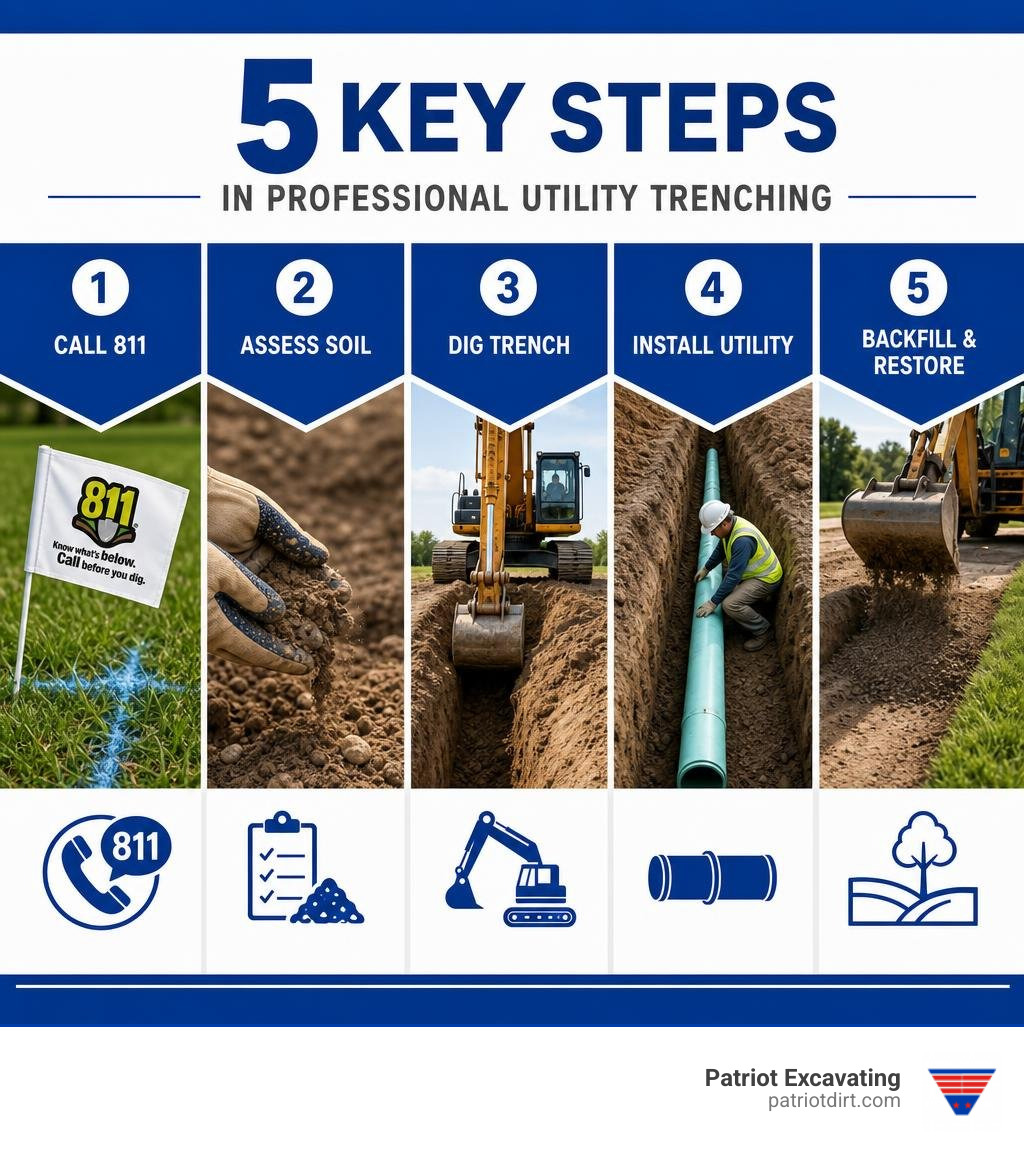
- Professional contractors handle everything from planning and utility locates to digging, installation, backfilling, and site restoration
- OSHA requires a cave-in protection system for any trench 5 feet or deeper
- Always call 811 before any digging to locate buried utilities
- Hiring a licensed, insured contractor protects your property, your utilities, and the crew on site
Getting underground utilities connected — or repaired — is one of the most critical parts of any construction or renovation project. But trenching isn’t just digging a ditch. It involves safety regulations, soil analysis, utility coordination, and heavy equipment. Done wrong, it can damage existing lines, create serious safety hazards, or cause costly project delays. Done right, it sets the foundation for everything else on your site.
I’m Clay Hamilton, President of Patriot Excavating, and with over two decades of hands-on experience leading excavation and utility projects across Indianapolis and central Indiana, I’ve seen what separates a smooth trenching job from a costly one — and I’ll walk you through everything you need to know to work confidently with trench digging contractors on your next project.
Learn more about trench digging contractors:
Why You Need Professional Trench Digging Contractors for Your Project
When you are looking at a patch of open ground, it is easy to assume that digging a trench is as simple as scooping out some dirt. However, the soil beneath our feet is a complex, unpredictable environment. Professional trench digging contractors bring a level of precision, specialized equipment, and safety management that general laborers simply cannot match.
To truly understand the scope of this work, it helps to ask: What is Trenching? Unlike general excavation, which involves clearing wide areas for basements or grading large tracts of land, trenching is the highly targeted practice of digging narrow channels where the depth of the cut is greater than its width. This requires exact control to prevent the surrounding soil from collapsing into the newly cut channel.
When property owners run into Trenching Troubles Find Your Perfect Residential Service Partner to handle the technical heavy lifting. For example, a failing main sewer line can quickly turn into a household emergency. Professional trenching contractors handle complex sewer repair by carefully uncovering the damaged line without destroying the surrounding landscape or adjacent utility lines.
Furthermore, we utilize advanced techniques like hydro excavation—which uses pressurized water and a vacuum system to safely carve away soil around sensitive lines—and implement comprehensive erosion control measures to ensure that your site remains stable and compliant with local environmental regulations. Whether we are preparing a site-work foundation or installing a complex network of drains, professional execution is the only way to guarantee a long-lasting, trouble-free installation. If you are facing any underground utility challenges, contact Patriot Excavating today for a professional site assessment.
Essential Services Offered by Trench Digging Contractors
Trenching contractors do not just dig holes; we establish the subterranean infrastructure that keeps our modern communities running. Our teams work on a diverse array of projects, ensuring that every underground connection is secure, durable, and buried to the exact depth required by local building codes.
Our core services include:
- Water Mains and Service Lines: Installing heavy-duty main water lines and connecting individual residential or commercial service lines.
- Sanitary Sewer Systems: Excavating deep, gravity-fed sewer lines that require absolute precision to maintain the correct slope over long distances.
- Storm Drains and Drainage Solutions: Designing and digging pathways for storm sewers, catch basins, and French drains to prevent water pooling and foundation damage.
- Underground Power and Telecom: Digging clean, debris-free trenches for electrical conduit, fiber-optic lines, and gas pipelines.
For property owners in Johnson County, projects like Greenwood In Utility Trenching demonstrate how critical these services are. Whether you are building a new agricultural barn in Whiteland, IN, upgrading a commercial space in Franklin, IN, or putting in a new drainage system, we ensure that every utility line is nested safely beneath the frost line.
We frequently collaborate with local specialists across the region, from site preparation experts in Trafalgar, IN to utility specialists in Whiteland, IN, to ensure that every phase of your project is handled by qualified professionals. If you need local expertise, you can learn more about regional projects through resources like Site Preparation | Trafalgar, Indiana and Surrounding Areas. Reach out to Patriot Excavating to discuss your specific regional utility needs.
Open Cut Trenching vs. Directional Boring
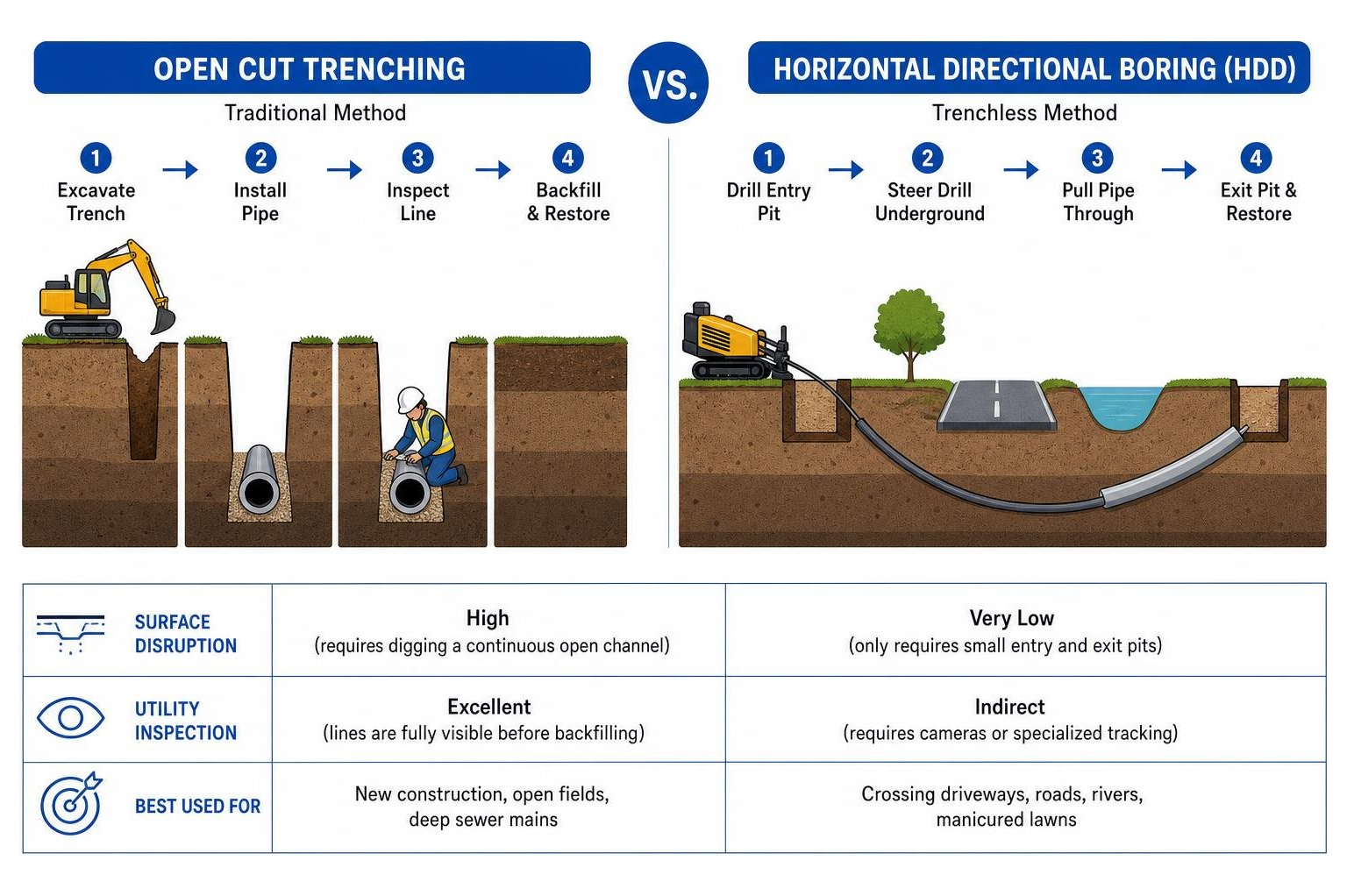
When it comes to putting utilities in the ground, professional contractors primarily rely on two main methodologies: traditional open cut trenching and horizontal directional boring. Both have distinct advantages, and choosing the right one depends entirely on your specific site conditions and structural constraints.
Open cut excavation is the traditional method most people picture. We use excavators, backhoes, or specialized trenching machines to dig a continuous channel from the surface down. This method is highly efficient, allows our crews to visually inspect the utility lines during and after installation, and is ideal for projects where there are no major surface obstructions.
Horizontal directional boring (or trenchless technology), on the other hand, is a steerable, trenchless method used to install pipes underground with minimal surface disruption. Instead of digging up your entire lawn, driveway, or a public roadway, we drill a horizontal path beneath the surface. This is particularly valuable in highly developed urban environments or areas with pristine landscaping. If you are planning a project in a heavily manicured area, consulting with specialized Carmel, Indiana Boring Contractors can save you from significant site restoration. Contact Patriot Excavating to determine the best trenching methodology for your property.
| Feature | Open Cut Trenching | Directional Boring (HDD) |
|---|---|---|
| Surface Disruption | High (requires digging a continuous open channel) | Very Low (only requires small entry and exit pits) |
| Utility Inspection | Excellent (lines are fully visible before backfilling) | Indirect (requires cameras or specialized tracking) |
| Best Used For | New construction, open fields, deep sewer mains | Crossing driveways, roads, rivers, manicured lawns |
| Soil Limitations | Can handle rock, wet soils, and heavy clay | Difficult in highly rocky or unstable shifting soils |
| Restoration Needs | High (requires backfilling, grading, and seeding/paving) | Minimal (only small point repairs at access locations) |
The Step-by-Step Professional Trench Excavation Process
A successful trenching project is a highly structured operation that requires careful planning long before any heavy machinery rolls onto the property. At Patriot Excavating, we follow a rigorous, multi-step process to ensure that every trench is dug safely, efficiently, and to exact specifications.

The process begins with a comprehensive site assessment. Our team walks the property to identify potential obstacles, evaluate access points, and analyze the terrain. For larger commercial and residential developments, we integrate digital design files (such as CAD files) directly into our planning. By utilizing advanced 3D modeling systems like Agtek and Autodesk, we can perform precise quantity take-offs, identifying any potential design discrepancies before we ever break ground.
Once on site, we bring out the heavy hitters. Our modern fleet is equipped with the Trimble Earthworks Grade Control System. This cutting-edge technology uses GPS and laser guidance to provide our operators with real-time blade and bucket positioning. This means we can dig to the exact millimeter of depth and maintain the perfect slope for gravity-fed sewer lines without over-excavating.
Finally, we practice meticulous spoil management. The dirt we dig out of the ground (known as “spoil”) must be stockpiled safely at least two feet away from the edge of the trench to prevent it from sliding back in or putting undue pressure on the trench walls. Depending on the project scope, we either stockpile this material for backfill or haul it away using our in-house trucking fleet.
How Trench Digging Contractors Ensure Safety and Utility Protection
Digging blindly is the fastest way to cause a catastrophic utility strike, which can result in massive fines, service outages, and severe injuries. To protect your property and our crews, we follow a strict utility clearance protocol on every single job site.
First and foremost, we never touch the dirt without contacting 811 (Indiana 811). This state-mandated service coordinates with public utility companies to mark the approximate locations of buried water, gas, electric, and telecommunications lines. However, public locates only cover lines up to your meter. For private lines—such as power lines running to a detached garage or yard irrigation systems—we perform our own advanced site sweeps.
To learn more about the strict safety frameworks that professional teams use to protect your site, check out our guide on Trenching Companies. When we encounter highly congested utility corridors, we often step away from mechanical excavators and utilize hydro excavation. By using pressurized water to liquefy the soil and a powerful vacuum to suck it away, we can expose buried pipes and conduits with zero risk of damaging them.
Navigating Safety Regulations, Soil Types, and Challenging Ground Conditions
Trenching is inherently one of the most hazardous types of construction work. Because of this, professional trench digging contractors must operate under strict regulatory standards to ensure that every trench is structurally sound and safe for workers to enter.
In the United States, all excavation work is governed by OSHA Subpart P. This federal standard requires that any trench reaching a depth of 5 feet or more must utilize an approved cave-in protection system. However, safety protocols don’t stop when the temperature drops.
In Indiana, we frequently deal with the challenges of a harsh Midwest winter. Digging through several feet of frozen earth requires specialized frost teeth attachments, heavy-duty machinery, and an understanding of how freezing temperatures affect soil stability. If you want to know how we keep projects on track during the coldest months, read our expert breakdown on Trenching Frozen Ground In A Midwest Winter.
OSHA Soil Classifications and Protective Systems
To determine the appropriate cave-in protection system, a “competent person” on our crew must first classify the soil. OSHA categorizes soils into three distinct stability levels:
- Type A Soil: The most stable soil type. This includes cohesive soils with high unconfined compressive strength, such as clay, silty clay, and sandy clay.
- Type B Soil: Medium-stability soils. This includes angular gravel, silt, sandy loam, and cohesive soils that have been previously disturbed.
- Type C Soil: The least stable soil. This includes granular soils like sand, gravel, loamy sand, and any soil from which water is freely seeping.
Based on the soil type and the depth of the cut, we implement one or more of the following protective systems:
- Sloping and Benching: Cutting the trench walls back at an angle away from the excavation. To understand how we step the soil down to prevent cave-ins, read our detailed guide on Excavation Benching Explaining This Essential Technique.
- Shoring: Installing aluminum hydraulic or timber structures against the trench walls to physically prevent the soil from moving.
- Trench Boxes (Shields): Heavy steel or aluminum boxes placed in the trench to protect workers inside from a sudden collapse.
- Sheeting: For deep, complex excavations in highly unstable soils, we utilize advanced structural retaining methods. You can learn more about this by reading Excavation Sheeting Securing Your Construction Site With Confidence.
Key Factors That Influence Trenching Project Complexity
No two dirt jobs are exactly alike. When we plan a trenching project, several critical variables dictate our approach, the equipment we select, and the timeline of the build.
- Trench Depth: Deeper trenches require significantly more soil removal, wider footprints for sloping, and heavier shoring systems.
- Soil Stability: Digging in stable Indiana clay is a very different process than digging in wet, sandy soils near a riverbed, which require continuous dewatering.
- Site Access: Tight-clearance residential backyards require compact mini-excavators, while wide-open commercial sites allow us to use massive 36-ton excavators.
- Utility Congestion: Crossing multiple active utility lines slows down production, requiring careful hand-digging or hydro excavation.
- Weather Conditions: Heavy rain can instantly turn a stable Type A soil into a dangerous Type C mud hazard, requiring us to constantly monitor and adjust our protective systems.
In areas like Johnson County, local geological variations can present sudden challenges. If you are a property owner in that area, reading about Trenching Woes In Greenwood Indiana will give you a clear picture of how local soil conditions and high water tables can impact your project’s complexity.
Frequently Asked Questions About Trenching Services
What is the difference between trenching and general excavation?
While both involve moving dirt, the difference lies in the dimensions of the cut. General excavation is a broad term that refers to removing soil to create an open, wide area of any shape (such as digging out a basement, grading a driveway, or performing bulk earthwork).
Trenching, however, is a highly specific subset of excavation. OSHA defines a trench as a narrow underground cut where the depth is greater than the width, and the width (measured at the bottom) does not exceed 15 feet. Trenches are used almost exclusively for laying narrow pathways like utility lines and drainage pipes.
Do I need a permit for trench digging in Indiana?
Yes, in most cases, you will need a permit if you are digging on your property, especially if the trench is deep, connects to municipal utilities, or encroaches on a public right-of-way. Permitting requirements vary by municipality across central Indiana.
For example, connecting a new sewer lateral or water service line to municipal mains in Indianapolis or Greenwood requires specific utility connection permits and inspections. When you work with a professional contractor like Patriot Excavating, we handle the permitting and planning process to ensure full compliance with local building codes.
How long does it typically take to dig a utility trench?
The timeline of a trenching project depends heavily on the depth, length, soil conditions, and the presence of existing underground utilities. A straightforward, 100-foot utility trench in stable soil can often be dug, utility lines installed, and backfilled in a single day using our advanced excavators and GPS grade control systems.
However, if we encounter hardpan clay, rocky ground, high water tables, or congested utility corridors that require slow, careful hand-digging or hydro excavation, the timeline will adjust accordingly. We always provide a detailed schedule estimate during our initial site assessment.
Conclusion: Choosing the Right Partner for Your Trenching Needs
At the end of the day, trenching is much more than just moving dirt. It is a highly technical, regulated, and potentially dangerous process that forms the literal backbone of your property’s infrastructure. Skimping on professional trenching services or hiring unlicensed, uninsured operators can lead to catastrophic utility strikes, collapsed trenches, structural damage to your foundations, and massive liabilities.
When you are looking for a reliable Trenching Contractor Near Me or searching for top-tier Trenching Services Indianapolis, you need a partner who brings local expertise, advanced technology, and an uncompromised commitment to safety to your job site.
At Patriot Excavating, we are proud to be a premier Indianapolis Excavation Contractor. As a family-owned, central Indiana company, we specialize in comprehensive site preparation, grading, demolition, and high-precision Sewer, Water, and Drainage Services. We don’t just dig trenches—we deliver peace of mind, ensuring that your underground infrastructure is installed perfectly, safely, and built to last for decades to come.
Ready to get your project off the ground—and into it—safely? Contact Patriot Excavating today to schedule a site assessment and get a professional estimate for your trenching and site development needs.