
Storm Sewer Pipe Installation Standards and Groundwork Practices
Introduction
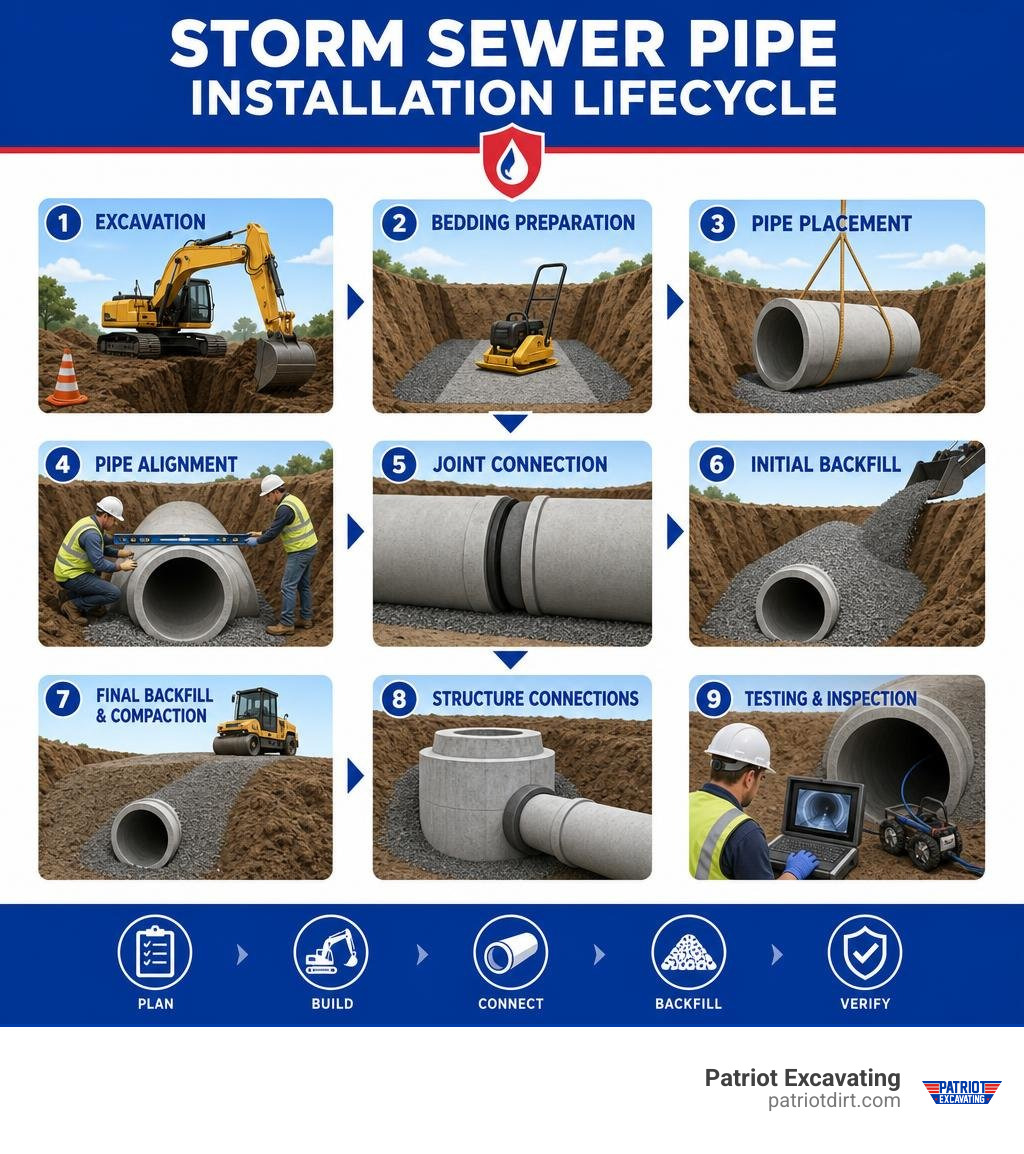
At Patriot Excavating, our storm drain pipe installation process follows a disciplined five-stage engineering standard: excavating trench lines to precise laser grade, placing compacted aggregate bedding, executing aligned bell-and-spigot joint assembly with elastomeric seals, knifing and consolidating structural backfill under pipe haunches in balanced lifts, and validating every run with mandrel deflection and CCTV inspections. Adhering to these strict quality standards prevents soil settlement, pipe shearing, and localized surface flooding.
A dependable storm sewer network serves as the structural backbone of commercial developments, municipal roadways, and residential subdivisions. Across central Indiana, subsurface drainage infrastructure must withstand heavy seasonal storms to protect pavement integrity and building foundations. Our operators maintain strict adherence to civil engineering specifications and OSHA trench safety regulations on every project.
As a family-owned commercial and residential excavating company serving Indianapolis and central Indiana, Patriot Excavating deploys the heavy machinery, certified operators, and technical expertise required to manage underground infrastructure projects from initial excavation through final compliance testing.
Pre-Installation Planning, Site Staging, and Material Handling
A durable drainage network begins long before heavy equipment arrives on site. Detailed pre-installation planning ensures utility safety, regulatory compliance, and material integrity. By integrating early engineering reviews with comprehensive sitework development, we establish a controlled job site that prevents delays and safeguards structural components.
Underground Utility Locates and Regulatory Compliance
Before breaking ground, our crews submit One-Call 811 utility locate requests across the project footprint. In accordance with Indiana 811 rules, our operators verify utility markings and perform precision potholing—utilizing non-destructive hydro excavation or hand digging—to expose buried assets like gas mains, electrical feeds, and fiber lines before heavy mechanical excavation begins.
Simultaneously, we secure municipal drainage permits and implement project-specific Stormwater Pollution Prevention Plans (SWPPP). By executing proven stormwater management practices, such as installing silt fencing, sediment basins, and storm inlet protection filters, we prevent off-site sediment migration throughout Marion, Johnson, Hamilton, and surrounding counties.
Receiving, Inspection, and Job Site Storage Protocols
When storm drainage pipe shipments arrive, our field supervisors conduct rigorous quality control inspections against ASTM and AASHTO standards:
- Material Verification: High-density polyethylene (HDPE) and polypropylene (PP) dual-wall pipes are checked for corrugation flaws, joint deformities, and bell-and-spigot integrity. Solid-wall PVC shipments are inspected against ASTM D3034 standards.
- Defect Rejection Thresholds: Any pipe section displaying surface gouges exceeding 10% of wall thickness, cracks, or deformed bells is rejected and removed from the site.
- Stockpile Management: Pipe bundles are stacked on level ground, blocked securely against rolling, and kept within manufacturer height limits.
- Storage Orientation: Gasketed pipes are stacked by alternating bell and spigot directions to prevent point loading. Tarps protect long-term stockpiles from UV degradation while allowing air circulation.
- Handling Standards: Crews use wide nylon slings for hoisting pipe bundles, prohibiting steel chains or direct dragging across rocky ground.
Trenching, Foundation Preparation, and Dewatering Standards
The structural integrity of a flexible or rigid storm conduit depends on the stability of its soil envelope. Executing proper underground utility trenching ensures the foundation supports heavy overburden and dynamic vehicular loads without shifting.
Trench Excavation and Bedding for Storm Drain Pipe Installation
Excavating the trench envelope requires careful adherence to dimensional standards. If a trench is dug too narrow, crews cannot properly place and compact backfill under the pipe haunches; excessive width places unnecessary earth loads on the conduit.
$$\text{Minimum Trench Width} = 1.5 \times \text{Pipe Outside Diameter} + 12\text{ inches (300 mm)}$$
For large pipes up to 60 inches, trench widths reach 96 inches to provide adequate clearance for compaction equipment. Deep excavations are stabilized using trench boxes or hydraulic shoring compliant with OSHA Type A, B, or C soil guidelines.
Our crews place a 4- to 6-inch bedding layer of Class I angular crushed stone (such as AASHTO #57 aggregate) across the excavated floor. Working as a dedicated trenching contractor, we verify trench depths using dual-slope laser grade control systems. Invert grades are held within tight civil tolerances—typically $\pm 0.125$ inch for vertical invert grade—ensuring positive gravity flow without low spots.
Subgrade Stabilization, Dewatering, and Preventing Flotation
When encountering soft clays, organic soils, or elevated water tables, our crews apply advanced stormwater drainage solutions to stabilize the trench bottom. Unsuitable soils are undercut and replaced with dense-graded aggregate wrapped in geotextile fabric.
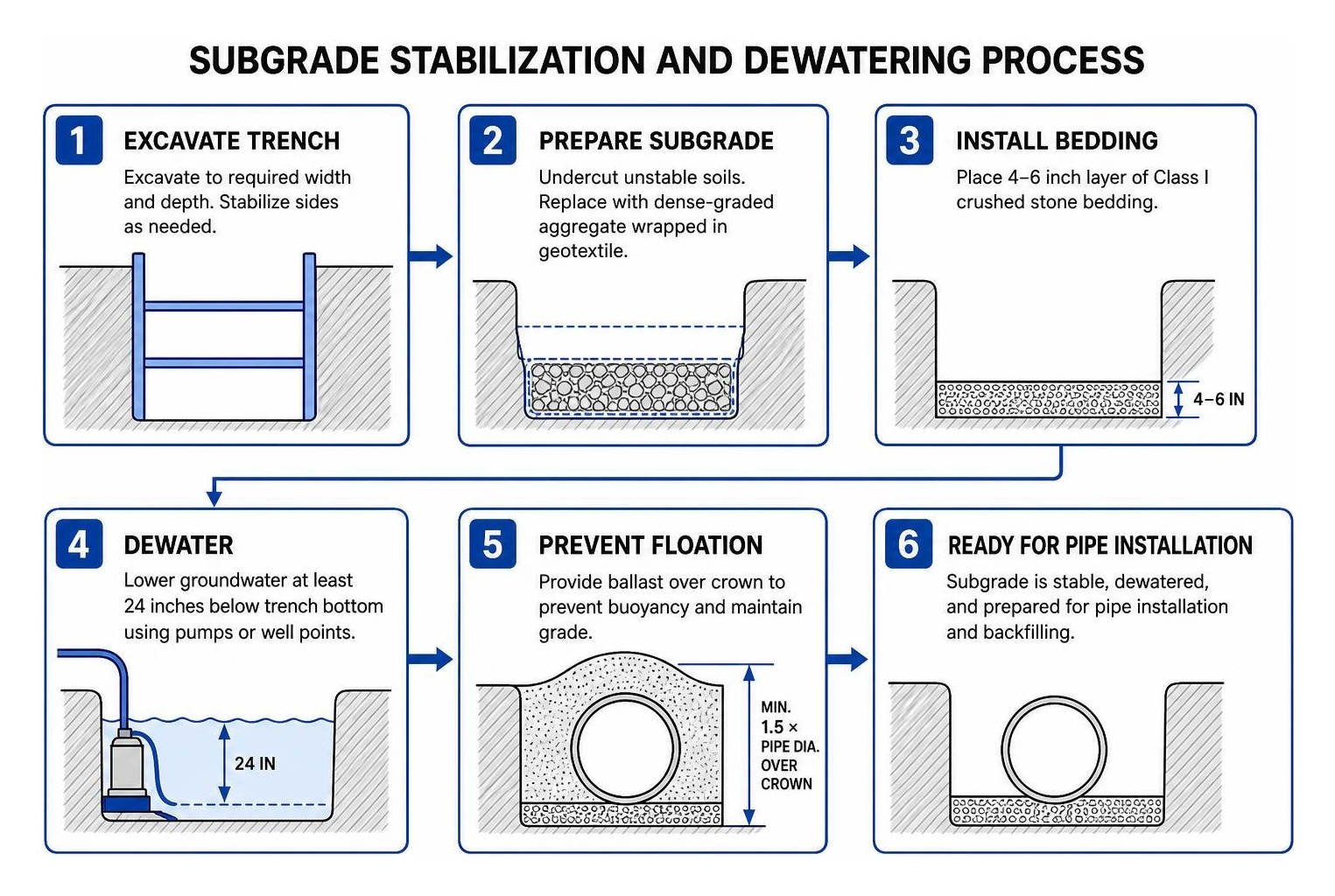
In saturated ground, water control is vital:
- Active Dewatering: Submersible pumps or well-point systems lower groundwater to at least 24 inches below trench grade, ensuring pipe is placed on a dry, unyielding foundation.
- Buoyancy Countermeasures: Empty plastic storm pipes act as buoyant cylinders when submerged. Rising groundwater can lift pipes off grade and shear joint seals.
- Ballast Placement: To prevent flotation, our crews place ballast fill equal to at least $1.5 \times \text{pipe diameter}$ over the crown immediately following assembly. For 60-inch lines submerged in high water tables, at least 40 inches of compacted cover or concrete hold-down collars are engineered into the run.
Professional Storm Drain Pipe Installation Procedures and Joint Assembly
Once our operators confirm the trench bedding is stable and verified to laser grade, Patriot Excavating begins pipe stringing and joint homing. Precise joint assembly is vital to prevent joint separation, soil infiltration, and sinkhole formation.

Bell-and-Spigot Assembly Methods
When assembling dual-wall HDPE, PP, or solid-wall PVC storm line joints, our field crews utilize controlled mechanical force and exact alignment:
- Surface Cleaning: Our crew cleans the interior of the receiving bell and exterior spigot surface, inspecting elastomeric gaskets to ensure uniform seating without twists.
- Lubrication: We apply a uniform coat of manufacturer-approved water-soluble gasket lubricant to the bell bevel and rubber gasket, avoiding petroleum-based formulas that degrade elastomeric seals.
- Inline Alignment: Operators align the spigot end axially with the receiving bell, eliminating angular stabbing to prevent rolling gaskets or cracking bell sockets.
- Controlled Joint Homing:
- Bar-and-Block Method: For pipe diameters from 4 to 24 inches, our pipe layers place a timber block across the downstream bell edge and use a pry bar against the bedding to lever the spigot home to the factory insertion mark.
- Installation Stub Method: For large storm conduits (30 to 60 inches), our excavator operators prohibit direct bucket contact, using an engineered installation stub or wide nylon rigging to deliver smooth, inline hydraulic thrust.
- Depth Verification: Field personnel verify that the insertion line sits flush with the bell face, preventing under-insertion or joint over-insertion.
Connecting Catch Basins, Manholes, and Dissimilar Pipe Transitions
Patriot Excavating creates watertight integrations with precast storm structures:
- Precast Structure Connections: Openings in precast concrete catch basins and manholes are cored or precast with flexible rubber boot connectors meeting ASTM C923, secured with stainless steel clamps.
- Grout and Waterstop Transitions: Where mechanical boots are omitted, our crews apply sand-grit adhesive to the pipe exterior, set the pipe into the structure opening, and pack non-shrink hydraulic grout with elastomeric waterstop rings.
- External Sealing Bands: In high-water-table applications, we install ASTM C877 external sealing bands wrapped with geotextile fabric across structure interfaces.
- Dissimilar Couplings: Transitioning between corrugated plastic and reinforced concrete pipe is completed using heavy-duty shear-ring couplings or poured concrete encasement collars.
Backfilling, Compaction Criteria, and Minimum Cover Protection
The long-term structural integrity of flexible thermoplastic storm pipe installed by Patriot Excavating depends on proper aggregate selection and compaction density. Thermoplastic conduits rely on passive lateral soil support from the compacted backfill envelope to resist vertical live loads.
Soil Classification and Compaction Requirements
Our operators categorize backfill materials into standard engineering classes based on particle distribution and angularity:
| Backfill Classification | Material Description | Recommended Lift Thickness | Target Proctor Compaction (Standard) | Pavement Zone Compaction (Modified) |
|---|---|---|---|---|
| Class I | Angular, crushed stone/rock (AASHTO #57 aggregate) | 8 to 12 inches | Consolidate with vibratory plates | 95% minimum |
| Class II | Coarse sands and gravel-sand mixtures (GW, GP, SW, SP) | 6 to 8 inches | 85% Standard Proctor minimum | 95% Modified Proctor |
| Class III | Fine sands, silty/clayey gravels (GM, GC, SM, SC) | 6 inches | 90% Standard Proctor minimum | 95% Modified Proctor |
| Class IV / V | Plastic clays, organic silts (CH, MH, OL, OH) | Not Permitted | Unsuitable for structural envelope | Unsuitable |
Critical Haunching and Layering Procedures
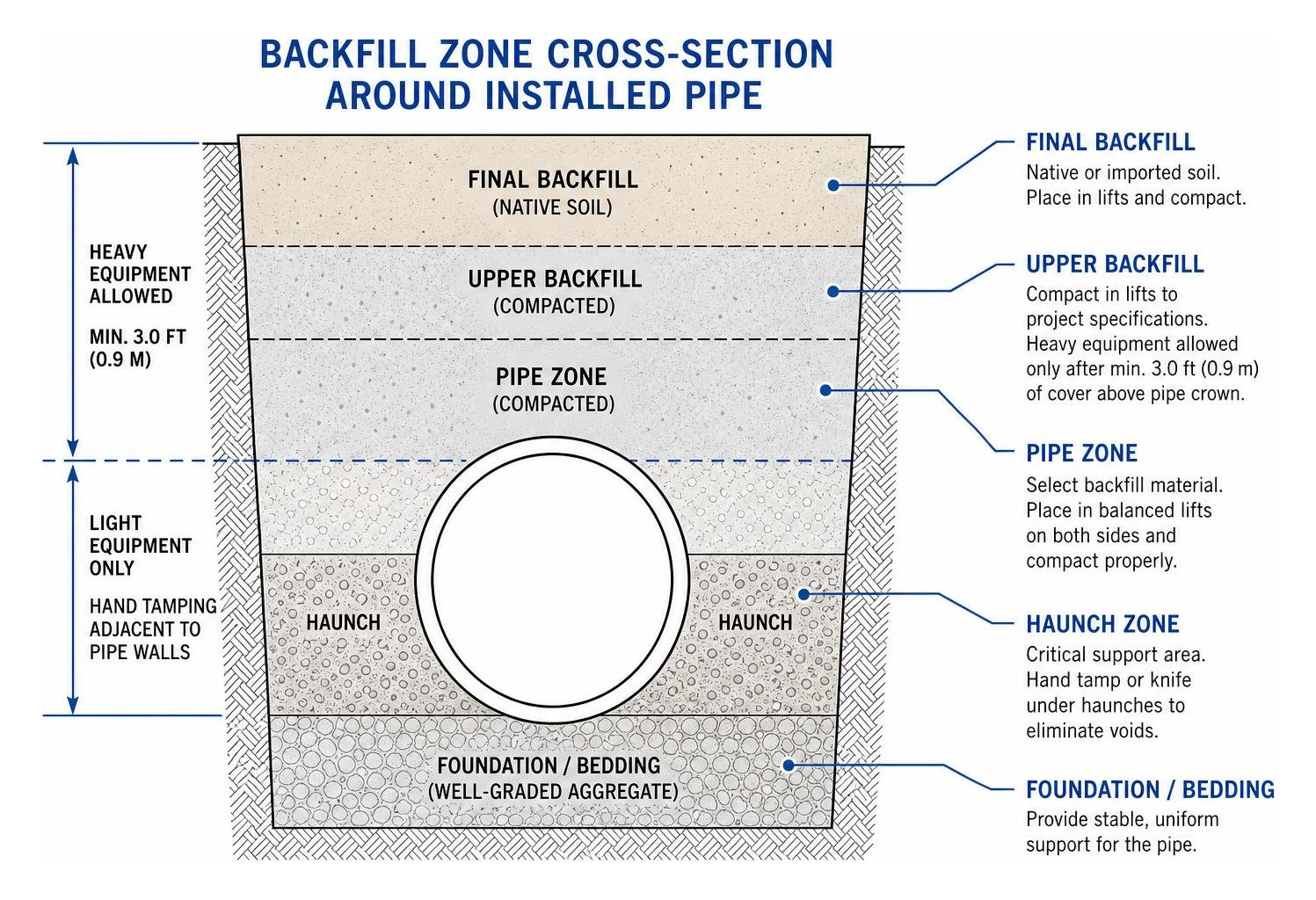
- Haunch Support: Patriot Excavating crews hand-tamp and knife Class I aggregate beneath pipe haunches to eliminate structural voids that cause pipe deflection.
- Balanced Lifts: Our operators place and compact backfill in balanced lifts on both sides of the conduit simultaneously to prevent lateral displacement.
- Compactor Clearance: Walk-behind vibratory plate compactors are operated alongside pipe barrels, keeping heavy vibratory rollers and loaded haul trucks at least 3.0 feet above the pipe crown.
Cover Depths for Traffic Loads and Construction Equipment
To safeguard storm lines against AASHTO H-25 highway loading across central Indiana job sites, Patriot Excavating enforces strict cover standards:
- Paved Corridors: For lines 4 to 48 inches in diameter, we maintain at least 12 inches of compacted cover between the pipe crown and the bottom of the pavement base.
- Large-Diameter Lines: For 54- to 60-inch storm pipes, our operators maintain a minimum of 24 inches of compacted structural cover in traffic corridors.
- Maximum Fill Heights: In well-compacted Class I stone, dual-wall HDPE installed by our crews supports up to 25 feet of cover for 60-inch lines and 44 feet for 6-inch lines, while polypropylene HP Storm pipe supports up to 28 feet for 36-inch mains.
Quality Control and Testing in Storm Drain Pipe Installation
To ensure structural integrity and compliance with municipal specifications, Patriot Excavating performs comprehensive quality assurance testing before final surface restoration.
Deflection and Low-Pressure Air Testing Protocols
- Mandrel Deflection Pull Testing: Flexible plastic pipes are evaluated for out-of-round deformation after backfill settlement. A rigid nine-arm mandrel sized to 95% or 92.5% of internal pipe diameter is pulled through the pipeline. For ASTM D3034 PVC sewer lines, the allowable 7.5% deflection mandrel size is 5.31 inches for 6-inch lines and 51.76 inches for 60-inch profile lines. If the mandrel encounters resistance, the section is flagged for remediation.
- Low-Pressure Air Testing: Watertight gravity storm networks undergo pneumatic air testing per ASTM F1417 (plastic) or ASTM C924 (concrete). Inflatable plugs isolate the pipe run between structures. The line is pressurized to 4.0 psig, stabilized at 3.5 psig, and monitored for pressure drop over specified test intervals to certify watertight performance.
- CCTV Laser Profiling: Motorized robotic CCTV cameras crawl the pipeline between structures. The camera records high-definition video while projecting radial lasers to verify joint homing distances, measure deflections to 0.05-inch accuracy, and confirm complete clearance from debris or standing water.
Remediation and Approved Repair Methods
When testing identifies compromised pipe sections or joint misalignments, our crews perform structural repairs based on engineering requirements:
- Watertight vs. Soil-Tight Compliance: Systems are repaired to meet project hydrostatic standards, resisting up to 10.8 psi of hydrostatic head where specified.
- Mechanical Repair Sleeves: Minor localized cracks or damaged ribs are repaired using stainless steel or HDPE mechanical repair sleeves equipped with elastomeric gaskets.
- Reinforced Concrete Encasement: Non-standard transitions or structural repairs receive a continuous 6-inch reinforced concrete collar with rebar encasement over geotextile sealing wraps.
- Section Replacement: If a section fails deflection limits from poor haunch compaction, our excavation operators re-excavate the trench, remove damaged pipe, place fresh Class I stone, and re-compact the backfill envelope to required density.
Frequently Asked Questions About Storm Sewer Installation
What minimum cover does Patriot Excavating maintain for storm pipes under traffic?
Under AASHTO H-20 and H-25 dynamic highway loading, our crews maintain a minimum of 12 inches of compacted cover measured from the pipe crown to the bottom of the asphalt or concrete base course for 4- to 48-inch HDPE and PVC pipes. For large 54- to 60-inch lines, we maintain at least 24 inches of compacted cover. During active site development, our operators establish a temporary 3-foot compacted buffer over buried lines before permitting loaded scrapers or off-road haul trucks across trench lines.
How does Patriot Excavating prevent storm pipes from floating in high groundwater?
Our crews utilize continuous well-point and submersible trash pump dewatering to keep trenches dry throughout bedding and pipe homing. To eliminate hydrostatic uplift on empty plastic conduits, we place a compacted ballast fill height equal to at least $1.5 \times \text{pipe diameter}$ directly over the crown. For large 60-inch pipes subject to high water tables, we install at least 40 inches of ballast or cast reinforced concrete hold-down anchor collars.
What backfill density does Patriot Excavating require around thermoplastic pipes?
Our field teams compact Class II coarse sands and gravels to at least 85% Standard Proctor density, and Class III materials to 90% Standard Proctor density. When storm trenches cross under municipal roadways, commercial parking lots, or building pads, our operators place structural fill in 6- to 8-inch lifts and achieve a minimum of 95% Modified Proctor density, verifying compaction across every lift with calibrated nuclear density gauges.
Conclusion
Storm drainage infrastructure represents a critical investment in site stability, flood protection, and environmental compliance. Substandard trench excavation, hasty joint assembly, or poor haunch compaction inevitably cause pipe deflection, joint leaks, and pavement failure. Adhering to rigorous civil engineering standards and validating installations through deflection and CCTV testing ensures underground drainage performs reliably for decades.
Patriot Excavating brings specialized excavation machinery, certified operators, and hands-on site experience to install commercial and residential storm sewer systems that satisfy municipal and civil engineering specifications across Indianapolis and central Indiana. From new subdivisions to commercial upgrades, we handle every phase of site preparation.
Contact our team today to review your civil engineering plans and request an estimate for our commercial sewer and drainage services or comprehensive site excavation contractor solutions.