
How to Install a Sewer Line from Trench to Tie-in
Sewer Line Installation Starts with a Precise Plan
Installing sewer service requires far more than simply digging a trench and laying pipe. A qualified excavation crew must first pinpoint underground utilities, establish precise municipal connection points, navigate local permitting jurisdictions, set laser-accurate pipe elevations and gradients, and assemble durable pipe joints. Only after rigorous pressure testing, mandrel deflection verification, and municipal inspection signoff can the final tie-in be completed and backfilled.
Every jobsite across Central Indiana presents unique subsurface conditions. Variable glacial till soils, deep frost lines, dense utility corridors, site topography, and public right-of-way restrictions directly influence the engineering plan. Detailed planning prevents costly hazards such as pipe bellies, utility line strikes, failed municipal inspections, and premature wastewater backups.
Patriot Excavating is a family-owned commercial and residential excavating company serving Indianapolis and central Indiana. With specialized field expertise in sanitary sewer repair, precision utility installation, hydro excavation, rough and fine grading, and erosion control, our team brings practical problem-solving to every underground infrastructure project. Clay Hamilton’s two decades of hands-on excavation, electrical, and mechanical systems experience guide our meticulous approach to installing sewer infrastructure safely and reliably. Property owners, builders, and facility managers can count on our crew for sewer installation in Marion County as well as comprehensive sewer line installation in Indianapolis.
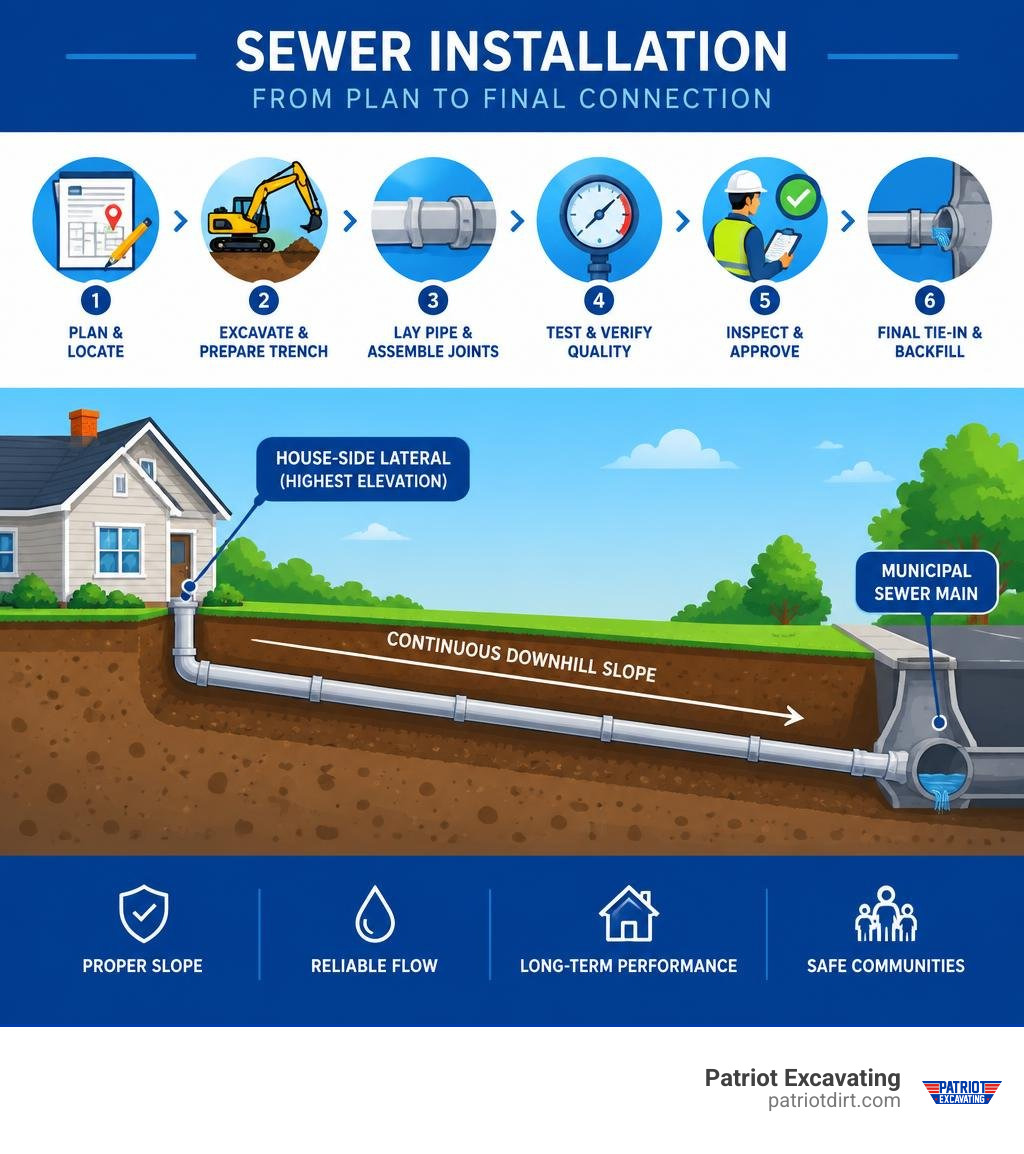
Pre-Installation Planning, Permitting, and System Comparison
Before heavy machinery arrives on site, successful sewer installation demands comprehensive engineering coordination and site evaluation. When transitioning an existing property away from on-site septic or developing raw commercial land, weighing centralized municipal wastewater infrastructure against decentralized treatment is a vital first step. Comparing the performance parameters of septic vs sewer systems demonstrates how municipal gravity connections support significantly higher discharge capacities without the ongoing footprint and drain field management required by private soil absorption systems. For unsewered acreage and rural parcels across Central Indiana, Patriot Excavating also provides complete residential septic tank installation.
Securing municipal utility approvals requires direct coordination with regional sanitary districts throughout Central Indiana. Our team regularly works alongside departments such as the Sanitary Sewer Utility | Greenwood, IN, the Town of Whiteland: Sewer utility office, and the Sanitary Sewer – Bargersville – IN.gov utility board. Before breaking ground, System Development Charges (SDCs), connection fees, right-of-way encroachment bonds, and municipal tap permits must be reviewed and approved by municipal engineers.
Patriot Excavating manages the pre-construction inspection sequence, establishing benchmark elevations and submitting 811 locate requests. Where existing buried utilities intersect the planned lateral path, our specialized hydro excavation units safely expose energized power conduits, gas mains, and fiber-optic cables using pressurized water and high-cfm vacuum extraction. This approach integrates seamlessly with our professional utility trenching standards and stormwater pollution prevention plans, utilizing silt fencing, sediment logs, and drain inlet protection to protect adjacent watersheds.
Municipal Sewer Lateral and Site Drainage Planning
A sanitary sewer lateral must function in harmony with the finished civil grading plan. When preparing residential subdivisions or commercial building pads, our excavation crews evaluate finished floor elevations, natural slope contours, and municipal main depths to achieve gravity flow, avoiding mechanical lift stations whenever possible.
Site grading and sewer alignment are closely connected. Poor surface drainage can saturate subgrade soils, causing structural ground settling that threatens pipe alignment. By coordinating site grading, swale creation, foundation drainage, and utility trenching together, Patriot Excavating protects the long-term durability of the wastewater lateral.
Main Lines, Lateral Lines, and Municipal Tap Connections
Navigating underground wastewater systems requires understanding the distinction between public infrastructure and private lines:
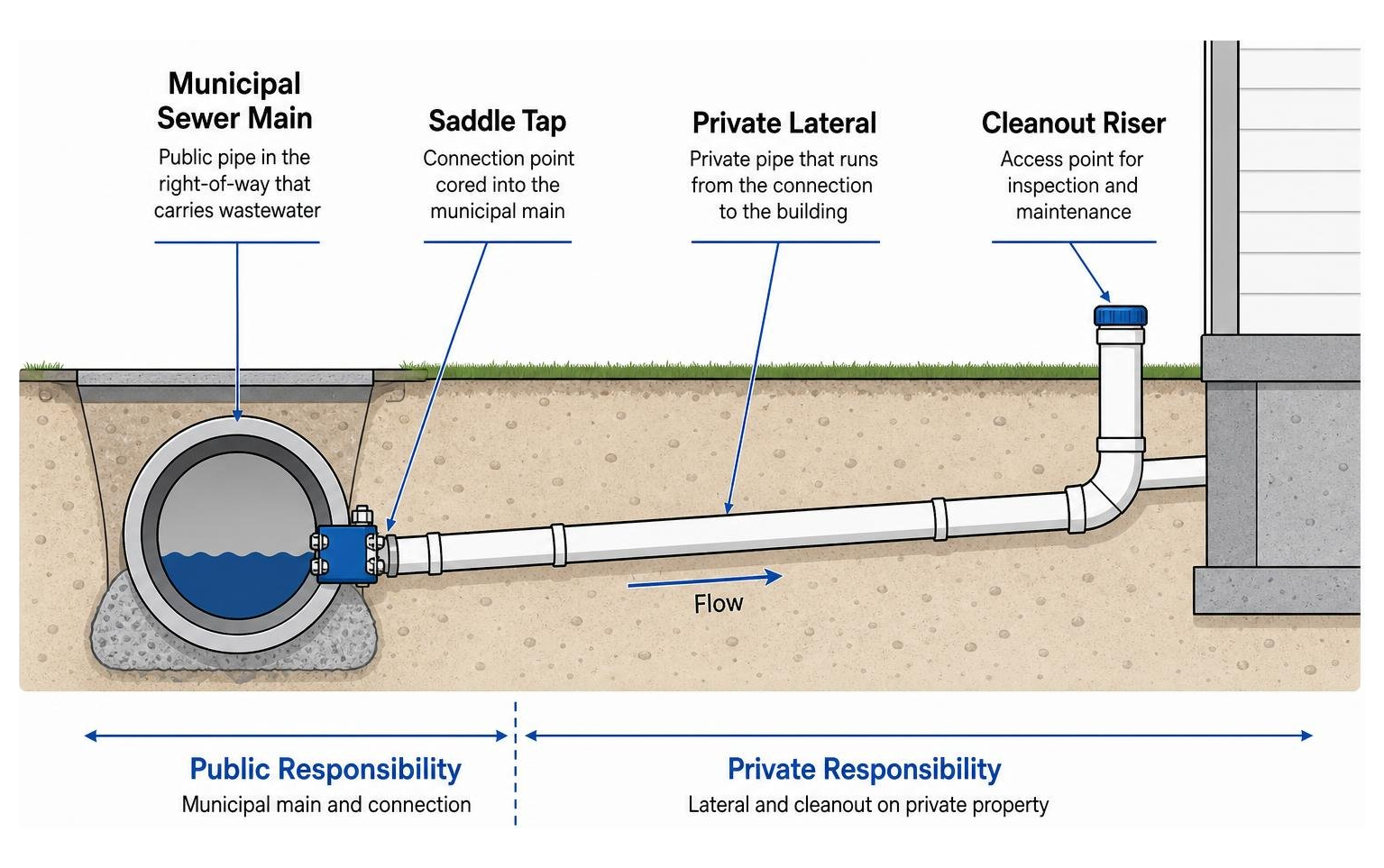
- Public Sewer Main: The municipal collector main (typically 8 to 24 inches or larger in diameter) located in the street easement or public right-of-way that conveys wastewater to a centralized treatment facility.
- Private Sewer Lateral: The 4-inch or 6-inch pipe running from the building’s exterior foundation wall to the property line or utility right-of-way, owned and maintained by the property owner.
- Municipal Tap Connection: The point where the private lateral connects to the public sewer main through an existing factory wye, a core-drilled saddle tap, or a dedicated manhole structure.
Completing deep connections in heavily trafficked rights-of-way requires specialized commercial utility excavation capabilities to safely navigate deep excavations, maintain traffic control, and handle subbase compaction.
Professional Standards for Installing Sewer Mains and Laterals
Sanitary sewer construction demands zero-tolerance engineering precision. Gravity wastewater systems rely entirely on uniform downward pitch to carry both liquids and suspended solids. Adhering to municipal standards and manufacturer technical specifications, such as the Installation Guide for Solid-Wall PVC Sewer Pipe published by the Uni-Bell PVC Pipe Association, ensures buried infrastructure performs for decades without sag points, joint failure, or root penetration.
When hiring an excavation contractor, property owners must verify that the team possesses valid municipal bonding, specialized utility licensing, and adequate commercial insurance. Partnering with seasoned sewer installers in Marion County ensures complete compliance with local unified development ordinances and regional sanitary district requirements.
Key Engineering Calculations When Installing Sewer Pipes
Achieving the proper flow velocity is critical in sanitary sewer engineering. The industry standard requires a minimum wastewater velocity of 2 feet per second to create a self-cleansing action that prevents suspended solids from settling along the pipe invert.
Plumbing codes and engineering standards dictate precise slope requirements based on pipe diameter:
- 4-inch pipe: Minimum slope of 1/4 inch per linear foot (2.08% grade, or roughly a 2-foot drop across 100 feet of run).
- 6-inch pipe: Minimum slope of 1/8 inch per linear foot (1.04% grade, or roughly a 1-foot drop across 100 feet of run).
Patriot Excavating crews maintain grade control using dual-slope rotary grade lasers and digital receivers attached directly to excavator sticks. Excessive slopes exceeding 10% can cause liquids to separate from solids, leaving waste stranded in the line while complicating downstream municipal tie-in elevations.
| Pipe Material | Common Residential / Light Commercial Diameters | Standard Slope Requirement | Primary Application & Structural Benefits |
|---|---|---|---|
| PVC (ASTM D3034 SDR 35) | 4-inch, 6-inch | 1/4″ per foot (4″), 1/8″ per foot (6″) | Standard gravity lateral; ultra-smooth interior wall maximizes flow; elastomeric gasketed joints prevent root intrusion. |
| PVC (Schedule 40 / Solid-Wall) | 4-inch, 6-inch | 1/4″ per foot (4″), 1/8″ per foot (6″) | Heavy-duty lateral pipe; superior impact and crush resistance under shallow burial depths or beneath driveways. |
| Ductile Iron (Class 50/52) | 4-inch, 6-inch, 8-inch+ | 1/4″ per foot (4″), 1/8″ per foot (6″) | Required when cover depth is under 24 inches, in deep high-load roadway crossings, or through unstable soils. |
| HDPE (High-Density Polyethylene) | 4-inch, 6-inch | 1/4″ per foot (4″), 1/8″ per foot (6″) | Trenchless pipe bursting and directional boring; heat-fused monolithic joints eliminate joint separations. |
Pipe Materials, Diameter Sizing, and Fitting Selection
Selecting pipe materials depends on burial depth, surface live loads, soil composition, and municipal sanitary specifications. Gravity laterals in Central Indiana rely on solid-wall PVC pipe engineered to ASTM standards. Contractors follow the Installation Guide For ASTM D3034 PVC Sewer Pipe to ensure gasket compression, homing depths, and angular joint deflections remain within manufacturer limits.
Fitting geometry requires equal diligence. Plumbing codes prohibit sharp 90-degree elbows on horizontal buried runs because they create major obstruction points. Directional adjustments must use two consecutive 45-degree bends or long-sweep fittings. Two-way cleanout risers must be placed within 30 to 36 inches of the foundation wall, every 75 to 100 feet on extended pipe runs, and at horizontal directional changes exceeding 45 degrees.
Step-by-Step Sewer Line Installation from Trench to Tie-In
Executing a sanitary sewer lateral installation requires systematic sequencing, modern heavy machinery, and strict adherence to workplace safety regulations from initial layout to site restoration.
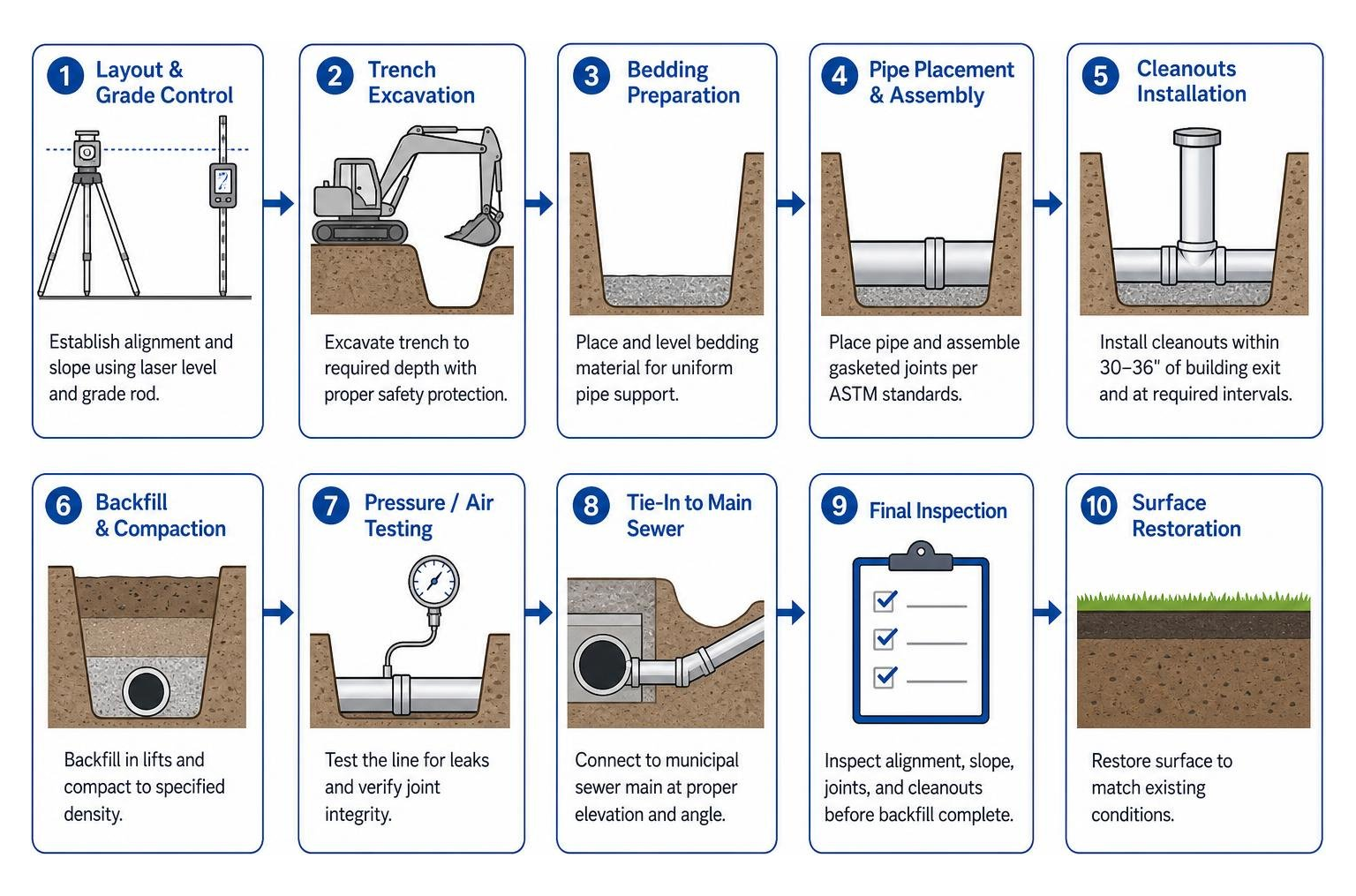
Understanding the mechanics of trenching helps commercial developers and homeowners appreciate the subgrade preparation, laser alignment, and shoring required throughout installation.
Precision Trench Excavation and Safety Guidelines
Trench stability is essential on every jobsite. Under OSHA excavation safety standards, trenches reaching 5 feet or deeper mandate protective systems such as benching, sloping, or certified aluminum trench boxes. When installing sewer lines in tight residential utility easements, heavy-duty shoring shields workers from cave-in hazards while limiting surrounding turf disruption.
Patriot Excavating utilizes modern excavators equipped with cab-mounted laser receivers, allowing operators to carve trench inverts below the local frost line (typically 30 to 36 inches across Central Indiana) without disturbing the native subgrade beneath the bedding zone. If standing groundwater or unstable soft soils are encountered, high-output dewatering systems and geotextile stabilization fabrics are installed prior to aggregate placement. When coordinating comprehensive site developments, our full-scale site excavation services ensure building pads, drainage contours, and utility trenches integrate seamlessly.
Pipe Laying, Joint Assembly, and Tie-In Connections
With the trench base laser-verified to the required grade, pipe installation begins downstream at the municipal tap and works upstream toward the structure:
- Bell-and-Spigot Alignment: Pipes are positioned with bell ends oriented uphill (upstream) to create a smooth hydraulic transition at every joint.
- Pipe Preparation: Field cuts are trimmed perfectly square and beveled with a chamfer tool to mirror factory spigots.
- Gasket Lubrication: Approved pipe lubricant is applied evenly across the spigot end and the elastomeric rubber gasket.
- Controlled Insertion: The spigot is guided into the bell socket using a bar-and-block assembly until the reference insertion line meets the bell collar.
- Municipal Connection: At the public main, our crew installs an approved cored saddle tap with dual stainless-steel bands or connects to an existing municipal wye fitting using heavy-duty shielded elastomeric transition couplings. If upstream manhole rims sit above fixture flood levels, a code-compliant backwater valve is installed.
Pipe Bedding, Testing, and Trench Backfill Procedures
The long-term structural performance of flexible PVC pipe depends on its engineered aggregate envelope. Placing uncompacted native soil directly around flexible pipe leads to joint shear, structural pipe deflection, and surface sinkholes.
Strict adherence to technical standards, such as the SECTION 300 Sewer Construction Specifications, ensures the lateral receives continuous side support and load distribution. When aging utility lines collapse unexpectedly on commercial or residential parcels, our guide to emergency sewer line replacement outlines the critical steps required to stabilize utility corridors and restore continuous flow safely.
Essential Bedding and Backfill Steps When Installing Sewer Laterals
A resilient pipe envelope requires three distinct installation zones:
- Bedding Layer: A 4- to 6-inch foundation of angular crushed stone (such as INDOT #8 limestone) placed over undisturbed subgrade to establish a firm, uniform resting surface.
- Haunching Zone: Crushed aggregate placed and hand-tamped beneath the lower curve of the pipe barrel to eliminate voids and provide lateral load support.
- Initial Backfill: Clean crushed stone placed evenly on both sides and compacted in 6-inch lifts to an elevation 6 to 12 inches above the top of the pipe crown, protecting it against rock strikes.
Final backfill is placed in successive 8- to 12-inch lifts, compacted with pneumatic tampers or vibratory rollers to achieve 90% to 95% Standard Proctor density. To simplify future line tracing, an insulated 12-gauge solid copper tracer wire is taped directly to the pipe crown, and magnetic green warning tape is placed 12 to 18 inches below finished grade.
Mandatory Pressure, Mandrel, and Camera Inspection Testing
Prior to final backfilling and municipal utility signoff, the completed lateral undergoes rigorous acceptance testing:
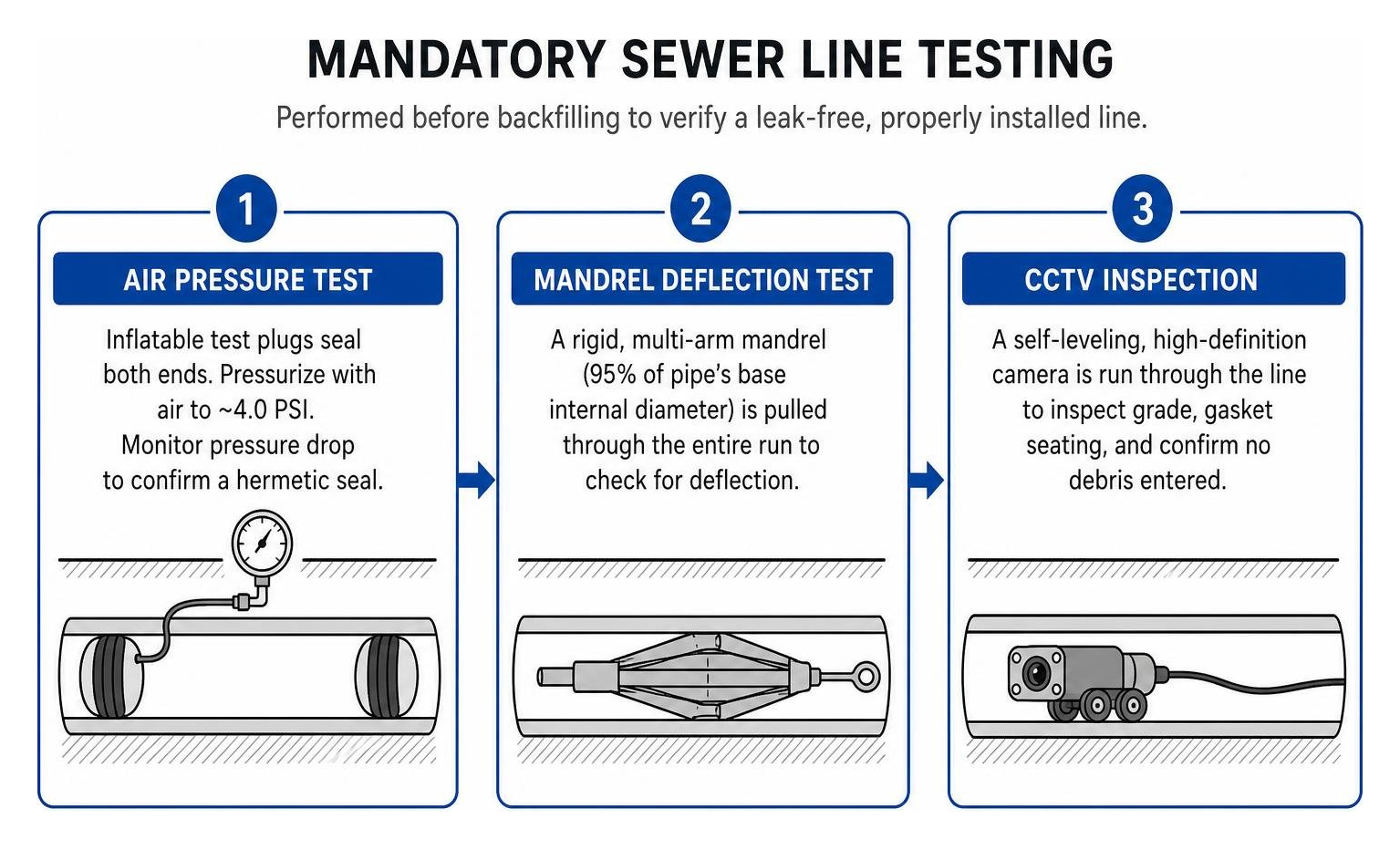
- Low-Pressure Air Testing: Mechanical test plugs seal both ends of the run while low-pressure air is introduced to approximately 4.0 PSI. The pipe must maintain pressure per ASTM F1417 standards without dropping, confirming an airtight seal.
- Mandrel Deflection Verification: A rigid, multi-fin mandrel sized to 95% of the pipe’s internal diameter is pulled through the pipeline to confirm no excessive ovality or cross-sectional deflection.
- CCTV Video Inspection: A self-leveling sewer crawler camera inspects internal joints, gasket alignment, and grade consistency throughout the run.
Maintenance Best Practices and Recognizing Pipe Defects
Once a sanitary sewer lateral is professionally installed and inspected, routine care preserves its hydraulic capacity for decades. While modern solid-wall PVC provides a slick interior surface that resists mineral scale and corrosion, ground movement and improper waste disposal can still create underground defects over time.
Property owners experiencing repeated drain backups, gurgling plumbing fixtures, or soggy patches across their yard can turn to Patriot Excavating for advanced sewer, water, and drainage solutions. For regional municipal repairs and utility installations across the greater Indianapolis area, our field crews deliver targeted Beech Grove sewer services, professional Fishers sewer line repair, and specialized Greenwood utility trenching.
Identifying underground pipe defects early prevents extensive property damage:
- Pipe Bellies: Low areas caused by uncompacted subgrades or unstable soils where wastewater pools, causing heavy solids and grease to settle into persistent blockages.
- Root Intrusion: Tree roots exploiting unsealed joints, cracked clay connections, or deteriorated cast iron transitions on older sites.
- Offset Pipe Joints: Displaced pipe sections resulting from ground shifting or improper bedding, creating interior ledges that trap solids.
To safeguard the lateral, cleanout caps must remain undamaged and tightly threaded. Commercial facilities should schedule regular hydro-jetting to prevent grease buildup, and deep-rooting trees should never be planted within 15 feet of the sewer lateral alignment.
Frequently Asked Questions about Installing a Sewer Line
How long does a residential sewer line installation typically take?
A standard residential sewer lateral installation typically takes 2 to 4 business days of active site excavation, depending on trench depth, underground utility density, weather, and soil composition.
The installation sequence typically follows these phases:
- Day 1: Site mobilization, 811 utility locate confirmation, hydro excavation around sensitive underground utilities, and initial trench excavation to planned bench levels.
- Day 2: Placement of crushed stone bedding, laser-guided pipe laying, cleanout riser assembly, and municipal tap tie-in.
- Day 3: Mandatory low-pressure air testing, mandrel deflection testing, municipal inspector verification, and initial aggregate compaction around pipe haunches.
- Day 4: Final trench backfilling, mechanical soil compaction in controlled lifts, finish grading, and erosion control installation. Deep roadway cuts requiring asphalt restoration or concrete paving may require additional coordination.
What is the minimum slope required for a residential sewer pipe?
For a standard 4-inch residential sanitary sewer lateral, national plumbing codes and local Indiana sanitary districts require a minimum slope of 1/4 inch of vertical drop per linear foot of horizontal run, representing a 2.08% grade.
For larger 6-inch commercial laterals or residential lines serving elevated fixture unit counts, the standard code-mandated slope is 1/8 inch per linear foot (a 1.04% grade). Maintaining these precise slope parameters ensures an internal scouring velocity of at least 2 feet per second, which keeps suspended solids moving smoothly with the wastewater stream to prevent line blockages.
Who is responsible for securing sewer permits and municipal approvals?
While the property owner authorizes site development on their land, the excavation contractor handles technical permitting submissions, right-of-way bond filings, and formal inspection coordination.
Patriot Excavating coordinates directly with regional municipal utility boards, county highway departments, and city engineering offices across Central Indiana to secure required sanitary sewer construction and right-of-way encroachment permits, ensuring your project meets local engineering specifications from excavation to final signoff.
Comprehensive Site Preparation and Sewer Solutions
Installing a durable sanitary sewer lateral is a critical underground construction project requiring commercial-grade excavation equipment, laser-accurate grading, and strict compliance with local municipal codes. From precision utility locates and hydro excavation to crushed stone bedding, gasketed joint assembly, and mandatory pressure testing, every phase directly influences the reliability of your property’s wastewater system.
Patriot Excavating provides complete commercial and residential excavation, grading, utility installation, hydro excavation, erosion control, and sewer line repair throughout Indianapolis and Central Indiana. Whether you are building a new residential development, connecting an existing structure to a municipal main, or replacing deteriorated underground utility pipes, our experienced team delivers the comprehensive site solutions needed to complete your project safely and efficiently.
Contact Patriot Excavating today to discuss your site development plans and request an estimate for professional sewer, water, and drainage services.