
Planning an Underground Gas Line Installation for Your Property
How to Plan an Underground Gas Line Installation
Start with a plan, not a trench. Identify where the gas line needs to go, confirm site access, contact 811 before excavation, and review permit requirements with the proper local authority. A qualified gas professional must size and install the pipe, test it, and coordinate inspections. Patriot Excavating supports the project by preparing the site, trenching safely, protecting nearby utilities, and restoring the work area after approval.
Patriot Excavating is a family-owned commercial and residential excavating company serving Indianapolis and central Indiana. We support gas-line projects with site preparation, utility trenching, hydro excavation, and backfill services coordinated with licensed mechanical contractors and local inspectors. When running gas line underground, proper coordination between excavation crews and gas professionals helps protect people, structures, landscaping, and existing utilities.
I’m Clay Hamilton, president of Patriot Excavating. My more than 20 years of excavation, electrical, and mechanical systems experience help me explain how the site work fits into a safe underground gas-line installation. If you are planning a gas-line excavation in central Indiana, contact Patriot Excavating to discuss the site conditions and request an estimate.
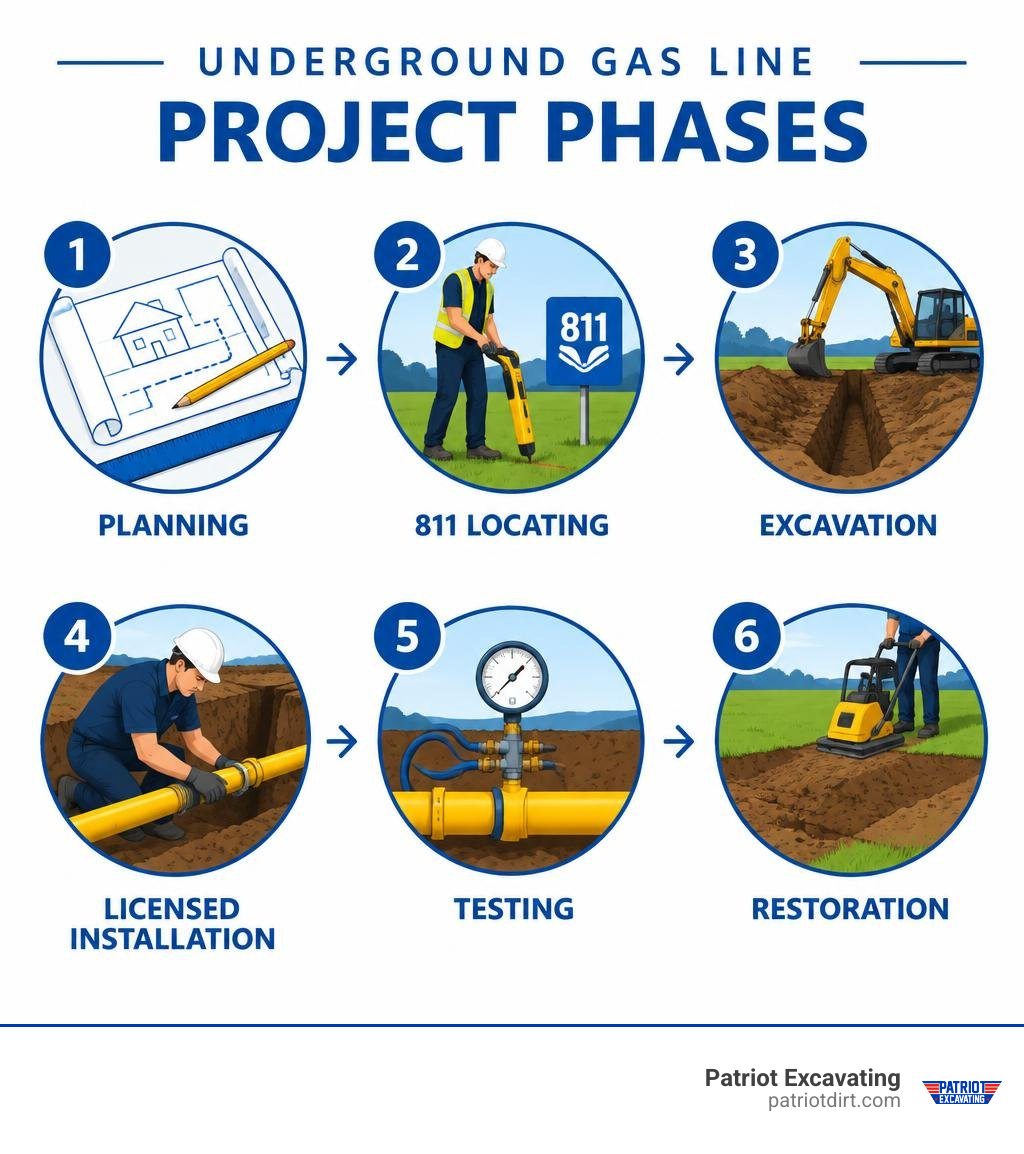
Pre-Installation Planning, Permitting, and Site Locating
Every successful underground utility project starts before equipment reaches the property. Whether the line serves an outdoor kitchen in Carmel, a standby generator in Greenwood, or a detached workshop in Noblesville, the excavation plan must reflect the actual site. Soil conditions, surface obstacles, drainage patterns, property lines, hardscaping, trees, and existing utilities all influence the trench route.
A licensed plumbing or gas professional calculates appliance demand, fuel volume, delivery pressure, and pipe size. Patriot Excavating pairs those specifications with a practical earthmoving plan for central Indiana soils, which often shift from soft topsoil to dense glacial clay in the same yard. Factoring those conditions into our professional site preparation process helps prevent settling, keeps trench bottoms stable, and supports the installer’s approved layout.
Underground Utility Locating and 811 Protocols
Federal regulations and Indiana state law require contacting Indiana 811 at least two full working days before excavation begins. After the locate request is submitted, public utility owners mark their underground assets with standardized colors:
- Yellow: Gas, oil, and steam lines
- Red: Electric power lines and lighting cables
- Blue: Potable drinking water lines
- Orange: Communications, fiber optic, and CATV lines
- Green: Sewers and drain lines
Public utility marks do not include every buried line on private property. Secondary electric feeds, private drainage, irrigation, septic laterals, and lines to detached structures may require private locating or controlled exposure by qualified crews.
The area around a marked utility is the tolerance zone. In Indiana, that zone includes the width of the utility plus 24 inches on each side. Mechanical excavation must be controlled in that corridor because a utility strike can cause fire, outage, environmental damage, or serious injury.

Patriot Excavating uses hydro excavation in Indianapolis and surrounding communities when gas-line routes cross crowded utility corridors. Pressurized water and high-capacity vacuum equipment expose buried lines without the same cutting force as a bucket or trencher, which is especially valuable in established neighborhoods and commercial sites.
Pipe Sizing and BTU Capacity Calculations
Proper pipe sizing is handled by the licensed gas contractor. The technician evaluates connected appliance demand, developed length from the meter to the farthest outlet, supply pressure, allowable pressure drop, and gas characteristics. Those specifications determine pipe diameter and the trench dimensions Patriot Excavating prepares.
Permits and Regulatory Approvals
Municipalities throughout Marion, Johnson, Hamilton, Hendricks, and nearby counties may require mechanical, building, excavation, or right-of-way approvals before underground fuel gas work begins. Patriot Excavating assists property owners, builders, and site managers with permit preparation and approval so excavation, inspections, and restoration can be scheduled in the correct order.
Code Requirements for Running Gas Line Underground
Underground gas-line work must follow federal pipeline safety rules, Indiana code requirements, local inspection standards, and utility specifications. Patriot Excavating’s role is to prepare the trench, protect existing infrastructure, coordinate around site constraints, and provide a stable route for the licensed gas installer.
Professional utility trenching establishes the required cover depth, working clearance, bedding area, and access needed for the approved piping system.
Approved Materials for Running Gas Line Underground
The licensed mechanical professional selects the approved pipe material and performs the required joining work. Patriot Excavating prepares a clean, debris-free trench bed that supports the pipe without sharp contact points, unstable voids, or unnecessary stress.
| Piping Material | Primary Application | Joining Method | Key Properties and Protection Needs |
|---|---|---|---|
| High-Density Polyethylene (HDPE / PE) | Common direct-burial outdoor gas service | Heat fusion or approved mechanical fittings | Corrosion-resistant and flexible; requires tracer wire and UV protection before burial |
| Protected Black Iron Pipe | Limited underground transitions when approved | Threaded or welded joints | Requires continuous coating or approved anti-corrosion wrapping |
| Coated Rigid Steel (API-5L / ASTM A53) | Certain commercial or high-pressure service lines | Butt welding or mechanical coupling | Requires protective coating, cathodic protection, and proper isolation |
Essential Equipment and Trench Sizing for Running Gas Line Underground
Trench dimensions depend on pipe diameter, connection points, soil stability, and the installer’s plan. For many service lines 2 inches or smaller, trench width is commonly around 18 inches. Larger lines need additional working room for bedding, fittings, and inspection access.
Patriot Excavating selects equipment based on site access and ground conditions across central Indiana:
- Compact Tracked Excavators: Useful for residential yards in Fishers, Brownsburg, and similar neighborhoods where controlled access matters.
- Track Trenchers: Efficient for long, open utility runs on acreage, commercial parcels, or new development sites.
- Hydro Excavation Rigs: Preferred near congested utilities in Indianapolis, older neighborhoods, and tight commercial corridors.
Our team provides trenching services in Indianapolis and surrounding communities, preparing flat trench bottoms, stable side clearances, and clean working conditions for the gas installer.
Trench Depth Requirements and Utility Separation Distances
Burial depth protects gas piping from vehicle traffic, landscaping activity, freeze-thaw movement, and future excavation. In many central Indiana residential settings, underground natural gas piping requires about 30 inches of cover to finished grade, though the final requirement must come from the local authority, utility, and licensed installer. Public rights-of-way and easements can have additional depth and access requirements.
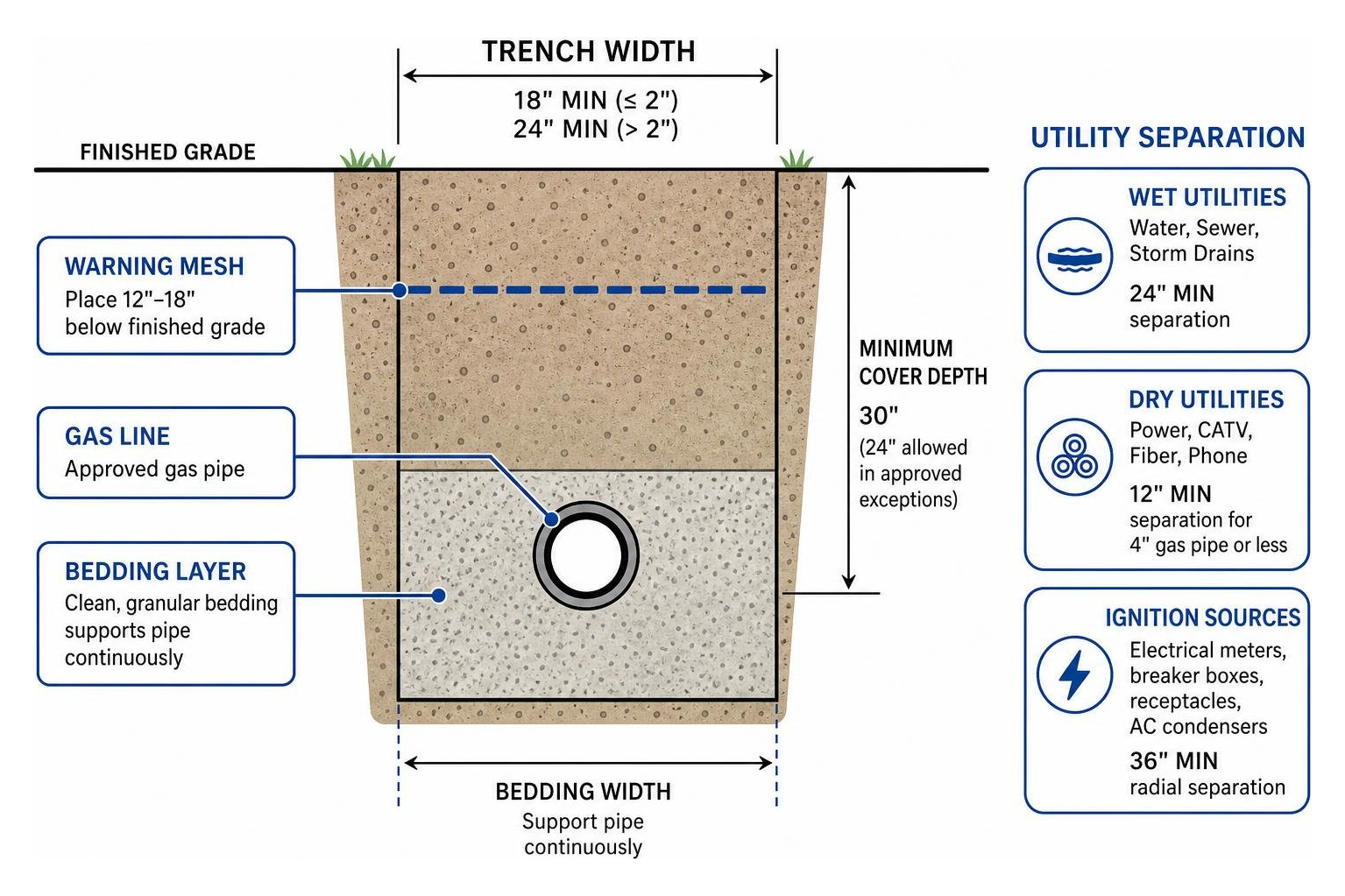
Utility separation rules protect gas infrastructure during future maintenance:
- Wet Utilities: Water, sewer, and storm lines typically require greater separation from gas piping than dry utility conduits.
- Dry Utilities: Electric, CATV, fiber, and phone conduits must be spaced to meet joint-trench requirements.
- Ignition Sources: Gas meters and regulator vents must be located away from electrical equipment and other ignition sources as required by code.
When planning shared utility corridors, Patriot Excavating coordinates electric and gas layouts with safe underground power installation practices.
Trench Preparation, Pipe Laying, and Backfill Standards
A gas-line trench must support the pipe evenly and protect it from sharp rock, frozen soil, and shifting backfill. Trenches deeper than four feet require protective systems such as shoring, shielding, sloping, or benching under OSHA rules. Patriot Excavating follows proven cave-in safety methods to protect crews, structures, and adjacent utilities.
Bedding Layer and Sand Padding Standards
Gas piping should not rest directly on jagged gravel, bedrock, frozen chunks, or construction debris. Point loading can concentrate pressure against the pipe wall and create long-term damage.
A typical Patriot Excavating trench preparation process includes:
- Base Cushion: A clean, rock-free sand bed is placed along the trench bottom to create a level, forgiving pipe support.
- Pipe Support: The pipe route is prepared so the installer can place the line without sags, kinks, or sharp bends.
- Protective Sand Cover: After placement and inspection requirements are satisfied, clean sand is placed around and above the pipe before native soil backfill begins.
Tracer Wire and Warning Mesh Installation
Polyethylene pipe is non-metallic, so standard electromagnetic locators cannot detect it without an added conductor. A continuous tracer wire is installed along the pipe and brought above grade at approved access points so the line can be located before future excavation.
High-visibility yellow warning mesh reading “Caution: Gas Line Buried Below” is also installed above the pipe. The mesh gives future excavators an early visual warning before digging reaches the gas line. Patriot Excavating coordinates the timing of bedding, mesh placement, and backfill with the licensed installer and inspector.
Anodeless Risers and Above-Ground Transitions
Polyethylene gas pipe cannot be exposed above ground because sunlight and physical impact can damage it. The transition from buried PE pipe to above-ground steel piping requires an approved riser assembly installed by the gas professional.
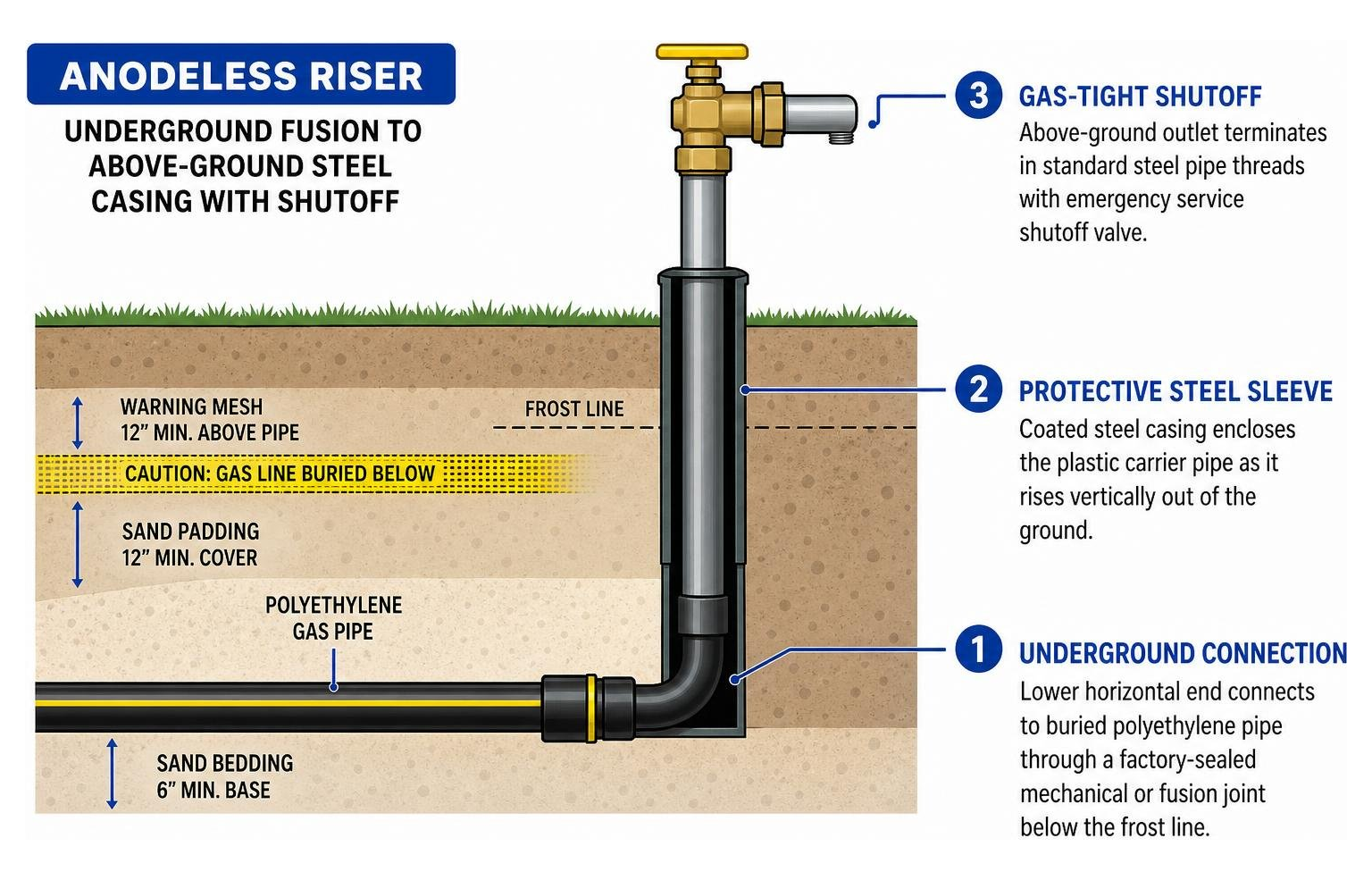
The lower end connects to the buried pipe below grade, while the steel portion rises to the shutoff and service connection. Patriot Excavating prepares the trench and surrounding grade so the riser is accessible, stable, and protected from drainage problems or soil movement.
Pressure Testing, Safety Devices, and Final Commissioning
Before the line is placed into service, the licensed gas contractor must test the piping assembly and secure the required inspection approvals. Patriot Excavating keeps the trench accessible as needed so inspectors can verify depth, bedding, utility separation, tracer wire, warning mesh, and riser placement.
Performing the Pneumatic Pressure Test
Pressure testing is performed by the installer using clean, dry compressed air or an inert gas such as nitrogen. Fuel gas is not used to test a new line. The typical process includes:
- System Isolation: The piping is capped and isolated from appliance valves and utility regulators.
- Gauge Attachment: A calibrated pressure gauge is connected to a test point.
- Pressurization: The system is pressurized to the level required by the applicable authority.
- Hold Period: The line must maintain pressure for the required duration without an unacceptable drop.
- Joint Review: Accessible fusions, threaded joints, and fittings are checked with approved leak-detection solution.
Safety Valves and Meter Clearances
Many new or replaced natural gas service lines require an Excess Flow Valve, which is installed near the supply connection. If the service pipe is damaged downstream, the valve responds to the sudden flow increase and limits uncontrolled gas release. Larger commercial installations may involve additional shutoff equipment required by the utility or local authority.
Clearance around meters, regulators, vents, electrical equipment, openings, and ignition sources must be verified during planning and inspection. Patriot Excavating coordinates grading and trench restoration so final grade does not bury vents, block access, or direct water toward the gas assembly.
Final Inspection and Utility Tie-In
After the line passes the required test and inspection, the utility or approved gas professional completes the tie-in and service activation process. Patriot Excavating then completes backfill in controlled lifts, compacts soil to reduce settlement, and restores the disturbed area. On sloped or drainage-sensitive properties, our erosion control in Indianapolis helps stabilize soil while vegetation or final surface work is completed.
For central Indiana gas-line excavation support, contact Patriot Excavating before schedules are finalized so trenching, inspections, and restoration can be coordinated properly.
Frequently Asked Questions About Underground Gas Lines
How deep does an underground gas line need to be buried?
Depth depends on the authority having jurisdiction, the utility, the gas contractor’s plan, and site conditions. In many central Indiana residential applications, about 30 inches of cover to finished grade is common, but certain rock, easement, right-of-way, or commercial conditions can change the requirement. Patriot Excavating prepares trenches to the approved specifications and coordinates with the installer before backfill.
Why is yellow polyethylene pipe often used for underground installations?
High-density polyethylene is common for buried fuel gas service because it resists soil corrosion and allows fused joints when installed by qualified gas professionals. Its flexibility also helps it tolerate normal ground movement in Indianapolis and central Indiana soils. Because PE pipe is non-metallic, tracer wire and warning mesh are critical parts of a locate-ready installation.
Can a gas line share a trench with water, sewer, or electrical lines?
Gas lines may share a utility corridor only when required separations and inspection standards are met. Wet utilities, dry utilities, communications, electrical conduits, and drainage systems all need careful coordination. Patriot Excavating plans shared corridors with the same attention we bring to sewer, water, and drainage work, helping property owners and contractors avoid conflicts before the trench is opened.
When should I contact Patriot Excavating?
Contact Patriot Excavating as soon as a licensed gas professional identifies the proposed route or service need. Early coordination helps us review access, soil conditions, 811 timing, hydro excavation needs, erosion concerns, inspection sequencing, and restoration planning. Reach out to Patriot Excavating for an estimate on gas-line trenching, utility excavation, or related site preparation in Indianapolis and central Indiana.
Conclusion
Running an underground fuel line safely requires coordination between property owners, licensed gas contractors, inspectors, utilities, and skilled excavation crews. Patriot Excavating supports that process with utility trenching, hydro excavation, controlled backfill, grading, and erosion control for residential and commercial sites throughout Indianapolis, Greenwood, Carmel, Fishers, Noblesville, Franklin, and nearby central Indiana communities.
From 811 coordination and utility exposure to trench preparation and final restoration, our operators focus on safe access, stable soil conditions, and clean execution. If you are planning a utility installation, generator line, outdoor living project, home addition, or commercial site improvement, explore our comprehensive excavation and utility services and contact Patriot Excavating today for an estimate.