
Why Your Yard Needs Proper Drainage
To solve common water problems on your property, a professionally installed drainage trench is the most effective solution. Completing this process correctly demands trained professionals and industry-level equipment, with each step carefully executed to protect your home and landscape for years to come:
- Plan the Route: Determine where water collects, mark the trench path, and always call 811 to locate underground utilities before any work begins.
- Excavate with Precision: Dig the trench to a specific depth and width, maintaining a consistent downhill slope engineered for optimal water flow.
- Install Drainage Components: Line the trench with durable geotextile fabric, add a gravel base, place a perforated drainage pipe, and cover the pipe with more gravel.
- Backfill and Restore: Fold the fabric over the gravel, then backfill the trench with soil, compacting it in layers to prevent settling and restore the landscape.
A soggy yard or standing water in central Indiana is more than an inconvenience; it’s a sign of drainage issues that can erode your home’s foundation. The clay-heavy soils common in the Indianapolis area struggle with water absorption, making a properly installed drainage trench an essential solution.
What’s the difference between a drainage trench and a French drain? While the terms are often used interchangeably, a drainage trench is any channel for moving water. A French drain is a specific type using a perforated pipe, gravel, and fabric to redirect subsurface water—a system particularly adept at intercepting groundwater.
My name is Clay Hamilton, President of Patriot Excavating. With over two decades of expertise in site work and drainage solutions across central Indiana, I understand how to effectively dig a trench for drainage that protects your property for years to come.
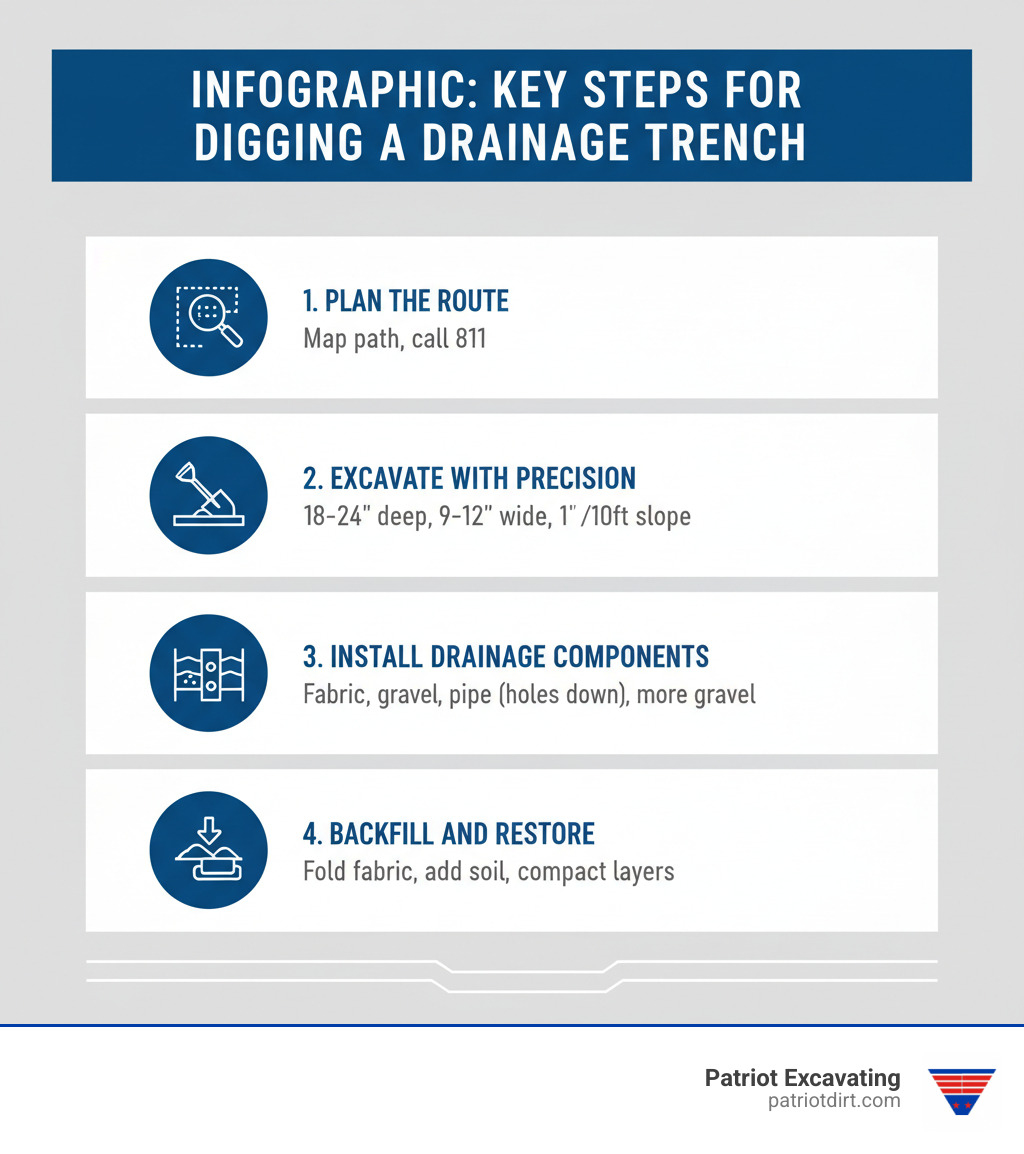
Basic dig a trench for drainage terms:
The Professional Process for Digging a Drainage Trench
Step 1: Professional Planning and Site Assessment
The most critical phase is proper planning. Our process begins with a thorough site assessment to identify where water pools and determine the optimal water flow path for the trench. A successful drainage system requires a consistent downhill slope; we engineer a minimum grade of one inch for every 10 feet, though a steeper slope is often necessary for central Indiana’s dense clay soils to guarantee swift water movement.
For most homes, a properly sized trench is excavated along a precisely marked route, and a laser level is used to ensure the slope stays consistent from start to finish. To protect your home’s structural integrity, the trench is always positioned a safe distance from the foundation.
For deeper insights into proper site grading and preparation, our Excavation Grading Complete Guide walks you through the fundamentals that make any excavation project successful.

Step 2: Ensuring Safety and Site Preparation
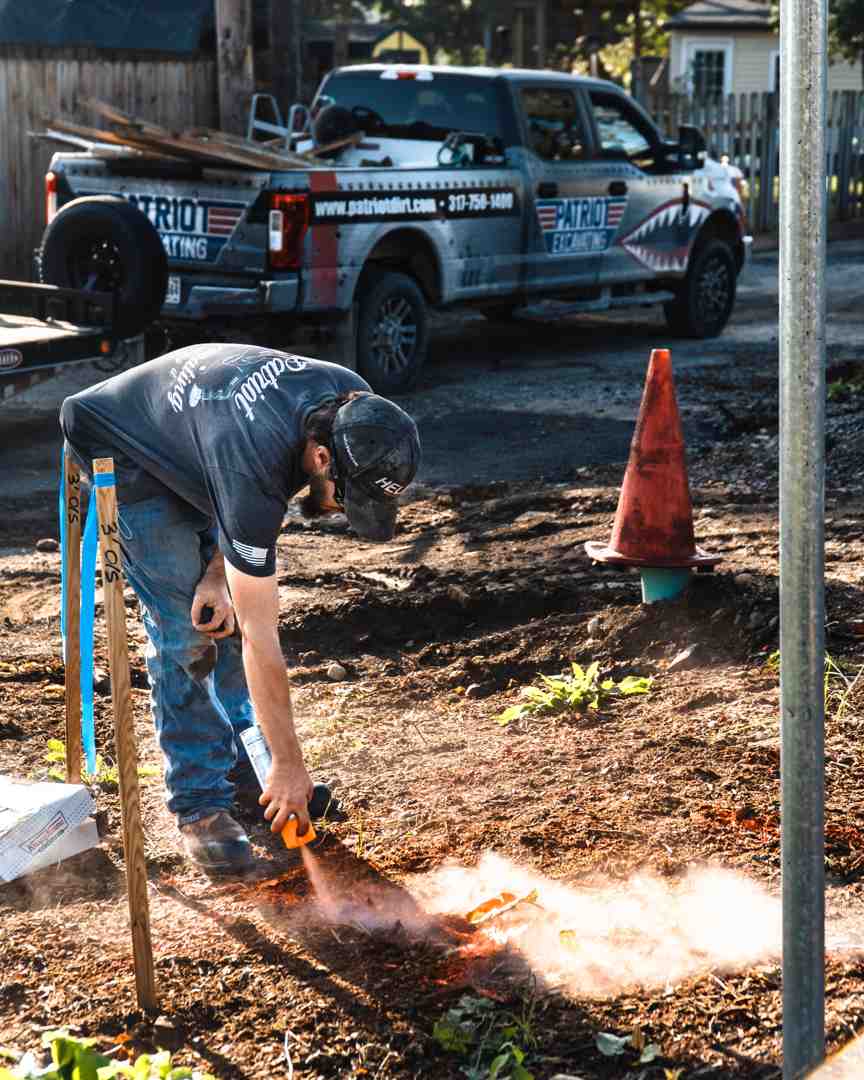
Safety is non-negotiable on any excavation site. Before breaking ground, law requires a call to 811. This free service is required to have all underground utilities professionally located and marked, preventing dangerous and costly accidents involving gas, power, or water lines. Our teams exercise extreme caution when digging near marked utilities, adhering to strict safety protocols.
Trench stability, especially in Indiana’s wet clay, is a serious concern, which is why we follow OSHA’s trench excavation fact sheet to the letter. Proper Personal Protective Equipment (PPE) is mandatory for our entire crew.
Step 3: The Professional Excavation Process
With industry-leading equipment and expert operators, Patriot Excavating provides the precision, safety, and reliability homeowners can’t get from competitors. For most drainage projects, our team utilizes mini excavators, which are powerful enough to handle central Indiana’s notoriously heavy clay soil yet nimble enough to navigate residential properties with minimal disruption. This equipment allows us to maintain a consistent depth and slope, which is nearly impossible to achieve by hand over long distances.
Our experienced operators expertly navigate obstacles like large rocks and dense tree roots, using the proper attachments and techniques to keep the project on track. This professional approach turns a multi-day manual labor project into a swift, precise excavation.
Step 4: Installing High-Performance Drainage Components
With the trench excavated to precise specifications, the installation of the drainage system begins. The trench bottom is smoothed and prepared before being lined with a durable geotextile fabric. This fabric is essential for the system’s longevity, as it prevents silt and soil from infiltrating and clogging the drain.
A 3 to 4-inch base of clean, washed gravel is installed, followed by the perforated drainage pipe. Crucially, the pipe’s perforations must face downward. This allows rising groundwater to enter the pipe efficiently while preventing debris from falling in from above. All pipe sections are securely connected to ensure a seamless, leak-free channel that maintains a consistent downhill slope.
For more on professional pipe installation, see our guide on Sewer Line Installation in Indianapolis.
Step 5: Expert Backfilling and Site Restoration
Proper backfilling is just as important as the excavation itself for ensuring long-term stability. The process begins by covering the pipe with another 3 inches of washed gravel. The geotextile fabric is then folded over the top, completely encapsulating the gravel and pipe to create a self-contained filtration system.
The trench is then backfilled with soil in thin, 4-inch layers. Each layer is mechanically compacted to prevent the ground from settling and creating depressions in the lawn over time. We take care to preserve the original sod whenever possible, allowing for a much faster and cleaner restoration. The final step involves grading the surface with quality topsoil to seamlessly blend the area back into your landscape.
Learn more about our complete Residential Drainage Services in Indianapolis.
Step 6: Common Mistakes That Lead to Drainage Failure
Most drainage systems fail prematurely due to common, avoidable mistakes:
- Improper Slope: An inconsistent or flat slope causes water to stagnate in the trench, rendering the system useless.
- Ignoring Utilities: Failing to call 811 is not only illegal and dangerous but can also lead to catastrophic damage and liability.
- Incorrect Backfilling: Simply dumping soil back into the trench without proper compaction in layers guarantees it will sink and create a new low spot in your yard.
- Wrong Materials: Using soil-filled gravel or omitting the geotextile fabric will cause the system to clog with silt and fail.
Many homeowners underestimate the technical precision and sheer labor required, especially in our heavy clay soils. For a solution that is guaranteed to work, it’s best to trust professionals who bring the right equipment, expertise with local soil conditions, and the liability insurance to handle the job safely and effectively.
Explore our professional Drainage Solutions Indianapolis to see how we can help.
Your Next Step to a Drier, Healthier Property
We’ve covered the essential steps involved in professionally digging a trench for drainage, from planning and excavation to installation and backfilling. A proper drainage system is vital for protecting your foundation and landscaping from water damage, especially in central Indiana’s clay soil.
While the process may seem straightforward, the technical precision, specialized equipment, and challenging soil conditions often lead to failed projects and costly rework. Mistakes like incorrect slope or improper backfilling are common when homeowners or unqualified contractors attempt drainage trenching—and they can completely undermine the system. Bringing in a trained excavation professional is essential for dependable, long-term performance.
Patriot Excavating is a family-owned company with over 20 years of experience serving the Indianapolis area. We understand our region’s unique soil and water challenges. If you’re facing a complex drainage issue or need an expert to ensure the job is done right, we’re here to help.
For comprehensive site work and drainage solutions, trust the team that knows central Indiana.