
How to Add a Sewer Cleanout Without Calling the Pros
Add a Sewer Cleanout for Easier Main-Line Access
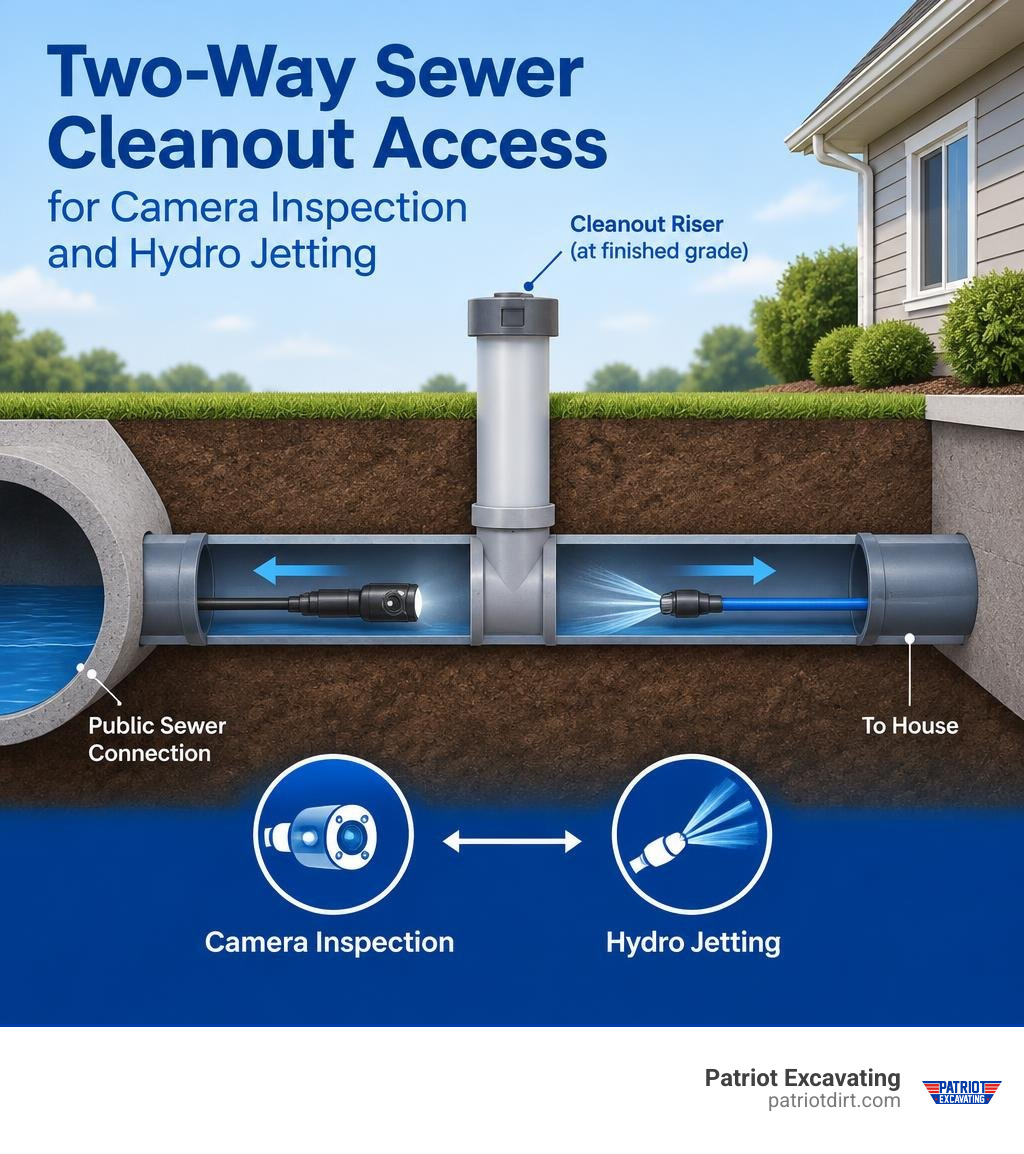
Installing a cleanout on a sewer line requires precision excavation to expose the existing building lateral, cleanly cutting into the pipe, integrating a code-compliant cleanout fitting, extending a capped riser assembly to finished grade, and structurally bedding the entire excavation. A two-way cleanout assembly is widely recognized across central Indiana as the most versatile configuration because it provides unrestricted access for high-definition diagnostic sewer cameras, heavy-duty mechanical root cutters, and high-pressure hydro-jetting equipment toward both the interior drains and downstream toward the municipal main.
Before initiating site excavation, property layouts must be surveyed, utility line locates coordinated via 811, and municipal permitting confirmed across Indianapolis, Marion County, and surrounding communities. The cleanout riser must terminate at an accessible height with an airtight, watertight cap that seals against sewer gases, surface runoff, soil intrusion, and tree roots. Because this installation involves working around active wastewater piping, fragile underground utilities, and variable soil profiles, it requires the specialized machinery, safety protocols, and expertise of professional excavation contractors.
An exterior cleanout gives utility technicians direct ground-level access during routine maintenance or severe sewer emergencies, eliminating the need to bring heavy equipment through finished residential living spaces. Patriot Excavating is a family-owned commercial and residential excavating contractor serving Indianapolis and central Indiana with dedicated sewer repair, precision hydro excavation, utility trenching, grading, and site-development capabilities.
Clay Hamilton, President of Patriot Excavating, brings more than 20 years of hands-on expertise in heavy excavation, underground utility installations, and site mechanical systems. That regional experience guides our comprehensive approach to installing a cleanout on a sewer line safely, efficiently, and with respect for the surrounding landscape.
To ensure your underground drainage network performs reliably, trust Patriot Excavating for professional sewer installation for Marion County properties and comprehensive sewer line installation in Indianapolis. Contact our experienced team today to schedule an on-site evaluation.
Understanding Cleanout Function, System Types, and Strategic Placement
A sewer cleanout is a surface-accessible maintenance portal integrated directly into a primary sewer lateral. It provides mechanical, optical, and hydraulic entry into buried piping without requiring technicians to remove indoor fixtures or disturb finished interiors. By installing durable sewer and water drainage solutions, residential and commercial properties throughout central Indiana establish an access point that simplifies routine diagnostic inspections, clearing operations, and emergency servicing.
When a lateral obstruction develops, clearing the line through an exterior cleanout riser prevents indoor wastewater contamination, protects flooring, and eliminates the need to operate high-pressure hydro-jetting equipment inside living spaces.
| Cleanout Type | Directional Flow Access | Jetting & Snaking Capability | Best Use Case |
|---|---|---|---|
| One-Way (Single Wye) | Downstream only | Excellent downstream cleaning; no upstream access | Straight piping runs, intermediate lateral runs |
| Two-Way (Double-Sweep) | Upstream and Downstream | Complete bi-directional access through one vertical riser | Primary building exit points (3–5 ft outside foundation) |
| Double Cleanout (Opposing Wyes) | Upstream and Downstream | Maximum clearance and gentle sweep for heavy root cutters | Deep burials, commercial sites, high-volume connections |
One-Way vs. Two-Way Cleanout Configurations
A standard one-way cleanout uses a single-sweep wye fitting angled downstream toward the municipal main. While this setup functions reliably for blockages between the cleanout location and the main, it offers no mechanical access back toward the structure’s foundation.
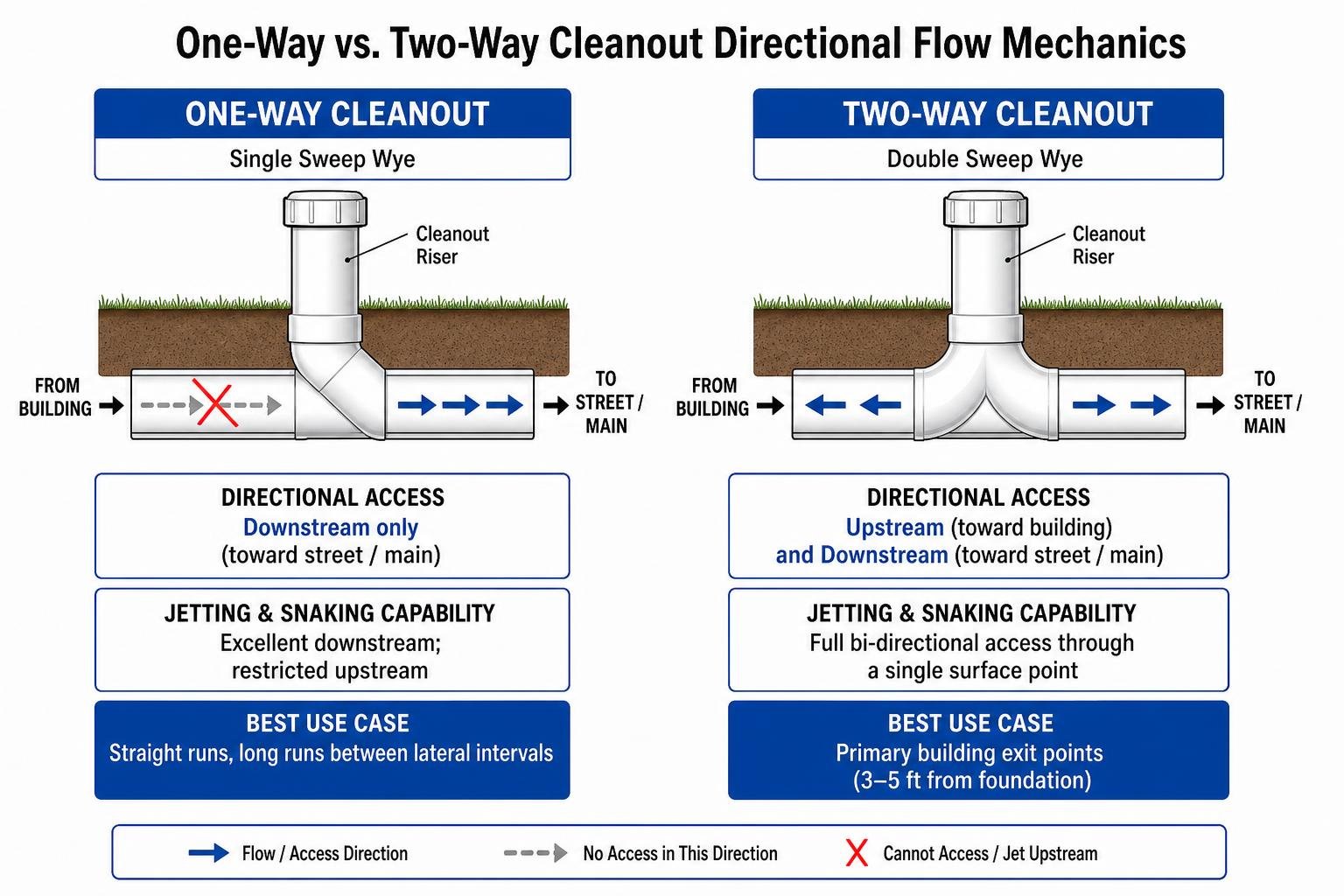
In contrast, a two-way cleanout assembly provides bi-directional access through a single vertical surface riser. This allows Patriot Excavating’s technicians to navigate diagnostic sewer cameras, hydro-jetting nozzles, and mechanical snakes upstream into sub-slab plumbing or downstream through the lateral. When evaluating property configurations, understanding proper sewer vs septic connections enables our team to determine whether a bi-directional assembly or a single-sweep fitting provides the most functional utility access for your drainage setup.
Strategic Placement Along the Sewer Lateral
Plumbing codes and utility standards dictate cleanout positioning:
- Building Exit Point: Positioned 3 to 5 feet outside the foundation footing, capturing the transition where indoor drains meet the exterior sewer lateral.
- Interval Spacing on Extended Runs: On long lateral runs, cleanouts are installed at intervals not exceeding 100 feet to maintain equipment reach.
- Horizontal Directional Changes: Any horizontal turn exceeding 45 degrees requires an upstream cleanout to prevent cables from binding.
- Property Boundaries: Positioning a cleanout near property lines separates private lateral maintenance from municipal infrastructure.
Whether our crews are resolving residential sewer issues in Greenwood or engineering lateral access in Marion County, Patriot Excavating evaluates grading, freeze lines, and site parameters so cleanout access points remain functional year-round.
Planning, Utility Locating, and Regional Code Compliance
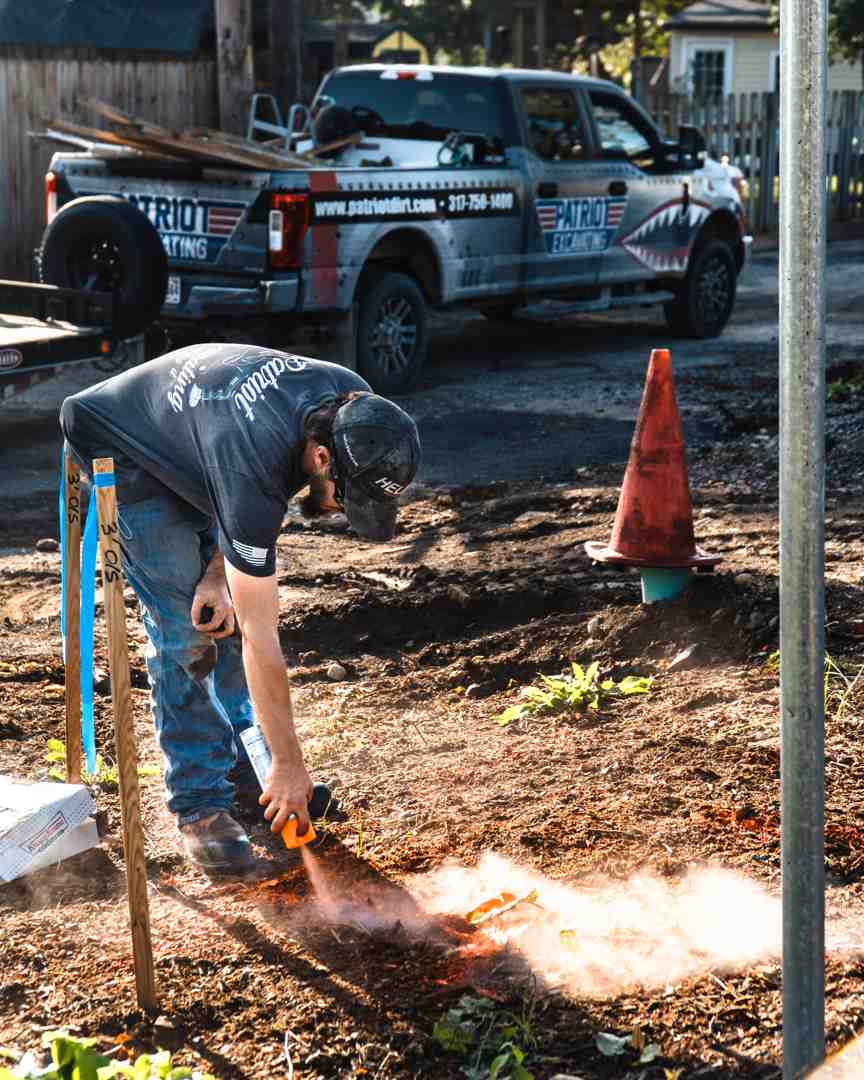
Before breaking ground, detailed site planning and adherence to Indiana safety regulations are mandatory. Excavating around buried utilities without professional preparation risks severe safety hazards and catastrophic utility damage. Striking an underground gas line, electrical conduit, water main, or communication cable disrupts service and creates hazardous site conditions.
In Indiana, submitting an 811 utility locate request prior to excavation is legally required. Utility operators mark buried infrastructure using standardized, color-coded paint and flags. When planning cleanout retrofits or lateral replacements, applying essential utility trenching procedures ensures Patriot Excavating maintains required clearance margins between newly installed cleanout assemblies and existing underground utilities.
Code Requirements Before Installing a Cleanout on a Sewer Line
Plumbing codes and municipal engineering guidelines establish rigorous specifications regarding pipe dimensions, fitting geometries, joint assemblies, and riser accessibility to ensure wastewater flows freely without soil contamination or sewer gas leaks.
Key code parameters verified by Patriot Excavating include:
- Material Compatibility: Utilizing Schedule 40 PVC or SDR-35 sewer pipe, matched with heavy-duty shielded transition couplings when tying into older cast iron or clay lines.
- Directional Fitting Sweeps: Mandating long-sweep directional wyes rather than sharp 90-degree elbows, which create hydraulic turbulence and block equipment.
- Airtight Riser Terminations: Riser pipes must terminate with threaded, gas-tight, and watertight cleanout plugs that maintain a complete seal against surface inflow.
- Permitting and Inspections: Following sewer lateral installation guidelines across Marion County guarantees that all trench dimensions, bedding depths, and pipe assemblies satisfy local building standards.
Site Assessment and Soil Considerations
Glacial till and dense clay dominate central Indiana soils, expanding when saturated and contracting during dry periods. Placing a cleanout directly on uncompacted clay can cause uneven settlement that shears plastic fittings off the lateral.
Understanding professional trenching and excavation methods allows Patriot Excavating’s skilled operators to assess soil load-bearing capacities, manage trench water intrusion, and place angular crushed stone bedding around newly installed components. Providing a continuous gravel envelope beneath and around the wye fitting supports the assembly against freeze-thaw cycles and ground movement. In congested utility corridors, our hydro excavation equipment utilizes pressurized water and vacuum systems to expose buried pipes safely. Contact Patriot Excavating today to plan your site excavation.
Essential Steps Patriot Excavating Uses When Installing a Cleanout on a Sewer Line
Installing an exterior sewer cleanout requires surgical excavation, precise pipe cuts, structurally reinforced connections, and engineered backfill placement. Because lateral retrofits involve cutting directly into functional sewer systems, adhering to proper pipe cut and join standards ensures a robust, root-proof connection built to last.
Precision Excavation and Pipe Preparation
Patriot Excavating’s experienced operators begin by pinpointing the lateral’s depth and alignment:
- Targeted Excavation: We remove overburden soil, switching to non-destructive hydro excavation near sensitive utilities, exposing the target sewer pipe with 12 to 18 inches of working clearance around the entire perimeter.
- Surface Cleaning and Prep: The exterior pipe surface is cleaned to eliminate soil, mineral scale, and biofilm, ensuring couplings achieve a solid bond.
- Precision Pipe Sectioning: Using specialized pipe cutters, operators remove a precisely measured segment of the existing lateral to accommodate the cleanout fitting without placing tension on adjacent pipes.
- Deburring and Beveling: Cut pipe edges are internally deburred to eliminate snags, while external edges are beveled to protect rubber gaskets during coupling installation.
Employing proven trenching and earthmoving techniques protects surrounding foundation footings, driveways, and utility conduits from structural shifting throughout excavation.
Fitting Assembly and Structural Coupling
Once the lateral section is removed, Patriot Excavating integrates the cleanout assembly using code-approved components:
- Solvent-Welded PVC Systems: On modern PVC lines, mating surfaces are treated with primer and welded with heavy-duty solvent cement.
- Shielded Transition Couplings: When connecting new PVC cleanout fittings to legacy clay or cast iron sewer pipes, our crews install stainless-steel-shielded transition couplings to prevent pipe misalignment and shear failure from soil settling.
- Calibrated Torque Fastening: Coupling bands are tightened with calibrated torque wrenches to exact manufacturer specifications, guaranteeing a hermetic, watertight seal.
Professional Installation Best Practices
Every sewer cleanout installed by Patriot Excavating is engineered for durability and serviceability:
- Plumb Vertical Alignment: Riser pipes are set plumb so cameras and mechanical cables feed smoothly into lateral sweeps.
- Grade-Level Finishing: In landscape beds, risers terminate 2 to 3 inches above mulch lines; in lawns, risers are finished flush inside heavy-duty access boxes.
- Anti-Seize Cap Lubrication: Threaded cleanout caps are treated with anti-seize lubricant for effortless opening during future maintenance.
- Geographic Utility Mapping: Applying efficient sewer repair protocols in Fishers and across central Indiana, Patriot Excavating records exact coordinates and depths of newly installed cleanouts for seamless future reference. Contact Patriot Excavating today to discuss your sewer project.
Inspection, Pressure Testing, and Trench Restoration
Before any excavation trench is backfilled, the newly installed cleanout assembly undergoes rigorous quality control and operational testing. Patriot Excavating verifies that all solvent-welded joints, mechanical transition couplings, and riser assemblies perform flawlessly under active operational demand.
Our quality verification process includes:
- Active Hydraulic Flow Testing: Water flow is directed through upstream plumbing fixtures to visually confirm smooth hydraulic transit through the cleanout fitting, ensuring that the directional wye carries waste efficiently without pooling or turbulence.
- Joint Integrity Verification: Mechanical transition couplings and solvent-welded joints are inspected under live flow conditions to ensure complete watertight and airtight integrity, guaranteeing that no subsurface leakage can compromise surrounding soil.
- Diagnostic Camera Verification: When required, an in-line fiber-optic sewer camera is deployed through the newly installed cleanout riser to confirm internal pipe alignment and verify that no interior joint lips or burrs impede flow.
Following successful inspection, structural backfilling and ground restoration proceed systematically:
- Granular Bedding Placement: Washed angular crushed stone or pea gravel is hand-placed underneath the belly of the pipe and thoroughly packed around the wye assembly. This granular bedding envelope locks the fitting firmly in place, prevents void formation, and shields the pipe from ground shifting.
- Lifts and Mechanical Compaction: Excavated soil is returned to the trench in controlled, 6- to 8-inch lifts. Each layer is mechanically compacted using specialized tamping rammers to achieve maximum soil density, preventing post-installation trench depression and sinkholes.
- Surface Grading and Restoration: The trench surface is finished to match surrounding yard contours, ensuring positive surface drainage away from building foundations. Adhering to professional site excavation and utility restoration protocols, Patriot Excavating prepares the disturbed ground for topsoil and seeding so your landscape recovers cleanly. Contact our team to schedule professional trenching and restoration services.
Frequently Asked Questions About Sewer Cleanouts
Where is the best location to position an exterior sewer cleanout?
The optimal location for a primary exterior sewer cleanout is within 3 to 5 feet of the foundation wall, directly along the path where the main sewer stack exits the building. Placing the cleanout adjacent to the foundation gives technicians direct access to both sub-slab interior plumbing and the exterior lateral leading to the municipal main.
Cleanouts should also be positioned clear of pedestrian paths, drainage swales, and dense landscaping. On lateral runs exceeding 100 feet, secondary cleanouts should be installed along the line or near property boundaries to provide complete utility access.
What is the difference between a sewer cleanout and a septic tank access lid?
A sewer cleanout is a narrow access pipe (typically 3 to 4 inches for residential laterals and 6 inches for commercial lines) designed for inserting cameras, snakes, and hydro-jetters into the lateral to clear obstructions.
A septic tank access lid is a wide port (typically 20 to 24 inches in diameter) located over the tank baffles. It accommodates large suction hoses used during pumping operations to extract sludge and scum. Cleanouts cannot be used to pump tanks, and septic lids do not provide functional access for clearing localized clogs within upstream sewer pipes.
How do you properly seal and protect the cleanout riser at ground level?
A cleanout riser must be secured with a code-compliant, threaded male cleanout plug to create a permanent, gas-tight, and watertight seal. This barrier prevents sewer gases from venting outside while stopping storm runoff, debris, and roots from entering the system.
To safeguard cleanout risers from lawn equipment, technicians install flush, countersunk brass plugs or house the assembly inside a heavy-duty ground box. Applying high-grade anti-seize compound prevents corrosion between cap and riser threads. For professional cleanout installation, contact Patriot Excavating today.
Conclusion
Installing a cleanout on a sewer line is one of the most essential upgrades you can make to your property’s underground drainage infrastructure. By creating direct, ground-level access to your primary sewer lateral, a professionally installed cleanout eliminates invasive indoor plumbing disruptions, protects living spaces during emergency sewer backups, and provides seamless entry for diagnostic camera inspections and hydro-jetting equipment.
Whether managing recurring root intrusion, modernizing an older property, or upgrading commercial utility connections, installing a code-compliant cleanout assembly protects your plumbing system for decades. Patriot Excavating provides decades of proven excavation, hydro excavation, trenching, and utility experience across Indianapolis and central Indiana. As a family-owned contractor, our team handles every phase of the project with precision machinery, comprehensive code compliance, and complete site restoration.
Take the proactive step to safeguard your underground utility infrastructure today. Contact Patriot Excavating to request an estimate on our comprehensive excavation and site development services and discover how our experienced team delivers reliable, long-lasting sewer solutions tailored to your property.