
Understanding Underground Septic System Costs Across Central Indiana Properties
What Determines Septic System Planning and Installation in Central Indiana?
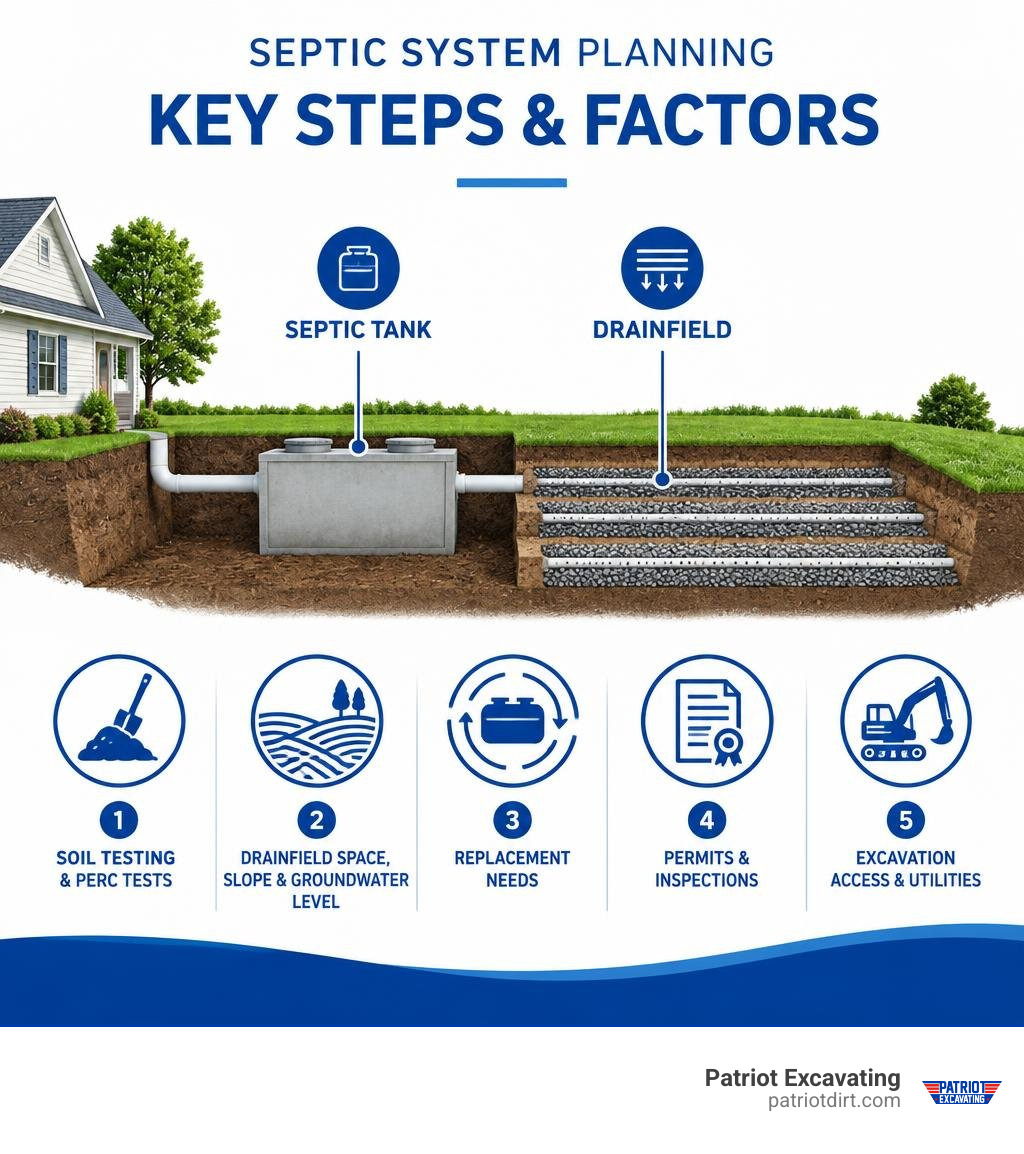
Planning a dependable on-site wastewater disposal setup depends heavily on the physical characteristics of the property. Before initiating a septic installation or replacement in Central Indiana, property owners must evaluate several core technical requirements:
- Soil structure and percolation test evaluations
- Available drainfield area, surface topography, and seasonal high groundwater markers
- Determination of whether the primary tank, absorption field, or complete system requires replacement
- County health department site design criteria, permitting parameters, and mandatory inspection stages
- Heavy equipment access routes, clearance zones, and proximity to buried utility infrastructure
A conventional gravity dispersal design can function reliably on a parcel with deep, permeable subsoil and generous open acreage. However, dense glacial till clay, shallow bedrock tables, high seasonal water tables, restricted lot boundaries, congested utility corridors, or a degraded absorption area demand engineered wastewater solutions. Because every parcel presents unique geological and structural conditions, two neighboring residential properties in Central Indiana often require completely different system designs.
Patriot Excavating is a family-owned commercial and residential excavating company serving Indianapolis and Central Indiana communities throughout Marion, Johnson, Morgan, Hendricks, Hamilton, and Hancock counties. Our team specializes in preparing sites for long-term wastewater infrastructure through heavy earthmoving, precision laser grading, sewer line connections, hydro excavation near sensitive utility corridors, and active erosion control. When advanced ecological filtration is necessary for challenging parcels, working with a qualified Enviro-Septic installer near me guarantees accurate aggregate bedding, precise distribution slope alignment, and full regulatory compliance.
I am Clay Hamilton, President of Patriot Excavating, with more than two decades of practical field experience in heavy excavation, grading, and underground infrastructure. In this guide, I will outline the essential site conditions and technical project phases that allow Central Indiana property owners to plan successful wastewater installations. Navigating every stage of septic system installation requires a thorough evaluation of local soil profiles, environmental permitting, and excavation variables.
Key Factors Influencing Septic System Planning
Planning an underground wastewater system involves balancing multiple engineering and geological variables before earthmoving machinery arrives on site. Reviewing essential guidelines on septic system installation helps clarify how property layout, weather patterns, and structural capacity come together.

Household wastewater volume dictates baseline infrastructure sizing. County health departments across Marion, Johnson, Morgan, Hendricks, and Hamilton counties calculate required capacity using bedroom counts rather than current occupant numbers. A four-bedroom residence generates a larger anticipated volume of daily effluent than a two-bedroom dwelling, necessitating a larger primary precast concrete tank and an expanded subsurface absorption area to handle peak flows safely.
Property layout and boundary constraints also direct component placement. Indiana health regulations enforce strict horizontal separation distances from property boundaries, private drinking water wells, foundation footings, surface water retention ponds, outbuildings, and mature root systems. On smaller residential parcels in communities such as Greenwood, Whiteland, Franklin, Bargersville, and Mooresville, locating a viable absorption envelope that satisfies every regulatory setback requires careful spatial planning. Patriot Excavating maps dedicated machinery access routes, protects surrounding turf from unnecessary compaction, and utilizes non-destructive hydro excavation when operating within congested utility corridors.
How System Type and Soil Impact Septic System Planning
The natural soil underlying your property serves as the primary biological treatment mechanism for residential wastewater. While heavy concrete containment tanks trap settleable solids, fats, and surface scum, the surrounding undisturbed soil performs essential biological filtration, neutralizes pathogens, and disperses treated effluent safely before it rejoins the regional water table.
Central Indiana is characterized by dense glacial-till clay subsoils that pack tightly and restrict natural percolation. When effluent enters heavy clay, water absorption slows significantly. An undersized absorption field installed in slow-draining clay risks surface breakout, strong odors, and plumbing backups. Conversely, excessively coarse gravelly soil can allow wastewater to drain too rapidly before soil microbes have adequate contact time to break down harmful contaminants.
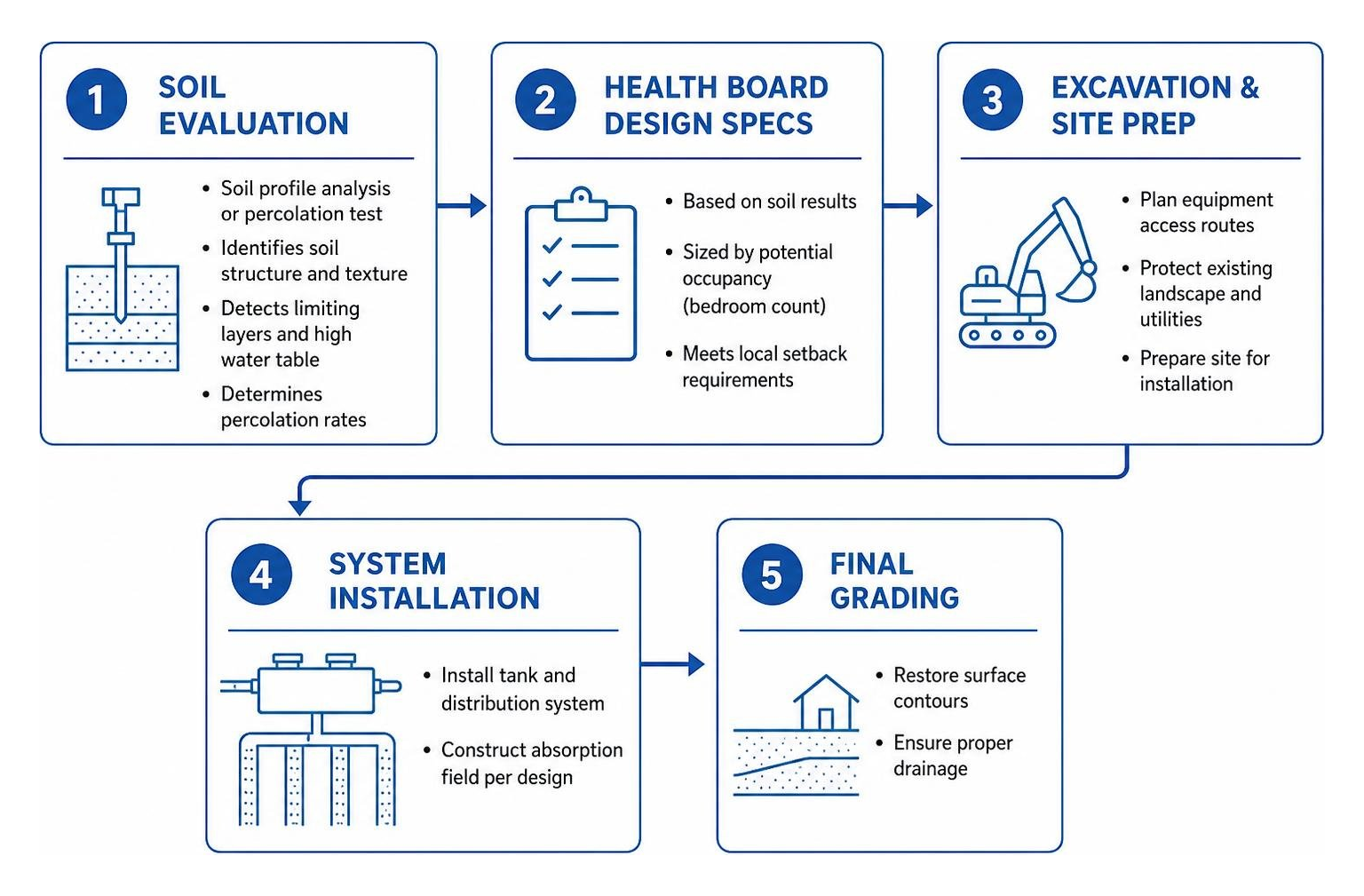
To determine the site’s true absorption capacity, a certified professional soil scientist performs a detailed soil profile analysis or percolation evaluation. This assessment identifies soil horizons, clay content, restrictive hardpan layers, seasonal high water tables, and percolation rates. When site investigations reveal low permeability or shallow water tables, standard gravity trenches cannot provide the vertical separation required by state sanitation standards. Health officials instead mandate engineered designs, such as elevated sand mounds or pressure-dosed networks, which Patriot Excavating installs with strict laser-guided elevation control.
Evaluating Tank Replacement Versus Full Septic System Replacement
When addressing wastewater operational issues, property owners must determine whether the scope of work involves isolated containment tank replacement or an entire absorption field overhaul. When evaluating infrastructure options, comparing municipal sewer vs septic options provides helpful clarity on long-term wastewater planning across rural and suburban properties.
Primary precast concrete tanks are engineered to withstand heavy earth loads for decades, but older tanks can suffer structural deterioration caused by corrosive hydrogen sulfide gas, ground shifting, or physical cracking. If thorough diagnostic testing confirms that the primary vessel has deteriorated while the downstream drainfield remains porous and free-flowing, an isolated tank replacement is the appropriate path forward.
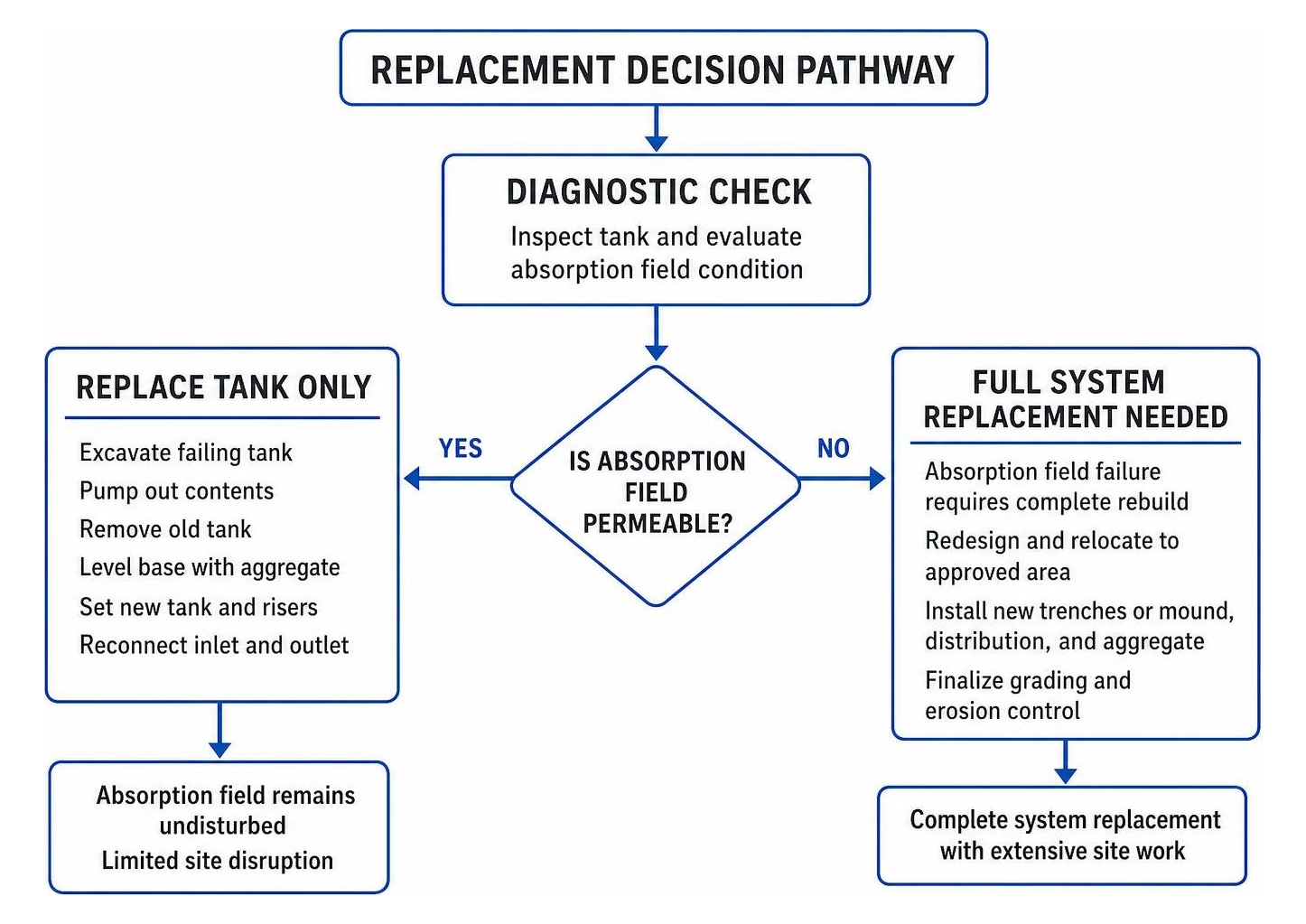
A tank replacement represents a targeted excavation project. The Patriot Excavating team excavates around the compromised vessel, pumps out residual material, extracts the damaged tank, stabilizes the subbase with compacted crushed stone aggregate, sets the new precast concrete vessel, installs watertight risers to grade, and reconnects inlet and outlet piping. A complete system replacement becomes necessary when the absorption field has accumulated heavy biomat slime or suffered mineral blinding over decades of use, requiring a newly engineered dispersal network positioned in an approved reserve area.
Site Evaluation, Permitting, and Excavation Realities
Executing a durable underground wastewater installation requires strict adherence to Indiana administrative codes and local county health ordinances. Partnering with an expert site excavation contractor equips property owners with the specialized heavy machinery, technical laser tools, and earthmoving experience necessary for complex site work.
Permitting represents the critical regulatory stage for every residential and commercial on-site sewage project. County health departments enforce detailed rules governing system dimensions, component specifications, and horizontal setbacks derived from Indiana Department of Health wastewater regulations. Heavy excavation equipment does not break ground until an official construction permit is issued based on approved engineering blueprints and certified soil reports. Patriot Excavating coordinates closely with local health sanitarians throughout Johnson, Morgan, Hendricks, Hamilton, Hancock, and Marion counties to execute installations exactly to approved specifications.
Surface water diversion, precision grading, and erosion control are vital elements of every installation. Subsurface trenching disturbs topsoil layers, leaving exposed earth vulnerable to heavy precipitation and runoff. Patriot Excavating implements silt fencing, surface berms, and temporary diversion ditches to protect the absorption field envelope. After underground tanks and distribution piping are positioned, backfilled, and compacted in lifts to prevent surface depression, our operators execute precision finish grading to divert surface runoff away from the absorption zone.
Soil Testing, Perc Tests, and Engineering Mandates
Before site excavation begins, technical soil testing verifies property feasibility. Indiana environmental health boards require a comprehensive soil morphology analysis performed by a certified professional soil scientist.
During this evaluation, the soil scientist analyzes deep soil core samples or test pits excavated by Patriot Excavating machinery to document soil texture, horizon structure, and seasonal high water tables identified through soil mottling patterns. Indiana health standards mandate a continuous vertical buffer of unsaturated, permeable soil between the bottom of the absorption trench and any restrictive layer or high-water indicator.
If soil testing identifies dense clay hardpan, shallow limestone bedrock, or a high seasonal water table, conventional gravity trenches are prohibited. The county health department requires an engineered wastewater plan specifying aggregate depth, sand filter grading, pipe manifold diameters, hydraulic dosing pressures, and control alarms. Patriot Excavating executes these engineered plans by maintaining exact trench depths with laser leveling systems, using low-ground-pressure tracks to avoid soil compaction, and placing certified washed aggregates.
Site Challenges: Utilities, Tree Clearing, and Site Restoration
Every Central Indiana jobsite presents unique physical obstacles, such as buried electric conduits, gas lines, water mains, and telecommunication feeds. Hitting an underground utility line during mechanical excavation poses severe safety hazards and causes project delays.
To safeguard underground infrastructure, Patriot Excavating utilizes advanced hydro excavation techniques alongside standard mechanical equipment. Hydro excavation uses pressurized water streams to break up soil around sensitive utilities while an onboard vacuum removes the wet slurry without damaging lines. Ensuring proper residential septic tank installation requires this level of care around every buried pipe, cable, and connection.
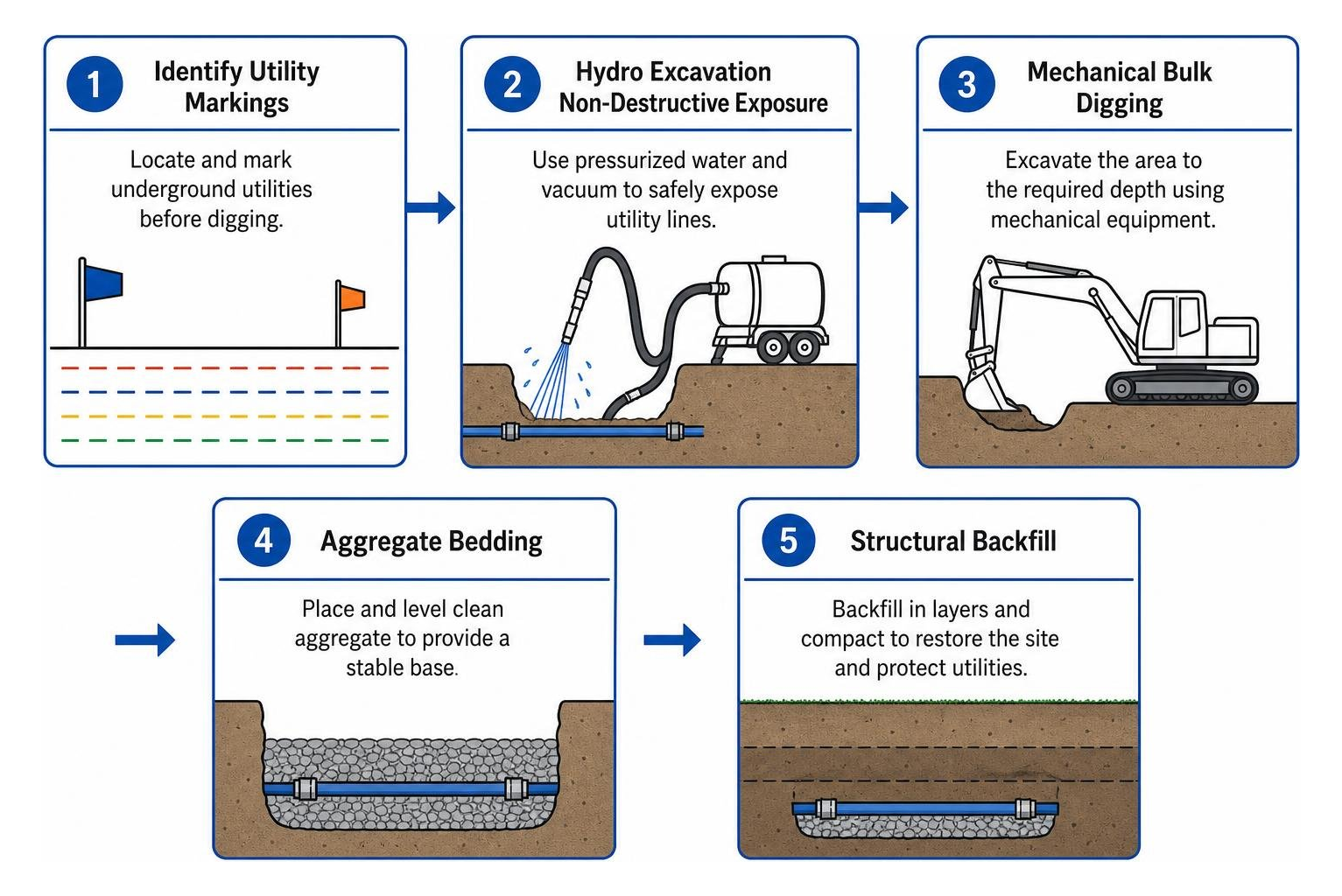
Tree clearing and root mitigation present additional site-work considerations. Mature hardwood trees situated near a planned absorption field must be removed because deep root systems infiltrate pipes, misalign distribution boxes, and clog aggregate void spaces. Patriot Excavating clears timber, removes massive root balls, and excavates subsurface rock shelves. Following underground component installation and health department inspection approvals, our team backfills trenches in engineered lifts, re-establishes topsoil layers, grades the terrain for proper drainage, and applies seed and straw for permanent site stabilization.
Comparing Installation Requirements by Treatment Technology
Every property requires a wastewater treatment design customized to its soil morphology, groundwater level, and lot dimensions. Different technologies address varying environmental limitations, requiring distinct excavation, material placement, and utility connections.

Modern residential wastewater systems fall into three primary categories: conventional gravity distribution, pressure-dosed sand mound setups, and advanced aerobic treatment units. Matching the right technology to site requirements ensures reliable treatment and regulatory compliance.
Conventional Gravity Versus Pressure Dosing Systems
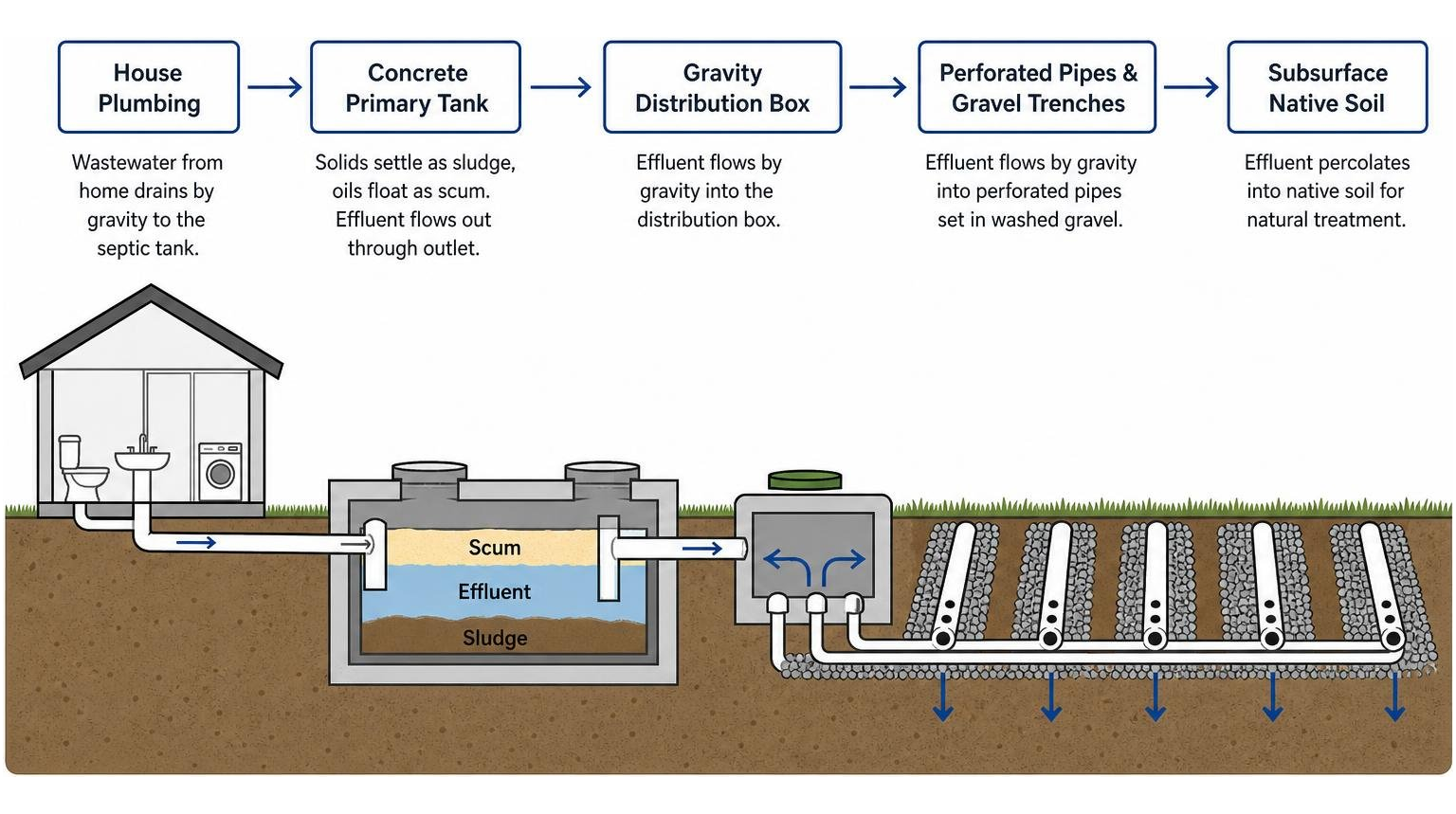
Conventional gravity distribution represents the traditional approach to residential wastewater management. Household plumbing feeds directly into the primary septic vessel, where solids settle as sludge while oils float to form scum. Clarified liquid effluent flows out through a baffled outlet, traveling downhill through solid PVC piping into a concrete distribution box.
From the distribution box, effluent flows naturally into perforated pipes laid in washed gravel trenches or slotted plastic chambers. Gravity systems require no mechanical pumps, but they demand continuous downhill slope and deep, permeable soil with an adequate buffer above seasonal groundwater.
Pressure dosing systems are required when property topography slopes uphill, lot layout restricts gravity flow, or soil requires controlled wastewater dispersal. A pressure-dosed system adds a dedicated pumping chamber directly downstream from the primary tank, housing a submersible pump, float switches, and high-water alarms. When effluent reaches a set level, the pump pushes liquid under pressure into the absorption field. Our team handles the excavation, pump chamber setting, check-valve plumbing, and electrical conduit trenching.
Engineered Solutions: Sand Mounds and Aerobic Treatment Units
When soil evaluations reveal slow-draining clay, shallow limestone bedrock, or high groundwater near the surface, standard subsurface trenches cannot provide adequate filtration. In these environments, engineered solutions like elevated sand mounds or Aerobic Treatment Units (ATUs) are necessary.
An elevated sand mound is an engineered absorption field constructed above natural grade. Our team prepares the native ground without compacting subsoil, imports certified concrete sand to build a filtration platform, beds distribution laterals in washed stone, and caps the core with shaped topsoil.
| System Technology | Ideal Site & Soil Conditions | Key Components & Infrastructure | Excavation & Earthwork Requirements |
|---|---|---|---|
| Conventional Gravity | Deep, permeable soils; low water table; continuous downhill yard slope | Concrete tank, distribution box, perforated pipes, washed drain stone or chambers | Standard trenching, basic slope grading, minimal site disturbance |
| Pressure Dosing | Rolling terrain, uneven grades, moderate soil permeability | Primary tank, dedicated pump chamber, effluent pump, pressure manifold | Dual vessel excavation, electrical conduit trenching, balanced trench grading |
| Elevated Sand Mound | Heavy clay, shallow bedrock, high seasonal groundwater table | Primary tank, pump station, imported certified sand, pressure lateral piping | Extensive site preparation, aggregate hauling, shaped mound grading |
| Aerobic Treatment (ATU) | Small lots, severe setback constraints, sensitive watersheds | Multi-compartment tank, mechanical air compressor, secondary filter media | Deep structural excavation, electrical controls, compact absorption footprint |
Aerobic Treatment Units function like miniature municipal sewage treatment plants. An ATU introduces oxygen into the waste stream using an electric air compressor to cultivate aerobic microorganisms that consume organic waste rapidly. Installing an ATU requires setting multi-chambered precast structures, running dedicated underground electrical circuits, placing aeration equipment, and connecting monitoring alarms alongside our grading and erosion control work.
Frequently Asked Questions About Septic System Planning
Does homeowners insurance cover septic system failure or replacement?
Standard homeowners insurance policies rarely cover the repair or replacement of a failed septic system. Insurance coverage is designed for sudden, accidental occurrences such as severe storm impacts or structural fires. Underground wastewater infrastructure failure is generally classified by insurance underwriters as the result of long-term aging, lack of routine maintenance, or biological saturation of the absorption field over many years.
Specific exceptions may apply when sudden physical damage occurs, such as an external vehicle accidentally crushing an underground concrete tank, severe uprooted trees damaging distribution pipes during a major wind event, or optional buried utility service line endorsements. These utility endorsements may help cover mechanical excavation and repair work for compromised utility lines. However, standard policies do not cover replacing an aged, biomat-clogged absorption field. Maintaining complete records of professional installations, system expansions, and routine maintenance is essential for documenting infrastructure condition.
How often should a tank be pumped to prevent total system failure?
For an average single-family home, a primary containment vessel should be professionally pumped and inspected every 3 to 5 years. Frequency depends on total household occupancy, tank capacity, and daily wastewater habits. Coordinating routine septic tank cleaning services on a steady schedule is the single most effective way to safeguard your downstream absorption field.
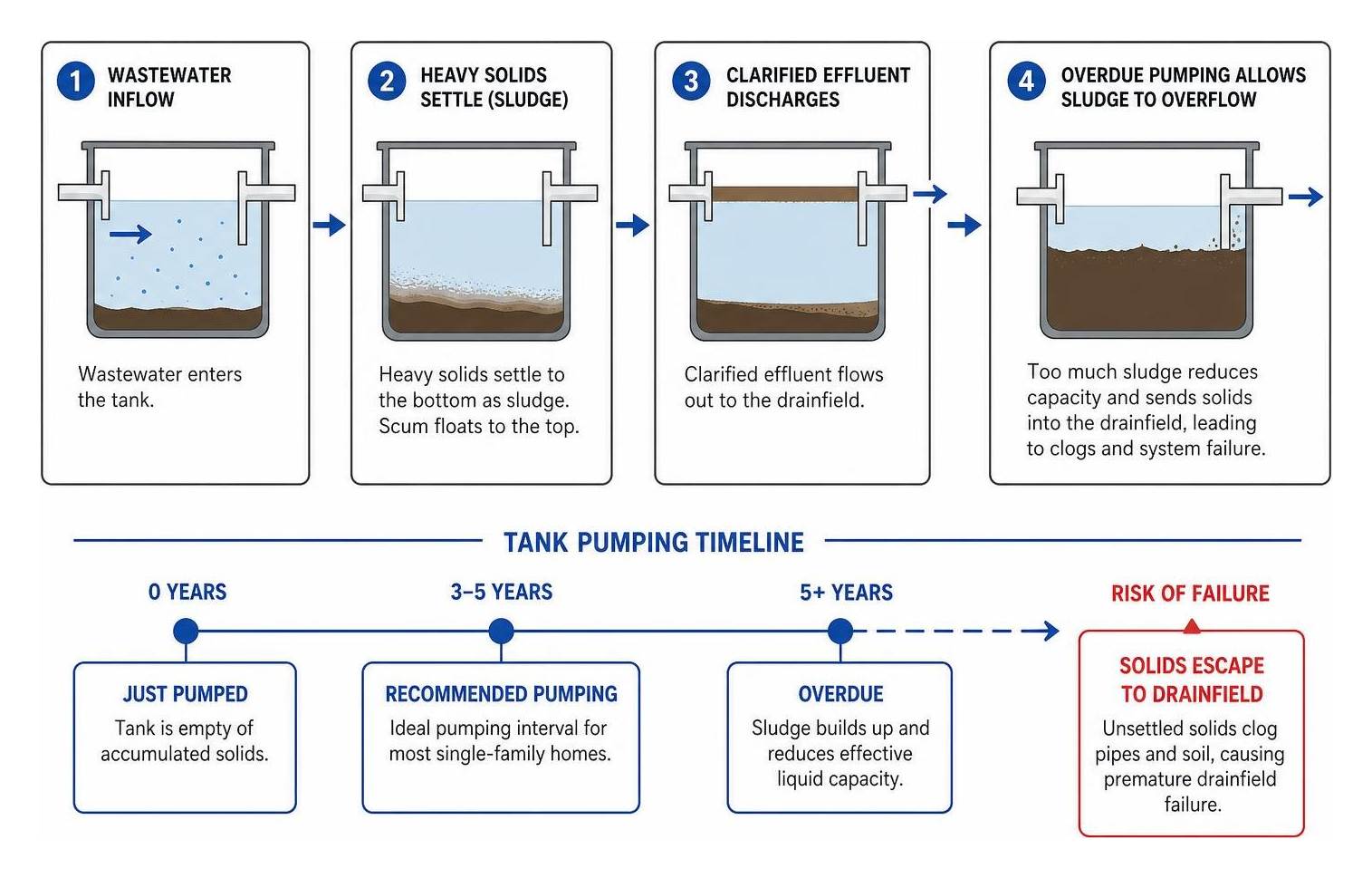
Inside the primary vessel, anaerobic bacteria break down organic materials, but non-biodegradable solids accumulate as sludge. Over time, this sludge layer shrinks the effective liquid volume of the tank, pushing unsettled solids and grease directly into your absorption field and causing premature drainfield failure. Pumping removes accumulated solids before they can migrate downstream.
Why are engineered mound systems more complex to install?
Elevated sand mound systems are more complex than conventional gravity setups because they are precision-engineered structures built above ground.
The installation process requires multiple specialized stages:
- Delicate Site Preparation: Our excavation crew removes surface brush and scarifies native turf without compacting underlying soil using low-ground-pressure machinery.
- Bulk Material Management: Constructing a sand mound requires trucking in and placing specialized, certified concrete sand meeting strict permeability specifications, followed by layers of clean aggregate.
- Mechanical and Electrical Integration: Mounds require a dedicated pump station, high-head effluent pumps, check valves, and calibrated pressure pipes for even distribution.
- Structural Grading and Erosion Control: Once distribution pipes are covered with geotextile fabric, the structure is capped with loam topsoil, crowned to shed surface rainwater, and stabilized with seed and straw.
Conclusion
Installing or replacing an underground septic system across Central Indiana requires careful management of soil conditions, environmental health regulations, site grading, and underground infrastructure. From managing dense clay subsoils in Johnson, Morgan, Hendricks, and Hamilton counties to working safely around buried utility lines using hydro excavation, every step demands practical site-work expertise.
Patriot Excavating is a family-owned commercial and residential excavating company serving Indianapolis and Central Indiana. We bring extensive hands-on experience in precision excavation, land clearing, finish grading, erosion control, hydro excavation, and water and sewer installations. Whether you are preparing ground for new construction or dealing with an aging absorption field, our team coordinates every phase of site preparation to ensure your infrastructure is built to last.
Contact Patriot Excavating today to schedule a site evaluation and request a comprehensive project estimate for your property. Discover how our professional site-development and excavation services deliver dependable wastewater solutions across Central Indiana by exploring our professional septic installation and repair capabilities.