
Everything Homeowners Must Know About Septic System Installation
Planning and Site Evaluation for Septic Systems
Septic system installation is a multi-phase engineering process that begins with rigorous soil morphology evaluation, advances through technical design and county permitting, and culminates in precision excavation, tank placement, drainfield construction, and health department verification. Because the native soil functions as the primary biological filter for domestic wastewater, every reliable installation hinges on an accurate understanding of the subterranean environment. Once site suitability is confirmed, professional installers obtain municipal and health permits, establish a stable sub-base bedding layer, construct the absorption lateral field using washed aggregate or specialized filtration media, and perform final laser grading. At Patriot Excavating, our comprehensive site development expertise pairs detailed soil science with complete earthmoving capabilities, ensuring that your on-site wastewater infrastructure operates smoothly, safely, and dependably across central Indiana properties for decades.
Soil Morphology and Site Assessment
Before heavy excavation machinery arrives on your jobsite, a certified soil scientist and our site specialists conduct a comprehensive soil morphology analysis. Native soil is an active biological treatment matrix responsible for neutralizing pathogens, filtering suspended solids, and dispersing treated effluent back into subterranean aquifers. A detailed soil investigation determines the precise subterranean horizons across your property, confirming that the subsoil can safely handle the projected daily wastewater volume without risking groundwater contamination or surface ponding.
Our Central Indiana site assessment protocol evaluates critical subterranean and geographic factors:
- Soil Profile and Texture Variations: We examine distinct horizons below the surface, mapping the distribution of sand, silt, and dense clay. Glacial till soils common across Johnson, Marion, Hamilton, Hendricks, Morgan, and surrounding counties require thorough evaluation to determine true percolation rates and long-term absorption efficiency.
- Percolation Rates and Permeability: Measuring the hydraulic conductivity of the soil horizons determines how rapidly effluent moves downward, directly dictating trench depth, overall lateral footage, and system configuration.
- Seasonal High Water Table Identification: Redoximorphic features—mottling and distinctive soil color patterns resulting from prolonged water saturation—indicate the highest seasonal groundwater levels. Identifying these horizons ensures we construct absorption fields that maintain mandatory vertical separation above the water table.
- Restrictive Layers and Dense Horizons: Shallow bedrock, dense fragipans, or heavy clay layers prevent downward water percolation. When encountered, our team engineers specialized sand mounds, elevated absorption fields, or alternative treatment configurations to overcome these natural barriers.
Homeowners building or expanding on rural and semi-rural acreage frequently weigh the long-term infrastructure benefits of septic vs sewer systems. When municipal utilities are unavailable, private on-site systems offer complete, self-contained wastewater management. Because Patriot Excavating provides complete site preparation, we seamlessly coordinate soil testing with comprehensive property clearing, structural excavation, driveway grading, and stormwater drainage planning.
Permits and Engineering Requirements for Septic System Installation
On-site wastewater installations are strictly regulated by local health departments and environmental agencies throughout central Indiana. Every municipality enforces exacting public health codes to safeguard regional aquifers, streams, and neighboring properties. A successful installation requires an engineered blueprint tailored specifically to your parcel’s topography, soil morphology, property setbacks, and anticipated daily household flow rates.
Navigating regulatory standards requires direct collaboration between licensed installers, registered professional engineers, and local health sanitarians:
- Permit Applications and Engineering Review: We coordinate with sanitarians and engineers across central Indiana counties, submitting detailed system designs that align with calculated daily wastewater loads and regulatory design standards.
- Mandatory Setback Compliance: County health codes mandate strict horizontal separation distances. Wastewater components must remain isolated from potable water wells, property boundaries, building foundations, utility corridors, swimming pools, and natural bodies of surface water.
- Utility Coordination and Hydro Excavation Safety: Before breaking ground, our team coordinates comprehensive 811 utility locates. When working in proximity to buried gas, electric, or telecommunication lines, we utilize advanced hydro excavation to expose underground utilities safely without mechanical strike risks.
Our extensive background in managing commercial and residential site infrastructure throughout central Indiana allows us to expedite the permitting process and maintain full compliance with local regulatory guidelines. For additional technical background on decentralized treatment infrastructure, the Onsite sewage facility overview provides detailed information on standard dispersal methods used in residential settings.
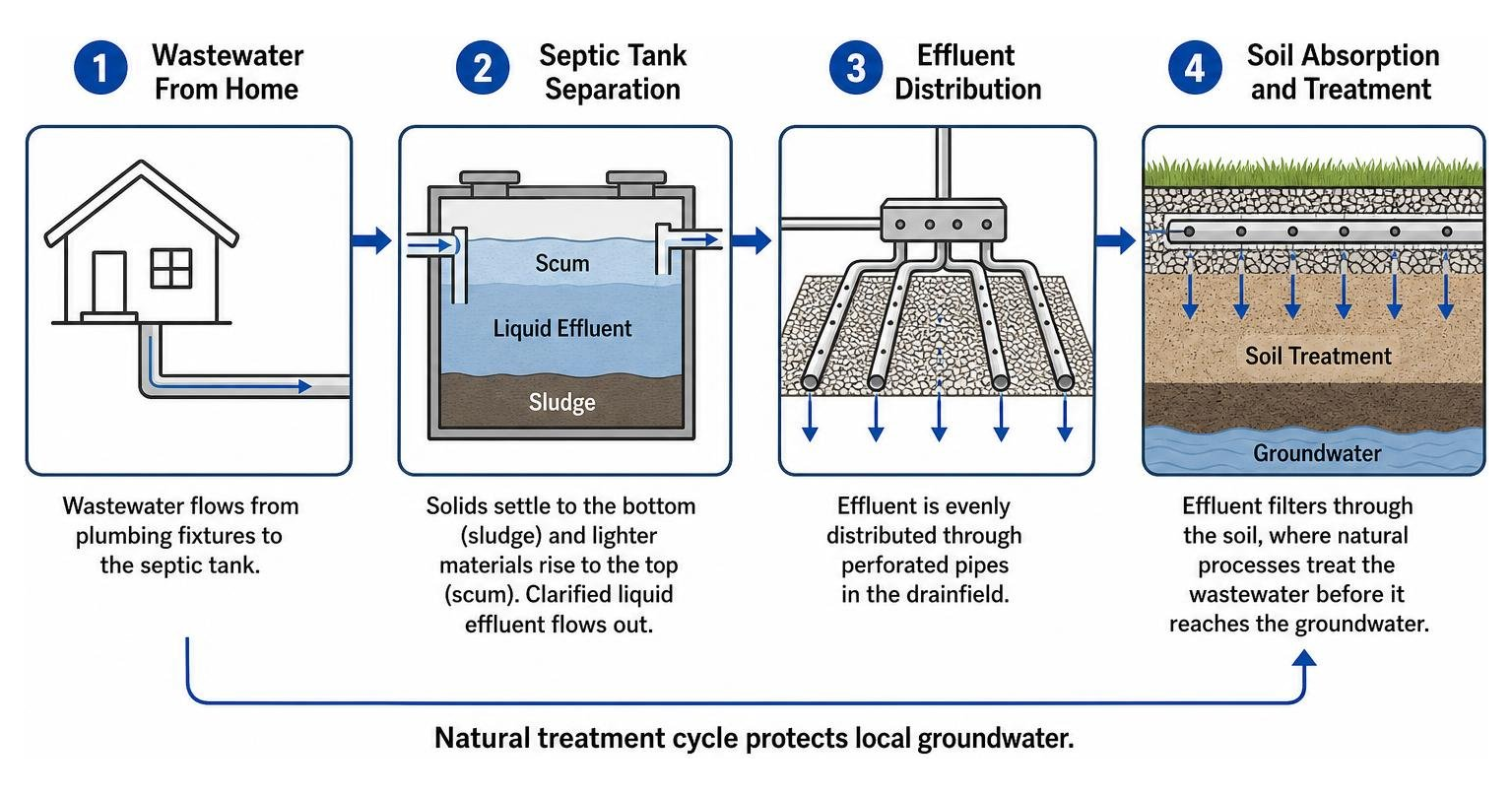
Comparing On-Site Wastewater System Types
Every parcel of land presents distinct topographic elevations, soil textures, and spatial constraints. Selecting the appropriate wastewater treatment configuration depends entirely on empirical data gathered during initial soil testing and topographic surveying. An engineered system must achieve an optimal balance between hydraulic capacity, soil absorption capability, and long-term serviceability.
| System Type | Best Suited For | Key Operational Characteristics | Soil & Site Considerations |
|---|---|---|---|
| Conventional Gravity | Deep, well-drained soils with low seasonal water tables | Relies entirely on natural gravity fall from tank to absorption laterals | Requires sufficient downhill slope and deep, permeable native soil layers |
| Pressure Distribution | Variable soil depths, sloping terrain, or irregular lots | Utilizes a dedicated pump chamber to dose effluent uniformly across trenches | Prevents localized saturation and extends drainfield life in variable soils |
| Sand Mound Systems | High seasonal water tables, shallow bedrock, or dense clay | Constructed above natural grade using specialized sand fill for filtration | Requires a larger surface footprint and precise engineered sand selection |
| Chamber Systems | Compact properties or sites with restricted machinery access | Open-bottom high-density plastic chambers replace stone aggregate | Provides flexible trench configurations and reduces overall soil disturbance |
Advanced Treatment and Enviro-Septic Options
When standard gravity trenches or traditional gravel absorption fields cannot overcome challenging site constraints—such as dense clay horizons, high water tables, or compact lot boundaries—advanced treatment technologies provide superior alternatives. Aerobic Treatment Units (ATUs) introduce regulated oxygen into a dedicated secondary treatment chamber, cultivating aerobic bacteria that break down organic waste significantly faster and more thoroughly than standard anaerobic digestion, resulting in clear effluent suited for specialized dispersal.
Similarly, passive advanced filtration systems—such as those installed by certified enviro septic installers and presby certified installers—combine secondary biological treatment and soil dispersal within a single compact footprint. These systems use specialized corrugated pipe wrapped in non-woven geotextile fabric and coarse sand, treating effluent to exceptionally high purity levels before it contacts the natural subsoil. These advanced solutions protect sensitive aquatic environments while substantially reducing the physical footprint required on constrained properties.
Our comprehensive capabilities in sewer, water, and subsurface earthmoving ensure that advanced wastewater systems integrate flawlessly into your overall site plan. For an in-depth reference on primary sedimentation and anaerobic digestion, the Septic tank reference details standard liquid separation mechanics used in modern residential applications. Reach out to Patriot Excavating to schedule a comprehensive site evaluation and discover the ideal wastewater configuration for your property.
Step-by-Step Professional Septic System Installation Process
Installing an on-site wastewater management system requires surgical earthmoving accuracy, laser-guided grading, and strict adherence to engineered depth profiles. A minor error in base compaction, tank leveling, or lateral slope can disrupt hydraulic flow, cause effluent pooling, or lead to premature drainfield failure. As a seasoned site excavation contractor, Patriot Excavating executes an exacting construction sequence designed to preserve the natural permeability of the surrounding soil while creating a resilient, long-lasting wastewater network.
Tank Placement and Pipe Connection Standards
The primary septic tank serves as the primary settling chamber for household wastewater. Whether the approved engineering specifications call for heavy-duty precast concrete vessels or lightweight, corrosion-resistant high-density polyethylene models, installation demands precise site preparation:
- Sub-Base Excavation and Bedding: We excavate the tank pit to engineered elevations, removing unstable native soil and installing a compacted six-inch bedding pad of crushed stone or coarse sand. This level foundation prevents settling that could shear inlet or outlet pipe connections.
- Precision Laser Leveling: The tank must sit perfectly level along both horizontal axes. A tilt of even two degrees can compromise internal baffle performance, accelerate uneven sludge accumulation, or permit premature solids to discharge into the drainfield.
- Watertight Seals and Effluent Filtration: Sanitary inlet tees and outlet baffles are installed with watertight rubber boot gaskets. We incorporate an integrated effluent filter inside the outlet baffle, creating a secondary physical barrier that traps suspended solids before they can reach the absorption field.
- Uniform Pipe Slopes and Hydro Excavation: Sewer lines connecting the home foundation to the septic tank are set to a precise pitch of one-quarter inch per foot to maintain optimal self-cleaning velocity. Where lines intersect existing underground utilities, we deploy hydro excavation to safely daylight lines without risking mechanical damage.
Our specialized methodology for residential septic tank installation ensures that all pipe penetrations, access risers, and tank seams remain sealed against seasonal groundwater infiltration.
Drainfield Construction and Final Grading in Septic System Installation
Following tank setting and distribution box placement, our crews begin constructing the absorption lateral field. Soil protection during this phase is paramount to preserve the ground’s natural hydraulic conductivity:
Our heavy equipment operators never traverse open trench bottoms with tracked excavators or loaded haulers. Compacting or smearing moist clay subsoil crushes natural soil pores, destroying the subgrade’s absorption capacity.
We place clean, washed aggregate and perforated distribution pipe according to engineered slope calculations, covering the media with breathable geotextile fabric to prevent backfill silt from entering the stone reservoir. After county health officials conduct their mandatory open-trench visual inspection, our operators backfill the site in uniform, uncompacted lifts.
Our final grading operations shape positive surface slopes that channel stormwater runoff away from the absorption area, protecting the subsurface field from excess saturation. Property owners in Johnson County and surrounding regions rely on our specialized craftsmanship for franklin in septic installation and regional site development. Contact our office today to discuss your site plans and receive a professional project estimate.
Maintaining System Health and Long-Term Performance
A professionally engineered and installed septic system can provide dependable service for decades when supported by proactive household care and regular professional maintenance. Implementing disciplined preventative stewardship protects your investment, prevents costly structural repairs, and preserves the purity of local groundwater reserves.
Protecting your subterranean wastewater infrastructure involves simple yet critical practices:
- Establishing Routine Pumping Intervals: Settleable solids settle to the bottom of the septic tank as heavy sludge, while oils and greases float to create a buoyant scum layer. Scheduling routine septic tank cleaning every three to five years clears these accumulated solids before they can migrate out of the tank and clog absorption lateral pores.
- Safeguarding Drainfield Surfaces: Heavy vehicular traffic, accessory structures, paved driveways, and livestock must be kept off the absorption field. Heavy surface loads compact the subsoil and crush distribution laterals. Furthermore, plant only shallow-rooted turfgrass over the drainfield; avoid planting large trees or taproot shrubs whose root structures can penetrate pipe joints.
- Practicing Water Stewardship: Spreading laundry cycles throughout the week prevents sudden hydraulic surges that can disturb settling inside the tank. Promptly repair leaking plumbing fixtures, as a continuous toilet leak can deliver hundreds of unnecessary gallons to your drainfield daily, causing system saturation.
- Protecting Biological Treatment: Avoid flushing harsh chemical solvents, automotive fluids, antibacterial agents, oil-based paints, or non-biodegradable hygiene wipes down drains. These compounds destroy the natural anaerobic and aerobic microbial colonies required to break down organic waste inside the tank and drainfield.
If you observe slow drains, sewage odors, or pooling surface water near your absorption field, our team can assess your property to determine whether the problem stems from line obstructions, settling issues, or surface drainage complications. Contact Patriot Excavating to schedule a consultation with our site specialists.
Frequently Asked Questions About Septic Systems
How long does the on-site wastewater installation process take?
The physical construction phase—including excavation, sub-base preparation, tank placement, distribution lateral installation, health department inspection, and final grading—generally takes our crew three to six working days, depending on weather and parcel conditions. However, the comprehensive timeline spans four to eight weeks, factoring in initial soil morphology testing, professional engineering design, and county health department permit approvals. Coordinating site excavation early in your property development schedule prevents unnecessary administrative delays.
Why is licensed professional installation critical for on-site wastewater systems?
On-site wastewater installations involve complex environmental engineering, strict health department compliance, and the operation of heavy excavation machinery. Improper trench depths, unlevel tank bedding, incorrect pipe pitch, or soil smearing from heavy equipment will cause premature system failure, plumbing backups, or wastewater surfacing in your yard. Licensed excavating contractors possess the precision laser equipment, hydro excavation safety technology, earthmoving machinery, and regulatory expertise required to build a code-compliant, durable system that protects your property and local groundwater.
What parameters dictate required septic tank capacity?
Septic tank capacity is governed by local county health codes and is calculated based on total bedroom count and projected daily fixture load rather than the immediate number of occupants. Health codes require adequate liquid volume to ensure sufficient hydraulic retention time for solid separation. In central Indiana, residential properties typically require a baseline tank capacity of 1,000 to 1,250 gallons for up to three bedrooms, with additional capacity mandated for each additional bedroom or specialized high-volume plumbing fixture.
How does property grading impact drainfield longevity?
Surface drainage directly influences subsurface absorption field performance. If roof downspouts, driveways, or adjacent slopes direct stormwater across the drainfield area, the soil becomes hydraulically overloaded. Patriot Excavating integrates positive swales, diversion berms, and laser-guided grading around every absorption field to redirect surface runoff safely away from the treatment area.
Conclusion
Patriot Excavating is a family-owned commercial and residential excavating company proudly serving Indianapolis and communities throughout central Indiana. We deliver complete site development solutions tailored to our region’s specific soil profiles, environmental regulations, and sanitary standards. From initial land clearing, laser grading, and erosion control to sanitary sewer installation, hydro excavation, and precision earthmoving, our team brings decades of field expertise to every project.
Installing a new septic system or upgrading an aging wastewater configuration requires thorough planning, strict adherence to engineering specifications, and skilled equipment operation. When you need dependable site excavation from a dedicated team that prioritizes quality craftsmanship and code compliance, explore our complete septic installation and repair solutions. Contact Patriot Excavating today to discuss your site development goals and request an estimate for your upcoming project.