
Mastering the Art of Driveway Grading: A Comprehensive Guide
Why Driveway Grading Is Essential for Long-Lasting Results
Driveway grading is the process of shaping your driveway to ensure proper drainage and a stable, smooth surface. It involves creating a precise slope and a solid foundation to prevent water damage, potholes, and erosion. A properly graded driveway not only improves curb appeal but also protects your property’s value.
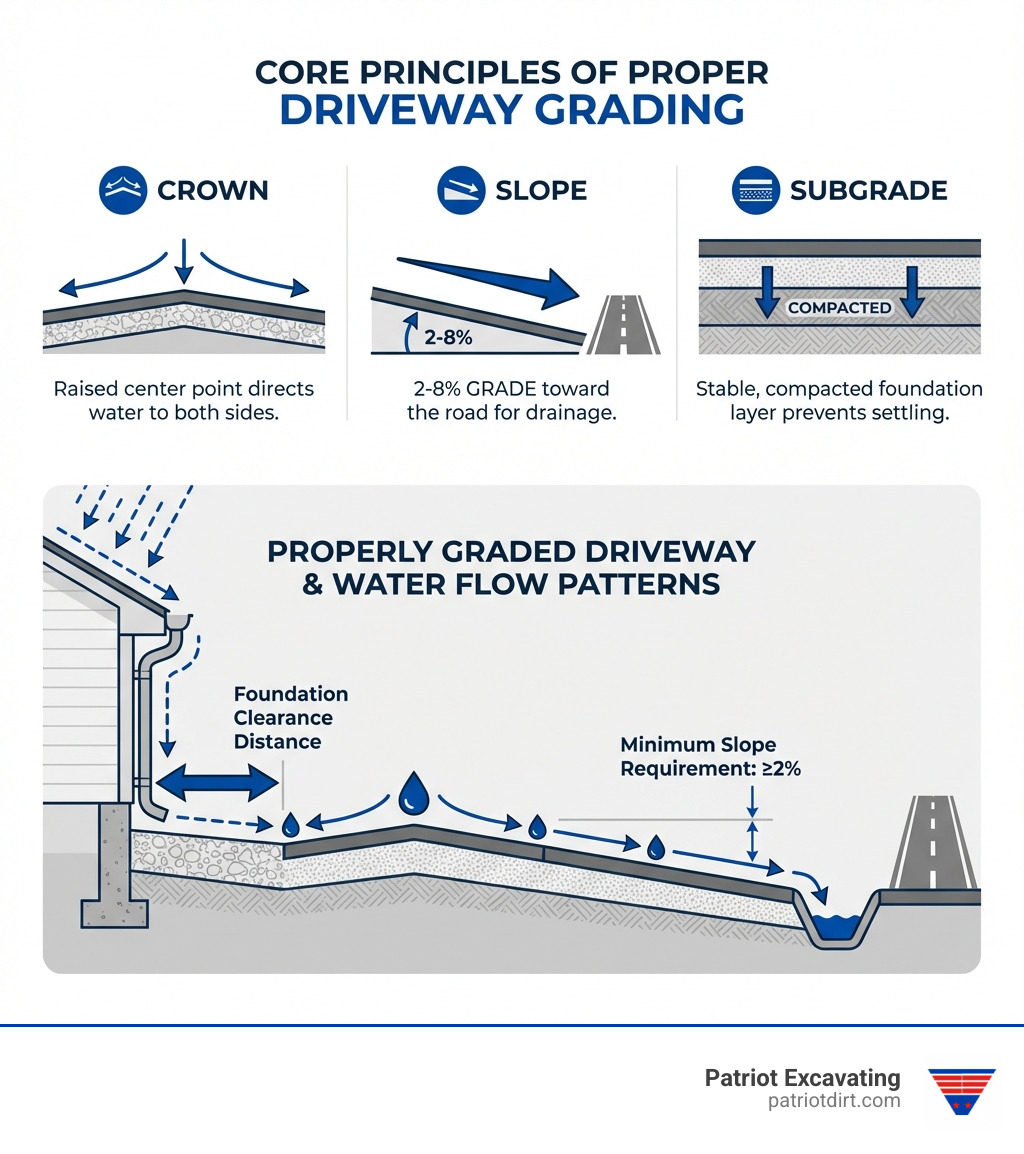
Key aspects of professional driveway grading include:
- Correct Slope: A 2% to 8% slope toward the road is essential for drainage.
- Central Crown: A high point in the center sheds water to the sides.
- Stable Subgrade: A compacted foundation prevents settling and damage.
- Water Direction: Runoff is directed away from your home and garage.
In Central Indiana, freeze-thaw cycles can destroy a poorly maintained driveway. Proper grading is the key difference between a surface that lasts for decades and one that fails within a few years. Without it, you risk pooling water, washouts, and costly foundation damage.
I’m Clay Hamilton, President of Patriot Excavating. With over two decades of experience in the Indianapolis area, I’ve seen that proper grading is the foundation of a durable driveway. Our team specializes in comprehensive site work, ensuring every project we undertake is built to withstand Indiana’s challenging weather.
The Fundamentals of Proper Driveway Grading
Recognizing the Telltale Signs: When to Grade Your Driveway
With Central Indiana’s weather, even well-built driveways show wear. Acting on early warning signs can prevent costly repairs. Here’s how to know it’s time for driveway grading:
- Potholes and Ruts: These hazards form where water erodes the base, making driving difficult and unsafe. If your driveway is an obstacle course, it needs attention. Learn more in our guide on How to Repair a Pothole in Gravel Driveways.
- Washboard Effect: Ripple-like bumps across the surface create a rough ride and signal a breakdown in surface integrity, often due to poor compaction.
- Standing Water: Puddles that linger after rain are a red flag for improper grading. This water weakens the foundation and leads to bigger problems.
- Loose Gravel: If gravel is scattering to the sides or thinning out in the middle, the driveway’s crown and compaction have likely failed.
- Uneven or Sunken Surface: A driveway that appears lower than it used to or has an awkward transition to the garage needs regrading to restore its shape and function.
Ignoring these signs leads to further deterioration and more expensive fixes. Prompt driveway grading is key to protecting your investment.
The Critical Role of Subgrade and Drainage
A durable driveway is built on two cornerstones: a solid subgrade and effective drainage.
The subgrade is the underlying soil that acts as the driveway’s ultimate foundation. It must be properly compacted to provide stable, uniform support. If we encounter soft spots during excavation, we remove and replace them with stable material to prevent future settling and structural failure.
Drainage is equally critical, as water is the primary enemy of any driveway. Proper driveway grading controls water flow by:
- Creating a Crown: A high point down the center of the driveway allows water to shed to both sides.
- Establishing a Slope: The entire driveway is sloped between 2% and 8% toward the road, ensuring water never pools on the surface.
- Protecting Foundations: Most importantly, grading directs water away from your home and garage. This is vital for preventing erosion and foundation damage, especially with the heavy rain and snowmelt in the Indianapolis area. Explore this topic further in our articles on The Crucial Role of Proper Drainage and Drainage Work Around Foundation.
A stable subgrade and smart drainage are non-negotiable for a driveway that lasts.
Driveway Grading vs. Land Leveling: Understanding the Difference
Though both involve moving earth, driveway grading and land leveling have different goals. Understanding this distinction is key for your Central Indiana property.
- Land Leveling aims to create a perfectly flat, uniform surface with zero slope. This is ideal for projects like sports fields or agricultural plots where evenness is the priority.
- Land Grading is about shaping the land to a specific slope. For driveways, this is not about making it flat but about creating a precise pitch to control water flow. We create a crown and a consistent 2-8% slope to direct water away from your home and prevent pooling.
A driveway that is simply leveled will become a pond during the first rain. It requires expert grading to ensure proper drainage and prevent erosion and water damage. For a durable driveway that protects your home, you need grading, not leveling. Learn more in our article on Land Grading vs. Land Leveling: Key Differences Explained.
A Step-by-Step Guide to Professional Driveway Grading
Achieving a long-lasting driveway requires precision, experience, and the right equipment. While minor fixes can be done by hand, professional mechanical grading is essential for durable results in Central Indiana. Here is our approach:
- Site Assessment: We start by evaluating the site, identifying drainage problems, and planning the final grade. The area is cleared of all debris.
- Excavation: For new or damaged driveways, we excavate 7 to 12 inches to create a solid base. Our expertise in Driveway Excavation and Grading Indianapolis ensures this is done with precision.
- Loosening and Redistributing Material: On existing gravel driveways, we use heavy equipment to break up compacted material, addressing potholes and ruts.
- Establishing the Subgrade: We shape and compact the underlying soil to create a stable foundation, removing any soft spots to prevent future settling.
- Adding New Aggregate: If needed, new aggregate is spread evenly to ensure a consistent, durable layer.
- Shaping the Crown and Slope: We carefully sculpt the driveway to create the central crown and the 2-8% slope, ensuring water sheds away from structures.
- Final Compaction: Using heavy rollers, we compact the entire surface. This locks the aggregate in place, creating a dense surface that resists washboarding and withstands heavy traffic and Indiana’s freeze-thaw cycles.
Material Matters: Grading for Different Driveway Types
The principles of a stable subgrade and proper drainage are universal, but the specifics of driveway grading vary by material. Each surface—gravel, asphalt, or concrete—requires a custom approach.
- Gravel Driveways: These rely heavily on grading for longevity. A well-defined crown and a 2-8% slope are critical. Regular grading is needed to redistribute gravel, fix ruts, and maintain the shape.
- Asphalt Driveways: The subgrade preparation is paramount. It must be perfectly graded and compacted before a base layer of crushed stone is added. Any flaws in the foundation will eventually show through the asphalt.
- Concrete Driveways: Like asphalt, concrete demands an exceptionally stable and well-drained subgrade. The ground is excavated, graded for slope, and compacted before a gravel base is laid. This prevents cracking and settling.
No matter the material, a perfectly prepared base is the key to durability. We ensure impeccable grading for any surface as part of our Driveway Construction Indianapolis services.
Maintenance and Timing: How to Preserve Your Driveway
Regular maintenance is crucial for extending your driveway’s lifespan, especially with Indiana’s harsh weather. Timely driveway grading is the most important part of that upkeep.
How often should a gravel driveway be graded? We recommend grading a gravel driveway twice a year: once in the spring and once in the fall.
- Spring Grading: Repairs damage from winter’s freeze-thaw cycles, fixing ruts and potholes.
- Fall Grading: Smooths the surface before winter, ensuring proper drainage to prevent ice buildup and damage.
Frequency may vary based on traffic and weather severity. More frequent grading might be needed if you notice recurring issues.
Why is neglecting grading a bad idea? Ignoring grading allows small problems to become major, costly ones. Consequences include:
- Worsening potholes and ruts.
- Severe erosion and material loss.
- Water damage to your home’s foundation.
- A significantly shorter driveway lifespan.
- Safety hazards for people and vehicles.
Proper driveway grading is the best preventative measure against potholes and ruts, as it ensures water drains correctly instead of eroding the surface.
Ensure a Perfect Grade with Professional Expertise
A properly graded driveway improves safety, prevents water damage, and extends the life of your investment. Achieving this in Central Indiana’s unique conditions requires professional equipment and deep knowledge of soil and water flow. DIY grading often leads to improper slopes and poor compaction, causing the very problems you’re trying to prevent.
At Patriot Excavating, we specialize in comprehensive site preparation. Our team brings decades of experience, state-of-the-art equipment, and proven techniques to every project. We build foundations that last, starting with a perfect grade. When you partner with us, you get the peace of mind that comes from knowing your property is in expert hands.
Ready to build a driveway that stands the test of time? Learn how we Get Your Land Leveled and Graded by Experts. For professional driveway excavation and grading in the Indianapolis area, trust our team to deliver lasting results. Contact us to discuss your project today.