
Mastering the Flow: Best Drainage Systems for Poured Concrete
Why a Concrete Drainage System Matters Before You Pour
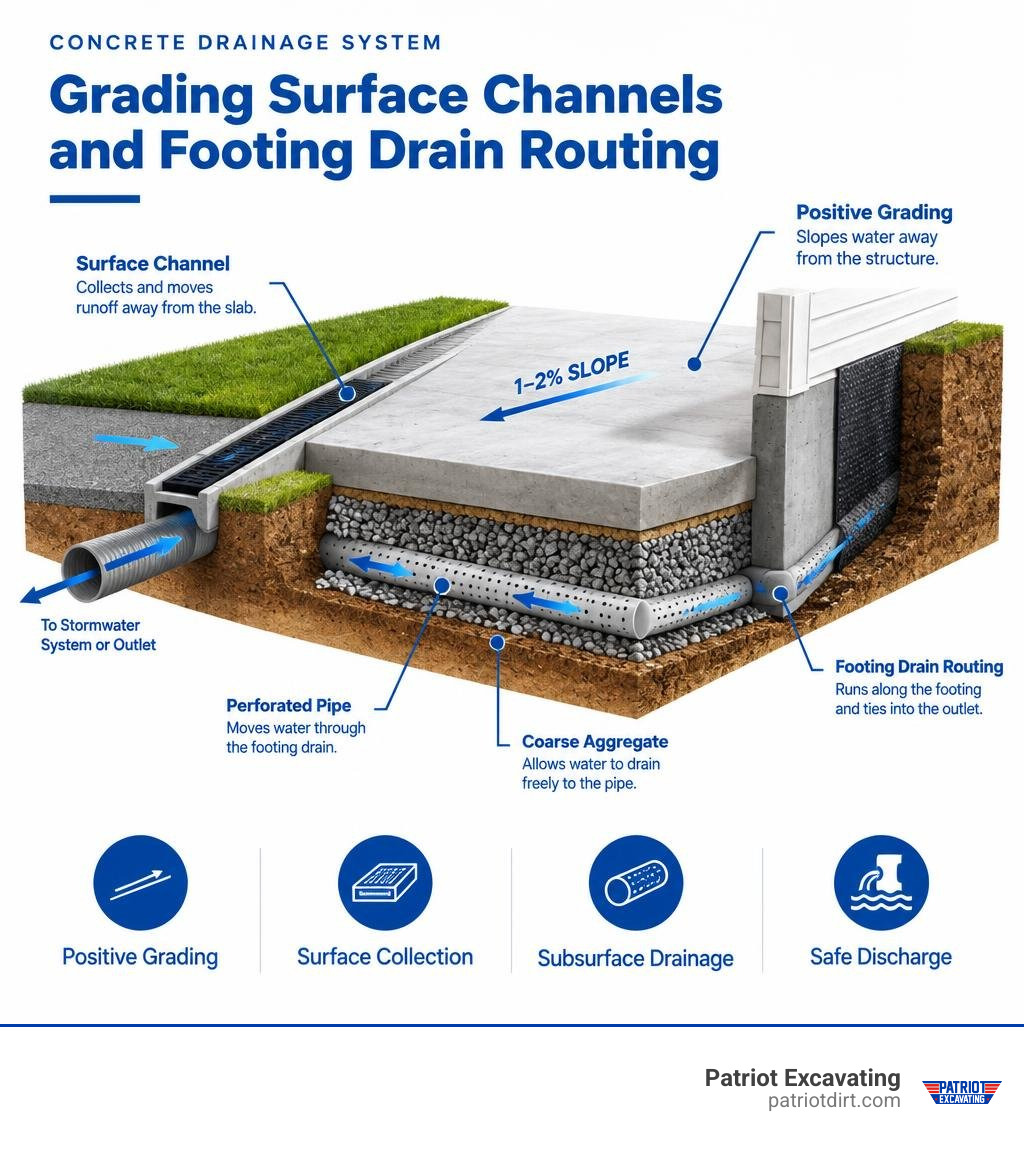
A concrete drainage system moves surface and underground water away from slabs, footings, driveways, and pavement before moisture can pool, erode the sub-base, or exert severe hydrostatic pressure against a structural foundation. In commercial developments and residential construction across central Indiana, poured concrete requires an integrated drainage framework that protects the structural integrity of flatwork and foundations long before the first ready-mix truck arrives on site. An effective layout combines four fundamental engineering pillars:
- Positive Surface Grading: Establishing continuous fall that channels runoff away from slabs and foundation footers at a calculated 1% to 2% slope (a 10 to 20 mm drop per linear meter).
- Surface Interception: Strategically positioning trench drains, slotted flumes, channel drains, and heavy-duty catch basins where water accumulates across large impervious slabs.
- Subsurface Water Relief: Installing smooth-interior perforated collector pipes, washed angular drainage stone, and geotextile filter fabric around footings and below interior slabs.
- Engineered Discharge Routing: Connecting collector networks directly to municipal storm mains, detention ponds, engineered bioswales, or approved gravity outfalls.
Water does far more than leave surface puddles on newly cured concrete. In the dense clay soils common throughout Indianapolis, Carmel, Greenwood, and Plainfield, standing water infiltrates subgrade soils, causing differential settlement, severe slab cracking, footing rotation, and premature surface spalling. When drainage is neglected during early site balancing, subgrade saturation creates structural failures across both residential flatwork and heavy industrial pavement. Professional site preparation and excavation must coordinate grading, subgrade compaction, underground utility placement, and final discharge routing before concrete is poured.
I am Clay Hamilton, President of Patriot Excavating, with over two decades of hands-on leadership in site excavation, mechanical infrastructure, and site coordination. Our family-owned team partners with commercial general contractors, developers, and homeowners across Indianapolis and central Indiana to engineer dependable concrete drainage system foundations through precision grading, sewer infrastructure, hydro excavation, and erosion control.
Explore our specialized site preparation and drainage services:
For a deeper understanding of surface hydrology and precipitation flow dynamics across paved surfaces, the surface runoff entry provides valuable background on the water movement principles that guide our site grading and excavation strategies.
Core Engineering of an Effective Concrete Drainage System
A concrete drainage system succeeds or fails based on fundamental hydraulic calculations, geotechnical subgrade stability, and material selection. Whether our operators are prepping a high-load logistics loading dock in Plainfield, a retail center in Fishers, or an expansive residential driveway in Greenwood, water must follow an unobstructed, engineered path.
Designing a Cast-in-Place Concrete Drainage System
Designing a cast-in-place concrete drainage structure begins with topographic survey analysis, soil classification, and layout geometry. In central Indiana, glacial till soils such as Crosby and Miami silt loams exhibit high plasticity and slow percolation rates. If the subgrade underneath a concrete slab becomes unevenly saturated or is improperly compacted, the flatwork will shift, heave during winter frost cycles, and crack prematurely.
To eliminate standing surface runoff, our grading crews establish positive site slope across every square foot of flatwork. The standard engineering benchmark requires a continuous 1% to 2% fall away from building perimeters, foundation walls, and heavy slabs. Mastering these fundamentals begins with understanding practical drainage systems basics, which emphasize how site elevation gradients dictate runoff velocities and downstream flow paths.

When calculating hydraulic flow through cast-in-place channels, flumes, and valley gutters, the concrete cross-section must maintain a self-cleaning velocity between 2.5 and 6 feet per second. This flow speed prevents sediment accumulation without causing hydraulic scouring or eroding adjacent subgrade soils. Patriot Excavating uses laser-guided grading and heavy compaction machinery to carve precision channel trenches, stabilizing subgrade soils with compacted aggregate base courses before concrete forming crews assemble their work.
Integrating a Polymer Concrete Drainage System for High-Load Areas
While traditional site-poured concrete flumes work well for open swales and perimeter curb lines, high-traffic commercial environments require tighter manufacturing tolerances, lower permeability, and extreme dynamic wheel-load resistance. In loading docks, commercial distribution hubs, and heavy equipment storage yards across Indianapolis and Noblesville, modular polymer concrete trench systems provide superior structural performance.
Polymer concrete replaces traditional water-and-Portland-cement paste with synthetic polyester or vinyl ester resin matrices mixed with graded quartz aggregates. This composition delivers exceptional physical characteristics:
- Compressive Strength: Polymer concrete channels regularly achieve compressive strengths exceeding 95 to 98 MPa (roughly 14,000 psi), far outperforming standard structural concrete mixes.
- Flexural and Tensile Capacity: Flexural ratings reach up to 26 MPa, absorbing cyclic vibrations from heavy vehicle traffic without micro-fracturing.
- Zero Moisture Penetration: With water absorption ratings as low as 0.07%, these channels do not absorb standing liquids, making them immune to severe Midwestern freeze-thaw spalling.
- Chemical and Thermal Resistance: Polymer formulations resist salts, fuels, industrial oils, and weak acids while offering non-flammable ratings that meet strict building codes.
- High Load Class Ratings: According to EN 1433 load classifications, these systems easily satisfy Class D (56,200 lbs) through Class F (up to 200,000+ lbs), making them ideal for heavy equipment yards, loading bays, and airport aprons.
Our excavation crew executes the deep trenching, structural concrete encasement beds, and bedding haunches required to lock these modular channels into place. By anchoring the channel with proper alignment pins and vibrating structural backfill around the modular units, we ensure the entire assembly withstands punishing wheel-impact forces for decades. Contact Patriot Excavating today to request an on-site consultation and project estimate for your excavation, grading, and drainage needs.
Primary Drainage Solutions for Slabs, Footings, and Flatwork
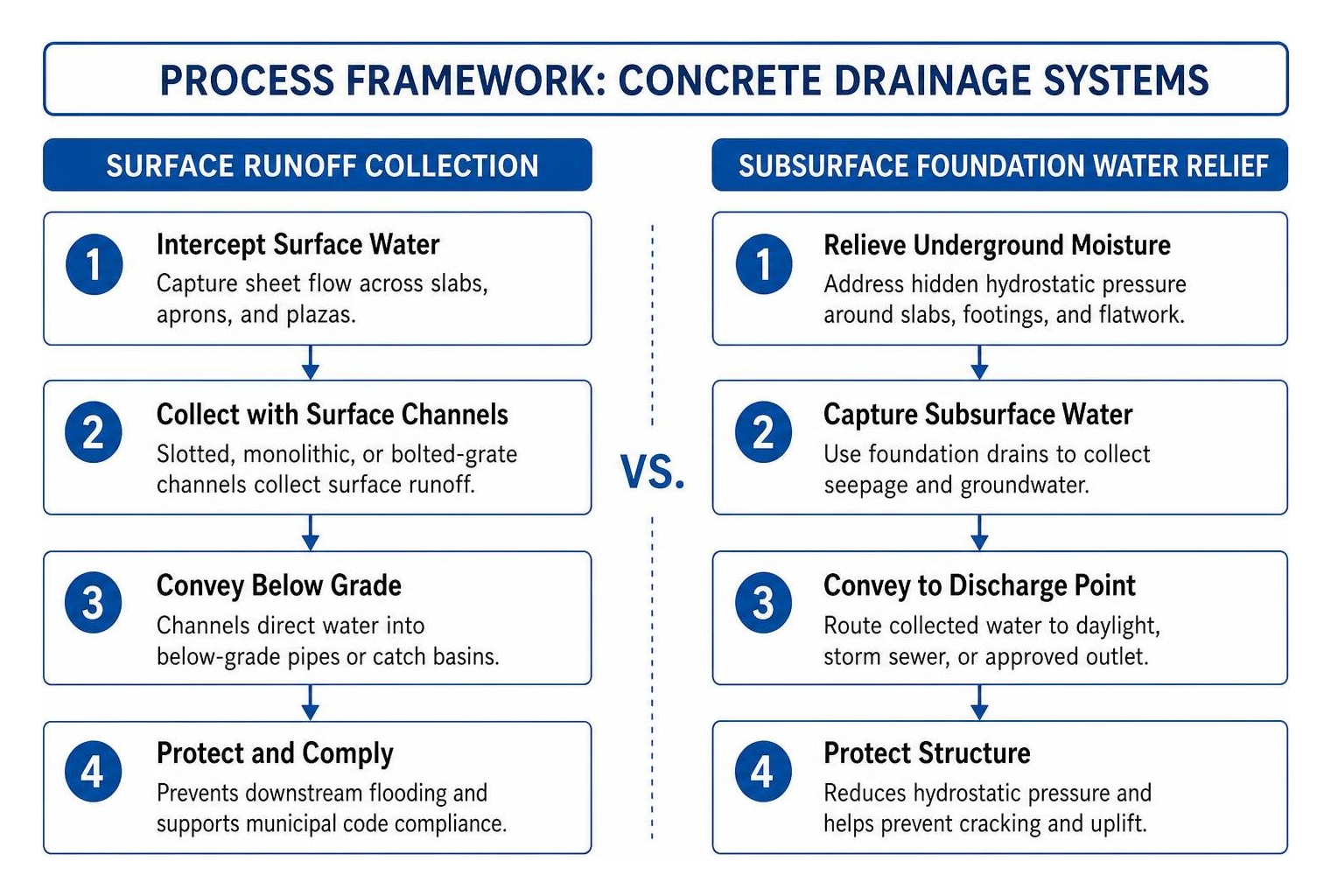
Comprehensive water management for poured concrete structures requires intercepting high-velocity surface sheet flow while continuously relieving subsurface hydrostatic moisture pressure that accumulates around footings. Combining engineered surface collection with below-grade foundation relief guarantees complete structural defense against soil saturation and water intrusion.
Surface Channel and Trench Drains
Surface drainage channels are the primary defense against sheet flow across large, impervious slabs like commercial parking lots, fire department aprons, and multi-bay garages. Without rapid surface interception, severe Midwestern rainstorms can overwhelm nearby subgrades, wash out perimeter landscape bedding, or force water beneath overhead doors and entry portals.
Modern surface trench channels feature low Manning’s roughness coefficients ($n \approx 0.011$), which allow water to move quickly even on minimal slopes. Slotted, monolithic, and bolted ductile-iron grate systems collect surface water and route it directly into below-grade smooth-wall collection mains or heavy-duty sediment catch basins. Integrating stormwater drainage solutions early in site development prevents downstream flooding and guarantees local municipal code compliance across Marion, Hamilton, Johnson, and Hendricks counties.
Our operators evaluate watershed catchment areas, soil absorption rates, and surrounding topography to position surface channels precisely where water collects naturally. We excavate accurate channel beds, tie in underground collection manifolds, and prepare the site for a seamless concrete pour.
Sub-Slab Foundation and Footing Drainage
While surface drains collect visible stormwater, subsurface groundwater represents the primary long-term hazard to concrete slabs and foundation footings. Water migrating through dense clay soils builds intense hydrostatic pressure against foundation walls, footer footings, and interior basement slabs, leading to cracks, water seepage, and structural slab heaving.
Executing drainage work around foundation assemblies requires laying perforated pipe networks at the base of the footing, encapsulated in washed, coarse aggregate and wrapped in geotextile filter fabric. This subsurface network relieves hydrostatic pressure and directs subgrade water away from the structure.
| Feature / Metric | Surface Channel & Trench Drains | Sub-Slab & Footing Drainage Systems |
|---|---|---|
| Primary Target | Sheet runoff, ponding, surface water | Groundwater table, hydrostatic pressure, capillary rise |
| Common Components | Polymer channels, cast grates, catch basins | Perforated pipe, coarse aggregate, filter fabric, vapor barriers |
| Primary Location | Flush with finished concrete pavement | Beside or underneath footers and foundation walls |
| Maintenance Need | Grate cleaning, sediment basket clearing | Inspection risers, occasional line jetting, cleanouts |
| Structural Risk Prevented | Surface hydroplaning, ice accumulation, pooling | Slab heaving, structural foundation cracks, basement flooding |
| Typical Flow Rate | Intermittent high-volume stormwater surges | Continuous low-to-moderate groundwater seepage |
We coordinate deep foundation excavation, footing trenching, and utility tie-ins so that sub-slab piping connects cleanly to municipal storm mains, dedicated drainage sumps, or engineered gravity discharge swales.
Site Preparation and Excavation Best Practices for Concrete Drainage
A concrete drainage system is only as durable as the excavation, grading, and compaction performed beneath it. When dirt work is rushed or subgrade stabilization is neglected, uncompacted soil will settle unevenly, shearing buried drainage pipes, reversing designed flow slopes, and cracking overhead concrete flatwork. Site preparation demands strict adherence to geotechnical standards, elevation verification, and specialized excavation equipment.

Precision Grading and Soil Compaction
Dependable drainage starts with establishing subgrade elevations. Our excavation operators use machine-guided grade control and precision rotating lasers to shape the native soil before aggregate base materials are installed.
After sculpting the site grade, heavy mechanical vibratory rollers compact the sub-base in controlled lifts to achieve optimal moisture-density ratios. In central Indiana’s expansive clays, uncompacted subgrade settling by even half an inch can create reverse slopes in a trench drain run, causing sediment accumulation, pipe joint separation, and stagnant water pockets that undermine the entire concrete section.
Protecting Site Soils and Environmental Integrity
Excavation strips away natural vegetation, leaving raw site soils exposed to heavy rainfall and stormwater runoff. Implementing proven erosion control and environmental compliance practices protects site stability throughout development. Silt fences, check dams, stabilized construction entrances, and sediment traps keep eroded soil from clogging newly installed perforated pipes, catch basins, and municipal connections. Maintaining clean drainage infrastructure during construction ensures long-term operational performance once concrete is placed.
Underground Utility Placement and Safe Hydro Excavation
Commercial and residential concrete slabs frequently sit atop a complex subterranean network of sanitary sewer laterals, storm mains, electrical conduits, and water lines. Planning and installing a sewer line under a concrete slab requires precise trench depth control, laser-verified pipe fall, structural aggregate bedding, and pressure testing prior to concrete placement.
When excavating in congested utility corridors throughout downtown Indianapolis, Carmel, Noblesville, or Westfield, our operators deploy non-destructive hydro excavation. Hydro excavation uses high-pressure water streams and high-volume industrial vacuum systems to safely expose buried utilities without mechanical shovel strike hazards, protecting existing infrastructure while preparing deep drainage trenches. Reach out to Patriot Excavating to discuss your upcoming project requirements and schedule an estimate.
Frequently Asked Questions About Concrete Drainage Systems
How does proper surface grading protect a concrete drainage system?
Proper surface grading establishes a continuous fall—ideally a 1% to 2% slope (a 10 to 20 mm drop per linear meter)—that uses gravity to guide runoff directly toward collection points like trench drains, catch basins, or bioswales. Without this engineered slope, rainwater ponds on top of flatwork. Over time, standing water seeps through micro-fissures, expansion joints, and perimeter edges into the subgrade, softening cohesive clay soils, washing out structural aggregate bedding, and causing concrete slabs to sink, tilt, or crack under traffic loads.
When should polymer concrete channels be selected over standard precast concrete?
Polymer concrete channels are the ideal choice when your project involves high axle loads, dynamic vehicle traffic, chemical exposure, or tight vertical elevation constraints. Because polymer concrete provides exceptional compressive strength (exceeding 95 MPa) and near-zero water absorption (around 0.07%), it resists freeze-thaw damage and deicing chemicals far better than traditional precast mixes. Their pre-sloped, modular interlocking designs also make them easier to align accurately across complex commercial layouts, ensuring uninterrupted drainage flow.
Why is subsurface foundation drainage essential beneath concrete flatwork?
Subsurface foundation drainage relieves hydrostatic pressure—the physical force that rising groundwater exerts against the underside of concrete slabs and foundation footings. In regions across central Indiana with dense, expansive clay soils, trapped subsurface water expands during freeze-thaw cycles, exerting immense upward pressure that heaves and shatters concrete. Subsurface perforated collector pipes and washed aggregate beds capture this water and carry it safely away to storm sewers or detention basins before it can compromise structural integrity.
Conclusion: Safeguarding Poured Concrete with Professional Site Drainage
A durable, crack-free concrete slab depends on what happens underneath the pour. Without thorough geotechnical site assessment, precision laser grading, dedicated utility coordination, and reliable surface and subsurface drainage channels, even the highest-strength concrete mix will eventually fail against pooling water, freeze-thaw cycles, and shifting subgrade soils.
Patriot Excavating brings decades of field experience to every commercial and residential project across Indianapolis, Greenwood, Carmel, Fishers, Westfield, Franklin, Noblesville, Plainfield, and surrounding central Indiana communities. From deep foundation excavation, precision site grading, and hydro excavation to utility trenching, sewer connections, and advanced erosion control, we build the solid, well-drained foundations your concrete installations need to stand the test of time.
If you are developing a new commercial site, replacing industrial pavement, or building residential infrastructure, integrate optimize stormwater management with expert solutions from the ground up.
Contact Patriot Excavating today to request an on-site consultation and project estimate for your excavation, grading, and drainage needs. Let our family-owned team establish the grades and ground conditions required to protect your poured concrete for years to come.