
Understanding Your Wastewater Options
For property owners and developers in Central Indiana, the septic vs sewer decision is a foundational piece of infrastructure planning. When you flush a toilet or run water down a drain, understanding where that wastewater goes is critical for your financial planning, property, and long-term goals.
Quick Comparison:
| Feature | Septic System | Sewer System |
|---|---|---|
| Treatment Location | On your property (tank + drain field) | Municipal treatment plant |
| Initial Financials | Installation & excavation | Connection & tap fees |
| Ongoing Financials | Periodic maintenance | Monthly utility fees |
| Maintenance | Owner responsible (pumping every 3-5 years) | Minimal (city maintains main lines) |
| Best For | Rural properties, larger lots | Urban/suburban areas with access |
| Lifespan | 20-40 years with proper care | Virtually unlimited (city responsibility) |
Septic systems are self-contained treatment plants on your property. An underground tank and drain field use natural bacteria and soil to treat wastewater. As the owner, you are responsible for all maintenance, including regular pumping and inspections.
Sewer systems use a network of underground pipes to transport wastewater to a centralized municipal facility for treatment. The city manages the main lines and treatment process, funded by your monthly utility fees. Your primary responsibility is the lateral line connecting your property to the city main.
In rural areas around Indianapolis, septic may be your only option. In established neighborhoods, you are likely already connected to city sewer. But for new construction or development projects, understanding these differences is key. As Clay Hamilton, President of Patriot Excavating, I’ve guided countless clients through the septic vs sewer decision. My two decades of experience in Central Indiana’s excavation and utility sector ensures you get the right solution for your property.
The Core Differences: Septic vs Sewer Systems in Central Indiana
When evaluating septic vs sewer for your Central Indiana property, it’s crucial to understand their distinct operational models, maintenance demands, and financial structures.
How They Work: On-Site vs. Centralized Treatment
The fundamental difference is where wastewater treatment occurs.
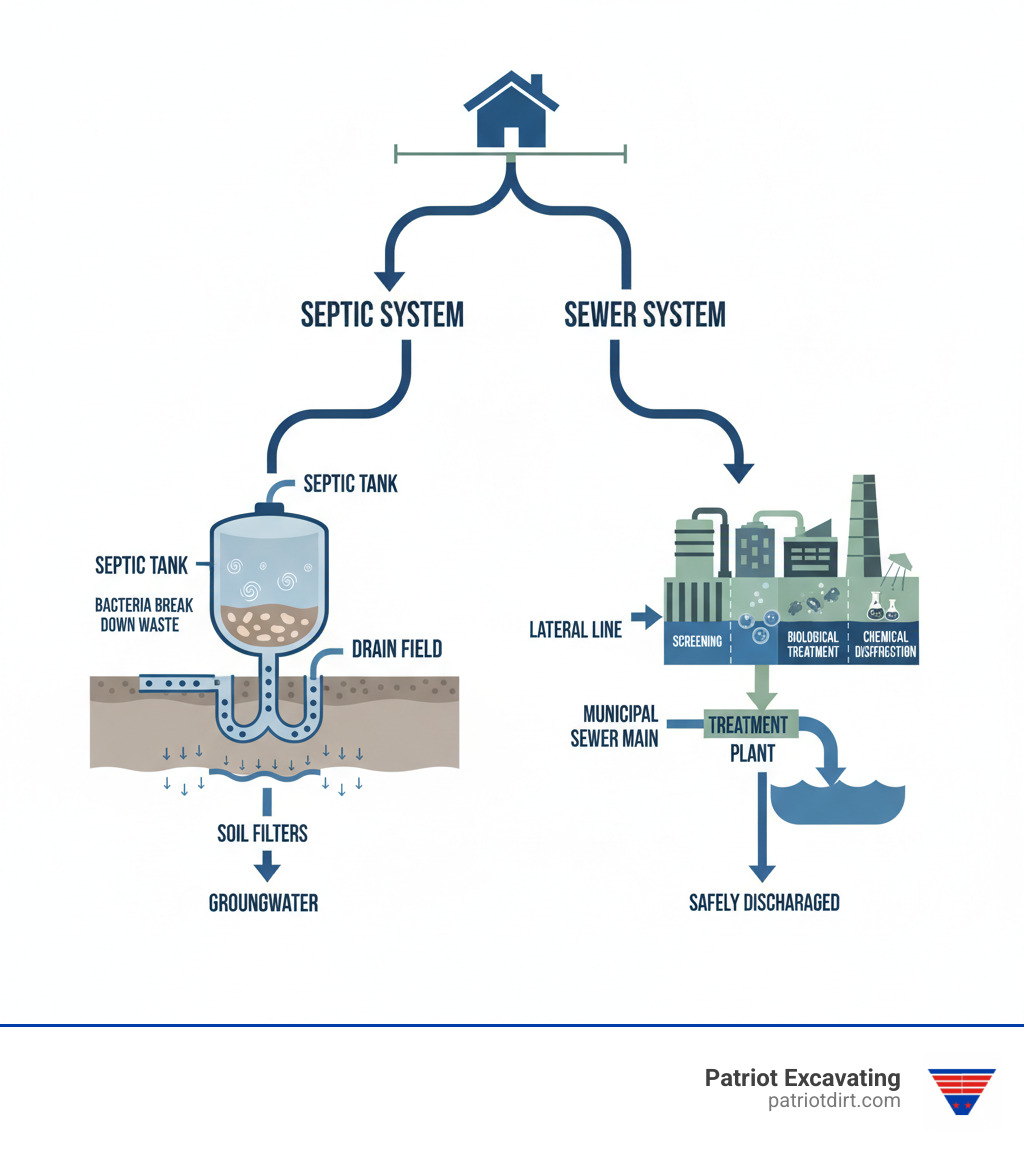
Septic systems are private, on-site treatment facilities. Wastewater flows into an underground tank where solids settle and bacteria begin breaking down organic matter. The partially treated liquid, or effluent, then flows into a drain field (also called a leach field), a network of buried pipes. Here, the soil acts as a natural filter, cleaning the water as it percolates back into the groundwater. This entire process is typically gravity-fed and relies on natural biology. For more on how these systems are custom for residential use, see our guide on Septic Tanks for Homes.
Sewer systems are a public utility. Wastewater leaves your property through a private lateral line and connects to a larger municipal sewer main. This network transports waste from thousands of properties to a centralized treatment plant. There, it undergoes a multi-stage process of screening, biological treatment, and disinfection before being safely discharged. The municipality manages this entire infrastructure. Our team specializes in making these connections with professional Sewer Line Installation in Indianapolis.
Your Role: Maintenance and Upkeep Responsibilities
Your responsibilities vary greatly between the two systems.
With a septic system, you are the operator. This requires proactive management. The most critical task is having the tank pumped every 3-5 years to remove accumulated solids. Regular inspections can identify minor issues before they become major failures. You must also protect the drain field from compaction by heavy vehicles or construction and be mindful of landscaping. Finally, what goes down the drain matters—avoid flushing anything other than human waste and toilet paper, as grease, chemicals, and non-biodegradable items can damage the system and lead to The Telltale Signs of a Septic Tank Backup.
With a sewer system, your maintenance is much lighter. The municipality handles the main lines and treatment plant, funded by your monthly utility fees. Your responsibility is the lateral line from your house to the city main. If this line becomes blocked or damaged, often by tree root intrusion, the repair is yours. While the municipal system is robust, it’s still wise to avoid pouring grease or flushing improper items down the drain to prevent clogs in your lateral line. When issues arise, Excavation Services Help Fix Common Sewer Problems.
Financial Structure: Installation vs. Utility
The financial structures for septic vs sewer are fundamentally different.
Septic systems center on the upfront investment for installation. This includes the tank, drain field, and significant excavation work. The scope of this work is influenced by your property’s size and soil conditions, as clay or rocky soil requires more extensive preparation. Once installed, there are no monthly wastewater bills. Your ongoing financial commitments are for periodic pumping and any necessary maintenance. A well-maintained system can serve a property for decades before needing major replacement. We handle all aspects of Residential Septic Tank Installation.

Sewer systems involve an initial connection or “tap” fee to the municipality, plus the installation of a lateral line to the city main. This is followed by ongoing monthly utility bills that cover the municipality’s operational and maintenance duties. You are also financially responsible for any repairs to your private lateral line, such as clearing blockages or addressing pipe damage.
Choosing between these two models depends on your budget, location, and long-term financial strategy. Our team at Patriot Excavating can help you evaluate these factors for your specific project on our Sewer Water and Drainage page.
Making the Right Choice for Your Central Indiana Property
Choosing between septic vs sewer is about matching the system to your property’s physical realities, your long-term goals, and Central Indiana’s regulatory environment. The right choice for one lot may be entirely wrong for another just down the road.
Site & Soil: The Deciding Factors for Installation
Often, the ground beneath your feet makes the decision for you.
Septic systems need space. A tank and drain field require a significant footprint, making them ideal for larger lots and rural properties common around Franklin, Greenwood, and the outskirts of the metro area. Beyond size, soil quality is paramount. Percolation tests determine if your soil can properly filter effluent. The heavy clay soil found in much of Central Indiana can drain too slowly, while a high water table can interfere with treatment. These conditions may require more advanced, complex systems. Our experience with Franklin IN Septic Installation gives us deep insight into navigating these site-specific challenges.
Sewer systems depend on access. For properties in Indianapolis, Carmel, or Fishers, the primary factor is proximity to a municipal sewer main. If a line is readily accessible, connection is usually the most practical path. However, if the main is distant, the excavation required to extend the line can be substantial. Our Trenching Services in Indianapolis – Patriot Excavating are essential for making these connections efficiently and correctly.
Environmental Impact & Local Regulations
Both systems have distinct environmental footprints and are governed by local regulations.
A well-maintained septic system is a model of sustainable, on-site treatment. It uses natural processes and replenishes local groundwater with minimal energy. However, a failing system poses a serious risk, potentially contaminating groundwater and nearby wells. The responsibility for preventing this rests solely with the owner.
Sewer systems offer the benefit of centralized, highly regulated treatment. This provides consistent public health protection for densely populated areas. The trade-offs include significant energy consumption for pumping and treatment, and the risk of overflows during heavy storms.
Both options are regulated to protect public health. Septic installations require permits and site plan approvals from county health departments (like Marion, Hamilton, or Johnson). Sewer connections must adhere to municipal codes. At Patriot Excavating, our commitment to Erosion Control and Environmental Compliance in Excavation Projects ensures every project meets or exceeds these standards.
Making the Final Decision for Your Property
After weighing the site, maintenance, and environmental factors, how do you make the final call? This summary can help guide your thinking:
| Feature | Septic System | Sewer System |
|---|---|---|
| Best Location | Rural areas, large lots, where sewer is unavailable | Urban/suburban areas, smaller lots, with sewer access |
| Financial Model | Upfront installation investment, periodic maintenance expenses | Initial connection fees, consistent monthly utility fees |
| Homeowner Maintenance | High: Pumping, inspections, drain field care | Low: City handles mains; owner handles lateral line |
| Environmental Profile | Pro: Low energy, natural filtration. Con: High risk if neglected. | Pro: Regulated treatment. Con: High energy, overflow risk. |
In Central Indiana’s real estate market, a sewer connection is often seen as a convenience, but a well-documented, properly maintained septic system is equally valuable, especially in areas where it’s the standard. Your long-term plans also matter. A sewer connection may offer more flexibility for future development, as a septic drain field requires protected space that cannot be built upon.
The best choice is never one-size-fits-all. With over two decades of experience across Central Indiana, Patriot Excavating understands the nuances of local soil, regulations, and site conditions. We provide the expert guidance and precision excavation needed to implement the right wastewater solution for your residential or commercial project.
Ready to discuss your project? Contact us today to learn more about our comprehensive services and how we can help you make the right choice for your property.