
Why Professional Excavation is the Bedrock of Your Project
Excavation for a home addition is the critical first step that determines whether your expansion project stands strong for decades or faces preventable structural problems. This process involves removing soil, preparing the ground, and creating a stable foundation that connects seamlessly to your existing home while supporting the additional weight and managing water drainage.
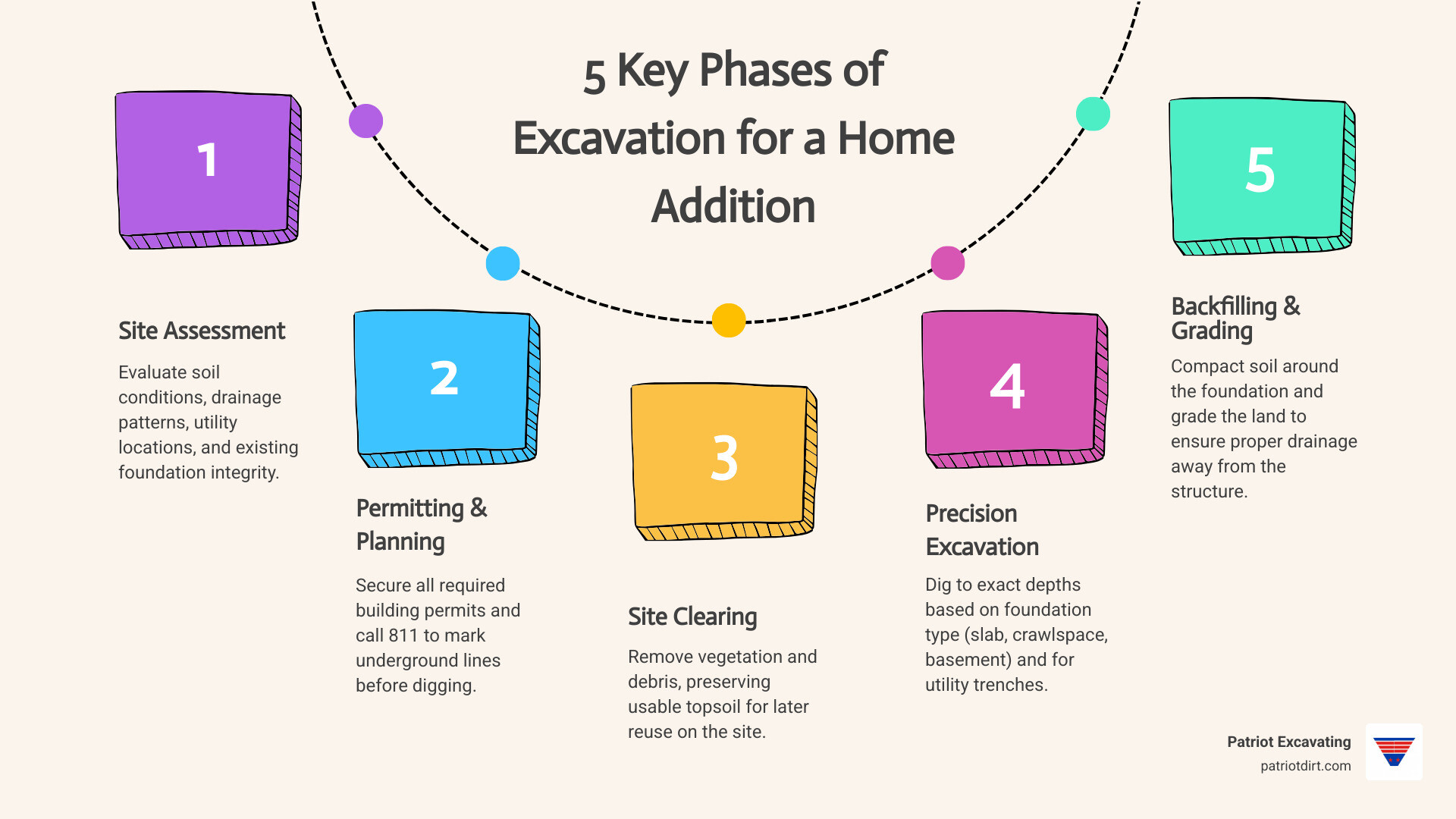
Key Steps in Excavation for a Home Addition:
- Site Assessment – Evaluate soil conditions, drainage patterns, and existing foundation integrity
- Permitting and Utility Location – Secure required permits and call 811 to mark underground lines
- Site Clearing – Remove vegetation, debris, and topsoil while preserving what can be reused
- Excavation – Dig to precise depths based on foundation type (slab, crawlspace, or basement)
- Foundation Connection – Carefully tie new foundation to existing structure with proper reinforcement
- Backfilling and Grading – Compact soil around the foundation and grade for proper drainage
Why Professional Excavation Matters:
- Structural Integrity – Proper depth and compaction prevent settling and foundation cracks
- Water Management – Correct grading directs water away from both old and new foundations
- Safety – Excavation is a dangerous construction activity requiring specialized equipment and expertise
- Code Compliance – Professional contractors ensure work meets local building codes and inspection requirements
The stakes are high. If the foundation is dug too shallow, graded incorrectly, or poorly connected to the existing structure, it can contribute to water intrusion and structural movement that is difficult to correct after the work is backfilled. Unlike other construction phases, excavation mistakes are literally buried and extremely expensive to fix later.
I’m Clay Hamilton, President of Patriot Excavating, and I’ve spent over two decades leading complex excavation for home addition projects throughout Indianapolis and Central Indiana. My team and I understand that your addition isn’t just about square footage—it’s about protecting your home’s structural integrity while creating space that serves your family for years to come.
The Critical First Step: What is Excavation and Why is it Essential?
At Patriot Excavating, we see excavation as more than moving dirt; it’s the meticulous ground preparation for a lasting foundation. This includes:
- Soil Removal: Digging and removing soil to create the addition’s footprint.
- Trenching: Creating precise ditches for footings, utility lines, and drainage.
- Grading: Shaping the land for a level base and proper water runoff.
The goal is a stable base that ensures the longevity and safety of your addition, preventing issues like settling and cracks. Proper drainage is also critical; effective grading directs water away from the structure, preventing damage, a topic we cover in The Crucial Role of Proper Drainage: Safeguarding Your Property Against Erosion and Damage. Finally, we create space for essential services with expert Utility Trenching, ensuring structural integrity and preventing future settlement.
Planning Your Project: Key Steps for a Successful Excavation for a Home Addition
Meticulous planning is essential. Our process begins with a thorough site assessment, evaluating soil conditions that vary across Central Indiana. We often recommend a geotechnical engineer for soil testing to understand its composition and load-bearing capacity, which is vital for foundation design and informs our approach to Land Grading.
Next, a professional surveyor marks the addition’s boundaries to ensure compliance with property lines and setbacks, preventing costly errors. Securing permits is another non-negotiable step; your excavating contractor should align excavation and foundation work with local residential permit and inspection requirements. We guide clients through the Permit Preparation & Approval process for Indianapolis and Central Indiana.
Finally, for safety, we contact Indiana 811 and follow the required notice timeline (at least two full working days in Indiana) so utilities can mark lines before digging begins. This prevents dangerous situations and costly delays. This comprehensive planning is a key part of our overall Site Preparation Process.
Foundation Types and Their Specific Excavation Needs
The type of foundation you choose for your home addition in Central Indiana will significantly dictate the scope and depth of our excavation work. Each foundation type has unique requirements that we carefully plan for.
Slab-on-Grade Foundations: Poured directly on a prepared grade, these require the least excavation. We clear and level the site, compact the soil, and dig shallow footing trenches. While less common for homes in our climate due to frost lines, they suit additions like garages, especially with frost-protected shallow foundation (FPSF) techniques that use insulation to avoid deep footings.
Crawlspace Foundations: Requiring more excavation than a slab, a crawlspace creates an accessible area (3-4 feet high) under the floor for utilities. We ensure adequate height and ventilation, preparing for foundation walls and support piers. Proper drainage is paramount to prevent moisture issues.
Full Basement Foundations: Full basement foundations require the most extensive excavation, with depth determined by engineered design, local requirements, and site conditions. Our team is equipped for deep digs, managing soil removal, and ensuring trench safety. We prepare the site for thick concrete walls and a floor slab, integrating drainage systems to prevent water intrusion. Our expertise in Basement Excavation Near Me ensures a solid start.
Regardless of the type, precise depth and footing requirements are critical and dictated by engineering specs and local codes, which we strictly follow. Our comprehensive Foundation Preparation Services Indianapolis ensure your addition rests on a perfectly prepared, stable base.
Navigating the Process and Challenges of Excavation for a Home Addition
Starting on an excavation for a home addition project is an exciting venture, but it’s also one that comes with inherent complexities and challenges. At Patriot Excavating, we pride ourselves on our ability to steer these intricate processes and overcome obstacles with professional solutions and unwavering safety protocols. We understand that excavation is regarded by some environmental safety experts as the most dangerous type of construction project, and we take that responsibility seriously. Our commitment to safety is detailed in our guide on Excavation Safety: Protecting Your Worksite – Patriot Excavation.

The Step-by-Step Excavation Process
Once planning and permitting are complete, our team gets to work, following a precise, step-by-step process to ensure a flawless foundation for your addition:
- Site Clearing: We clear the area of vegetation, debris, and old structures. Our Land Clearing and Grading expertise ensures this is done efficiently.
- Topsoil Separation: We separate the nutrient-rich topsoil and set it aside for later reuse in landscaping, reducing waste.
- Bulk Digging: Using excavators and bulldozers, we perform the initial large-scale digging to the approximate depth required.
- Detail Excavation: This phase involves fine-tuning the excavation with smaller equipment or by hand to achieve the exact dimensions specified in the blueprints.
- Trenching for Utilities: Precise trenches are dug for all necessary utility lines, including water, sewer, and electrical. Our team is expert in Sewer Line Installation in Indianapolis and other utility trenching needs.
- Foundation Construction: Once excavation is inspected, the foundation (footings, walls, slab) is constructed.
- Backfilling and Compaction: After the foundation cures, we backfill the area in layers, compacting the soil to prevent settlement.
- Final Grading: The final step is grading the land to slope away from the foundation, directing rainwater away to prevent damage.
This methodical approach ensures precision. Learn more in our Step-by-Step Guide to the Excavation Process.
Overcoming Common On-Site Challenges
Even with meticulous planning, excavation projects can present unforeseen challenges. Our experience in Central Indiana has equipped us to handle a wide array of on-site issues:
- Rocky Soil and Bedrock: Encountering rocky soil or bedrock can slow projects. We use specialized tools like hydraulic hammers on our excavators to break through stubborn layers and stay on schedule.
- Unstable Ground: Loose or wet soils can pose a cave-in risk. We implement shoring systems or use sloping and benching techniques to create safe working conditions.
- High Water Table and Dewatering: A high water table can fill an excavation with water. We use strategic dewatering with sump pumps to keep the site dry and prevent delays.
- Hidden Utilities: During excavation for a home addition, crews must be prepared for unexpected utilities even after 811 markings; work pauses until the line is identified and protected.
- Tight Access: Many additions are in areas with limited space. Our mini-excavators can access compact areas (as little as 39 inches wide) for precise work in constrained backyards.
- Environmental Protection: We manage sediment runoff with silt fences and implement erosion control methods. We also ensure responsible disposal of excavated soil, as detailed in our guide to Construction Site Sediment Control.
Our ability to anticipate and respond to these challenges sets us apart, ensuring your project proceeds safely and efficiently, no matter what lies beneath the surface.
Connecting to the Existing Structure: A Delicate Operation
One of the most critical phases of excavation for a home addition is seamlessly connecting the new foundation to the existing one. This is about integrating two structures into a single, stable unit.
Our process begins by exposing the existing foundation to assess its type and condition. Older Central Indiana homes may have poured concrete, stone, or pier foundations, each requiring a custom approach to avoid undermining the structure.
When excavating below the existing foundation, techniques like underpinning (strengthening the existing foundation) or shoring (temporary supports) may be needed. This complex task requires consultation with a structural engineer, with whom we work closely to ensure your home’s integrity.
The physical connection, or “tying in,” is crucial to prevent differential settlement. We achieve this by drilling into the existing foundation and epoxying rebar dowels that extend into the new foundation, creating a strong bond.
Finally, waterproofing the seam where the foundations meet is vital to prevent moisture intrusion. We use effective membranes and sealants to create a continuous barrier, ensuring your addition performs as a seamless, stable extension of your home.
Ensuring a Successful Build: Your Next Steps
Completing a home addition is a major project, and its success hinges on the quality of its foundation and site preparation. At Patriot Excavating, we firmly believe that professional excavation is the bedrock of project success, ensuring structural safety and long-term performance for your home. A properly executed excavation prevents future headaches, from water intrusion to structural instability, making it one of the most important decisions in your home addition plan. We elaborate on this crucial point in our article, Why Excavation is Important for Home Building or Renovation Projects.
Choosing the right partner for this critical phase is paramount. When hiring a professional excavation contractor, vet them thoroughly. Look for companies with a proven track record, comprehensive insurance, proper licensing, and deep local expertise. Our team at Patriot Excavating is not only highly skilled and equipped with state-of-the-art machinery but also possesses an intimate understanding of the unique soil conditions, regulations, and challenges specific to Indianapolis and Central Indiana. We ensure that every project adheres to the highest standards of safety, quality, and compliance.
For homeowners in Indianapolis and Central Indiana, partnering with an experienced site-work expert is the most critical decision you’ll make. We are dedicated to laying the literal and figurative groundwork for your dream home expansion, ensuring it stands strong for generations to come.
If you’re planning excavation for a home addition, work with an experienced excavating contractor who understands local permits, soil conditions, and safe foundation tie-ins. Contact Patriot Excavating to schedule a site assessment and plan your addition the right way from the ground up.