
The Complete Guide to Finding Indianapolis Excavation Contractors
Start Your Indianapolis Excavation Project With the Right Plan
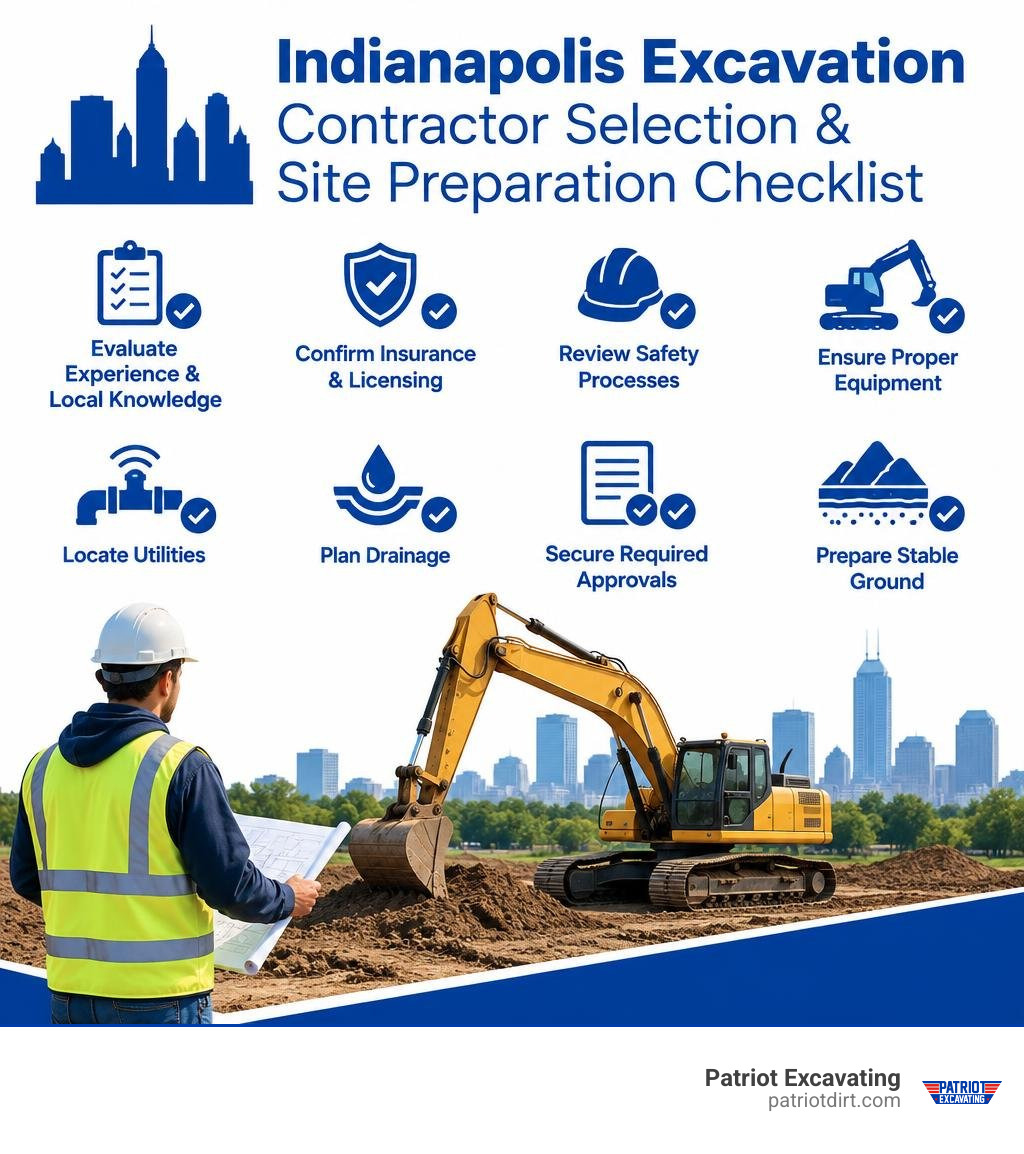
Successful Indianapolis Excavation starts with a qualified contractor who can assess the site, locate utilities, plan drainage, secure required approvals, and prepare stable ground for the next construction phase. Before hiring, confirm that the contractor has local experience, proper insurance, a clear safety process, and the specialized heavy machinery needed for your residential or commercial project.
In central Indiana, excavation may include foundation digging, basement work, grading, demolition, utility trenching, and site preparation. Local clay soils, changing ground moisture, freeze-thaw conditions, and roughly 40 inches of yearly rainfall can all affect soil stability and project schedules. Good planning helps prevent avoidable delays, drainage issues, and unsafe trench conditions.
This guide explains what to expect from professional earthwork across the region, from municipal permits and utility locating to contractor selection and downstream construction handoffs. Choosing established excavating companies in Indianapolis, Indiana ensures your site is engineered accurately from the initial pass. Whether evaluating full-service site work or utilizing non-destructive hydro excavation in Indianapolis, our experienced team delivers reliable performance across every phase.
I am Clay Hamilton, President of Patriot Excavating, a family-owned commercial and residential excavating company serving Indianapolis and central Indiana. With more than two decades of experience in excavation, electrical, and mechanical systems, I have seen how careful planning and clear communication make Indianapolis Excavation projects safer and more dependable. Reach out to Patriot Excavating today to discuss your site plans and project requirements.
Comprehensive Scope of Indianapolis Excavation Services
Excavation forms the bedrock of any successful building effort across Marion County and surrounding communities like Greenwood, Carmel, and Fishers. Our approach at Patriot Excavating is rooted in treating earthmoving not as simple digging, but as a systematic engineering discipline designed to establish long-term structural viability. Whether breaking ground on a custom home or reshaping acreage for an expansive logistics facility, working with a full-capability site excavation contractor guarantees every layer of subgrade meets exacting compaction and load-bearing metrics.
Our services bridge early-stage earthwork with downstream trades, ensuring that once soil is moved, it performs reliably under structural loads. From precision site stripping and bulk earth clearing to specialized grading around utilities, our fleet handles the diverse landscape conditions found throughout central Indiana.
Residential Indianapolis Excavation for Basements and Foundations
Residential development across central Indiana requires an acute understanding of how native soils support structural foundations. Over 60% of regional earthwork projects involve dedicated residential foundation work, including full basement digs, crawlspace excavations, and monolithic slab prep. When tackling residential excavation, our team focuses heavily on establishing uniform subgrades that eliminate differential settling.
Our operators cut footers with clean vertical faces and laser-verified depths, establishing a stable floor for concrete placement. Once footers and walls cure, we execute controlled backfilling using engineered soils, preventing excessive lateral pressure that could compromise newly laid masonry. Protecting foundation walls from future water intrusion starts at this early stage through proper sub-base leveling and perimeter slope grading.
Commercial Indianapolis Excavation and Site Preparation
Commercial developments—ranging from retail strip centers in Noblesville to industrial warehouses in Plainfield—demand high-volume earthmoving and rigorous ground engineering. Our commercial site work centers on subgrade stabilization, structural building pad construction, and the formation of heavy-duty retention basins designed to capture intense runoffs.
We utilize advanced cut-and-fill balancing to move soil efficiently across broad acreages, reducing haul-off requirements and optimizing project timelines. Partnering with a dedicated commercial site development specialist ensures that every square foot of the building envelope satisfies civil engineering standards, preventing subgrade deformation beneath structural steel and heavy slabs.
Precision Utility Trenching and Underground Infrastructure
Underground utilities represent the lifelines of any modern building, demanding high-precision earthmoving to ensure correct pitch, depth, and protection. Our team handles complete utility trenching for municipal water mains, sanitary sewer lines, stormwater conduits, and primary electrical duct banks across residential and commercial developments.
We carefully shape trenches to match structural pipe bedding requirements, layering granular aggregate beneath and around utility lines to prevent point-loading from heavy surface traffic. Using non-destructive hydro excavation methods alongside conventional trenchers, we safely uncover sensitive areas, ensuring clean grade elevations that keep gravity-fed systems flowing without interruption.
Navigating Marion County Geology, Soil Conditions, and Seasonal Weather
Central Indiana possesses a complex geological profile shaped heavily by historic glaciation. The resulting subsoil consists largely of dense glacial till, silt, and over-consolidated cohesive clay layers. These soil profiles require specific handling techniques during excavation to maintain density and prevent deep-seated shear failure beneath structural footings.

Excavating through Marion County ground means constantly managing moisture variation. When dry, Indiana clay hardens into a dense mass that challenges standard cutting edges; when saturated, it turns slick, loses internal friction, and slumps quickly under heavy equipment tracks. Our operators monitor moisture content closely, employing soil amendment strategies and mechanical compaction to maintain proper load-bearing capacity across every layer we place.
Handling Dense Clay Soils and Freeze-Thaw Cycles
Expansive clay soils across central Indiana undergo dramatic volume shifts as moisture fluctuates throughout the seasons. During winter and early spring, seasonal freeze-thaw cycles present severe risks to exposed subgrades and open trenches. The frost line in our region reliably reaches down to 30 or 36 inches, freezing moisture within uncompacted clay and causing significant frost heave that can displace uncured footings or destabilize trench walls.
When managing winter projects, we employ strict protocols for excavating frozen ground. We clear surface frost caps using high-breakout machinery, never place structural backfill over frozen material, and protect freshly dug subgrades from overnight freezes using insulated thermal blankets. This proactive management prevents hidden voids from forming once the spring thaw arrives.
Site Drainage, Stormwater Mitigation, and Erosion Management
With Indianapolis receiving roughly 40 inches of rainfall annually, unmanaged surface water can quickly turn an active construction site into an unstable marsh. Uncontrolled runoff compromises soil compaction, washes out cut slopes, and deposits heavy sediment loads into adjacent waterways.
Our team integrates comprehensive stormwater drainage solutions from the initial grading pass. We shape interceptor swales, dig temporary retention basins, and deploy sediment barriers to control stormwater velocity across exposed earth. By pairing precision land shaping with targeted drainage work around foundations, we guide high-volume downpours away from building envelopes, ensuring structural footings stay dry and intact long after construction concludes.
Safety Protocols, Permitting, and Local Indiana Regulations
Excavation remains among the most hazardous phases of any construction project. Urban projects across Marion County, Speedway, and Lawrence demand rigorous adherence to local zoning rules, right-of-way ordinances, and federal safety standards. At Patriot Excavating, our operators and field crew enforce strict site-specific safety plans tailored to surrounding structures, foot traffic, and variable soil classifications.
| Safety Compliance Factor | Open Cut Excavation (Sloping/Benching) | Shored / Shielded Excavation (Trench Boxes) |
|---|---|---|
| Applicable Soil Types | Best suited for cohesive Type A/B soils with adequate room | Essential in unstable Type C soils or tight urban corridors |
| Space Footprint | Requires extensive horizontal clearance for angled step-downs | Minimal surface footprint; fits neatly within tight property lines |
| Protective Equipment | Heavy earthmoving equipment for mass benching cuts | Certified aluminum hydraulic shoring or steel trench shields |
| Collapse Protection | Relies on natural angle of repose to prevent slope failure | Provides rigid mechanical barrier against sudden sidewall collapse |
| Urban Utility Safety | Difficult around dense underground infrastructure | Safely isolates utilities while protecting subterranean workers |
Indiana 811 Requirements and Subsurface Utility Locating
Striking an underground utility poses severe life-safety risks, substantial municipal penalties, and catastrophic project delays. Under Indiana law, contacting Indiana 811 at least two full working days before breaking ground is mandatory for any excavation activity.
Once utility operators mark public mains, our work turns to careful on-site verification. We utilize advanced hydro excavation and hand-digging techniques to daylight buried lines, visually confirming their true alignment and depth before deploying heavy machinery. Proper utility identification forms a core component of our comprehensive site preparation protocol, protecting water lines, high-pressure gas conduits, and fiber-optic communication networks from accidental damage.
Securing Local Permits and Managing Project Timelines
Breaking ground in Marion County or surrounding municipalities like Greenwood, Franklin, and Westfield requires specific documentation before equipment can mobilize. Depending on scope and property boundaries, projects may require:
- Marion County Drainage Permits (evaluating post-construction runoff rates)
- Right-of-Way (ROW) Excavation Permits for curb cuts, drive access, or public utility taps
- Structural building and foundation permits from local planning departments
- Indiana Rule 5 / Construction Stormwater General Permits (CSGP) for disturbances exceeding one acre
Our experienced builder services team coordinates directly with local engineering offices, handling municipal submittals and coordinating mandatory rough-in inspections to keep project milestones moving without administrative delays.
Criteria for Selecting Qualified Excavation Contractors in Indianapolis
Selecting the right earthmoving partner can make or break a project’s timeline and structural integrity. At Patriot Excavating, we encourage property owners and commercial developers to review credentials carefully, verify specialized equipment capacity, and evaluate real customer track records across central Indiana.

Patriot Excavating’s Licensing, Bonding, and Insurance Credentials
Earthmoving involves significant physical risks and property liabilities. Patriot Excavating maintains comprehensive coverage and credentials that protect every project we undertake across Indianapolis and central Indiana. Our documentation includes:
- Commercial General Liability: Comprehensive policies protecting against underground utility strikes, third-party structural damage, and jobsite accidents.
- Workers’ Compensation: Complete coverage for every technician and machine operator on our team.
- Surety and Municipal Bonding: Fully bonded for work within public rights-of-way across Indianapolis and Marion County.
- Specialized Licensing: Drainage, septic, and utility certifications demonstrating our up-to-date knowledge of local construction codes.
We provide proof of coverage before mobilization so you can move forward with confidence. Our team’s approach to finding the right excavation contractor starts with transparency about our own qualifications and safety record.
Our Equipment Fleet Capabilities and Technical Expertise
Patriot Excavating’s machinery fleet directly dictates the precision, efficiency, and safety we deliver on every job. Our diverse equipment line ensures the right tool is deployed for the specific project, whether an ultra-compact mini excavator for tight residential side-yards in Meridian Hills or a 30-ton tracked machine for bulk commercial cuts in Whitestown.
Our operators utilize laser-guided elevation controls and high-precision hydraulic attachments on every project. Combining modern heavy machinery with deep technical know-how in excavation and grading ensures cuts are executed precisely to plan on the very first pass, eliminating unnecessary re-work and material delays for our clients. Contact Patriot Excavating today to review your jobsite specifications with our technical team.
Integrating Earthwork with Foundations and Utility Installation
Excavation is never an isolated construction phase—it sets the stage for every trade that follows. At Patriot Excavating, we synchronize earthwork directly with downstream trades through our proprietary site development workflow. We maintain strict tolerances on foundation cuts so concrete crews place footers directly without excess formwork. When installing underground sewer, water, and drainage infrastructure, we verify pipe invert elevations against master civil plans, ensuring seamless utility connections with municipal mains.
Our field supervisors coordinate directly with concrete contractors, mechanical installers, and municipal inspectors at each handoff point. This proactive communication prevents disruptive delays and structural misalignments that occur when excavation crews work in isolation.
Patriot Excavating’s construction milestones when transitioning from excavation to foundation framing:
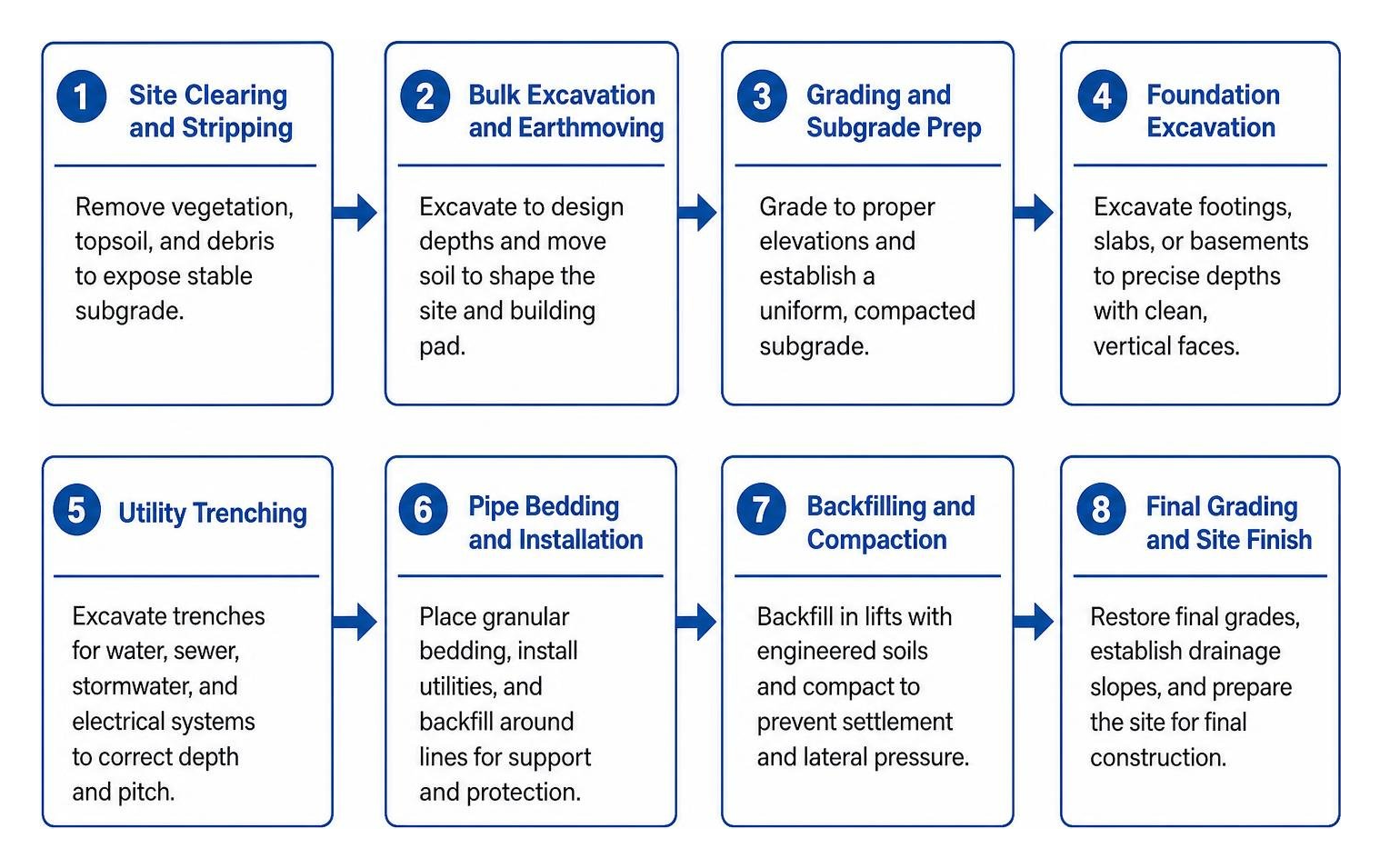
- Initial Site Clearing and Demolition: Our crews strip vegetation, remove surface obstacles, and clear unsuitable topsoil layers using our specialized demolition equipment.
- Bulk Mass Excavation: We move primary earth volumes down to engineered rough-grade elevations using GPS-guided machinery.
- Rough Utility Trenching: Our operators dig main lateral trenches and establish granular bedding for plumbing and utility feeds.
- Precision Subgrade Compaction: We mechanically test and compact footing zones to verify structural bearing capacity before concrete placement.
- Footer Trenching and Concrete Pour: Our team digs clean footer trenches, coordinating directly with concrete crews for immediate structural rebar placement and pours.
- Foundation Wall Construction: We prepare the site for poured concrete or masonry block foundation walls.
- Waterproofing and Foundation Drainage: Our crews install exterior moisture barriers, dimple boards, and perforated French drain systems.
- Engineered Backfilling and Compaction: We place granular backfill in controlled lifts to protect new structural walls.
- Final Grading and Swale Shaping: Our operators direct surface water away from the structure to establish positive site drainage.
Frequently Asked Questions About Excavation Services
How long does a standard foundation excavation take in central Indiana?
A standard single-family residential foundation or basement excavation generally takes between one and three days of active digging under normal conditions. However, total timelines depend on lot accessibility, foundation footprint, total yardage, and subsurface soil composition. Encountering unexpected buried debris, high groundwater tables, or dense clay can extend the dig schedule. Furthermore, seasonal storms producing heavy rain may require temporary pauses to allow soil to dry, preventing trench collapse and subgrade rutting.
Why is pre-excavation soil testing crucial in the Indianapolis area?
Pre-excavation geotechnical soil testing determines the bearing capacity, moisture content, and expansion potential of native subsoils. Because central Indiana features extensive pockets of cohesive clays and unconsolidated fill, testing identifies whether subgrade soils can safely support structural loads without settling unevenly. Testing reveals if soil stabilization methods—such as lime stabilization, stone backfill, or deeper undercut excavation—are necessary before pouring footings, preventing cracked foundations and severe structural remediation later.
What permits are required before breaking ground in Marion County?
Most excavation projects in Marion County require several local permits before ground is broken. Residential foundation work requires building permits administered by the Department of Business and Neighborhood Services (BNS). If the project involves tying into city utilities or working within public easements, a Right-of-Way (ROW) Excavation Permit is mandatory. Projects disturbing significant land area or altering historical drainage paths also require an approved Stormwater Management and Erosion Control Plan to satisfy local and state environmental mandates.
Conclusion
Every successful building project across central Indiana starts with stable, accurately graded ground. Patriot Excavating delivers dependable site development, precision utility trenching, and comprehensive ground preparation across Indianapolis and surrounding communities.
Planning your next commercial development or residential build? Explore our Indianapolis excavation guide and contact Patriot Excavating today to discuss your site plans and request a project estimate.