
Why Putting in a Gravel Driveway Is One of the Smartest Home Improvements You Can Make
Putting in a gravel driveway is one of the most practical ways to improve access, durability, and curb appeal for properties across central Indiana. Whether you are a homeowner in Greenwood looking to enhance curb appeal or a developer in Carmel preparing a new residential site, the quality of your driveway foundation shapes long-term performance. At Patriot Excavating, we treat every driveway as essential site infrastructure—built with the same attention to grading, drainage, and stability that we bring to larger excavation and site development projects throughout Indianapolis and the surrounding region.
Here is a high-level overview of the professional process we follow for putting in a gravel driveway that holds up in central Indiana conditions:
- Strategic Layout Planning – We confirm alignment, turning radii, sight lines, and tie-in points to existing pavement or county roads.
- Utility Coordination and Permitting – We coordinate locates and handle requirements that may apply when connecting to public roads.
- Professional Excavation – We remove organic topsoil and unsuitable material to reach stable subgrade.
- Geotextile Installation – We install commercial-grade separation fabric to prevent soil migration and strengthen the base.
- Base Layer Integration – We place and compact large angular #3 stone for structure and drainage.
- Middle Layer Stabilization – We apply and compact #57 angular stone to lock the base and support the surface layer.
- Surface Layer Finishing – We install and compact a topped layer such as crusher run to create a tight, smooth driving surface.
- Edging, Restraint, and Precision Grading – We shape the final crown and edges to manage runoff and reduce long-term migration.
When putting in a gravel driveway, long-term performance depends on excavation depth, stabilization, drainage planning, and compaction—not just spreading rock. Achieving that kind of performance requires far more than spreading rock. Excavation depth, stabilization methods, drainage planning, and compaction practices are what separate a professionally built driveway from a surface that quickly turns into mud, ruts, and standing water after the first hard Indiana freeze or storm.
I’m Clay Hamilton, President of Patriot Excavating. With over two decades of excavation and site preparation experience across Indianapolis and central Indiana, I’ve seen how poor drainage and weak subgrade preparation can undermine an otherwise good-looking project. In this guide, we’ll break down the standards we use when putting in a gravel driveway, from layout and drainage to stone selection and compaction.
If you’re planning a new driveway or replacing one that washes out, contact Patriot Excavating to schedule a site assessment and review your drainage and subgrade conditions.
Planning and Site Preparation for Putting in a Gravel Driveway
Putting in a gravel driveway that stays smooth starts long before equipment arrives—site conditions and water movement drive every decision. In central Indiana, soil conditions vary significantly—from the heavy, moisture-retaining clays of Johnson County to the loamier soils found in parts of Hamilton County—and those soil differences affect how a driveway must be excavated, stabilized, and graded. At Patriot Excavating, our work starts with a site assessment that focuses on the factors that most often determine driveway performance over the long term: drainage patterns, subgrade stability, traffic expectations, and the best location for the driveway to meet the roadway safely.
We walk the property to evaluate natural water flow and identify low areas, springs, or saturated zones that can cause pumping and rutting if they are not addressed early. We also look at existing vegetation and root zones—especially where established trees sit close to the proposed alignment—because organics and root intrusion can compromise the subgrade if left in place. When a driveway crosses a ditch line or approaches a roadside swale, we plan ahead for drainage structures so the driveway can carry water safely instead of becoming a dam that forces water back into the stone.
When putting in a gravel driveway, utility coordination is one of the most critical planning steps because it protects infrastructure and prevents rework. Our team manages this process, so underground power, gas, water, and communications lines are clearly marked before excavation begins. Utility coordination is also about protecting your project schedule and preventing avoidable disruptions. If markings reveal conflicts with the preferred driveway alignment, we can adjust the layout early, before any excavation or aggregate placement occurs.
Permitting and right-of-way requirements also matter in many central Indiana communities. When a driveway needs a curb cut or a tie-in to a municipal road in places like Fishers or Noblesville, we help navigate the process so the entrance is built to the proper standards for slope, visibility, and drainage. These details are often the difference between a driveway that functions well and one that struggles with washouts or standing water at the entrance.
Soil analysis is particularly important across Marion and Shelby counties, where clay content and freeze-thaw cycles can create movement in poorly prepared subgrades. Professional driveway excavation and grading indianapolis is not simply about digging; it’s about creating a stable, well-drained platform that supports stone layers through seasonal moisture changes. When the subgrade is prepared correctly, the driveway performs as a system—stone stays in place, water sheds the way it should, and maintenance needs are reduced.
Dimensions and Slope Requirements
When we design a driveway, we plan for more than passenger vehicles. Many properties in central Indiana need access that can accommodate delivery trucks, emergency vehicles, trailers, and service equipment without cutting corners into soft shoulders. A standard single-car driveway is typically 10 to 12 feet wide, while a two-car setup often requires 20 to 24 feet for comfortable maneuvering and door clearance. Long rural driveways may also need widened areas for turnarounds, pull-offs, or passing zones, depending on how the property is used.
Drainage is the single most important factor in the longevity of a gravel surface. We do not build perfectly flat driveways, because standing water is the primary cause of potholes, erosion, and base failure. Instead, we incorporate a 2% to 5% cross-slope or a crown (where the center is slightly higher than the edges). This ensures Indiana rain events shed water to the sides rather than allowing it to saturate the driveway’s core. Where the driveway meets garages, public roads, or existing pavement, we carefully manage transitions so water does not funnel toward buildings or create icing hazards in winter.
For a driveway that’s planned around your property’s drainage and traffic needs, contact Patriot Excavating to schedule a site review and discuss the right approach for your location in central Indiana.
The Engineering Behind a Lasting Foundation
The most common failure in driveway construction is skipping proper excavation and subgrade preparation. When stone is placed over grass, topsoil, or other organic material, the organics eventually break down and retain moisture, creating soft spots that move under vehicle loads. In central Indiana, that problem is amplified by seasonal freeze-thaw cycles: saturated areas expand, shift, and then settle, which leads to rutting, potholes, and standing water.
At Patriot Excavating, we typically excavate to a total depth of 8 to 12 inches, depending on site conditions, anticipated traffic, and the condition of the existing soils. This process involves stripping away all dark, nutrient-rich topsoil until we reach stable subsoil or hardpan. This is a fundamental aspect of what is land grading, because it creates a solid, non-organic platform that is far less likely to shift as seasons change. By building from a stable layer, we create a foundation capable of supporting the driveway’s stone structure and protecting it from premature settlement.
Geotextile Fabric and Sub-Base Compaction
Once the subgrade is reached, we perform proof-rolling to identify pumping, deflection, or unstable zones. If soft areas appear, they must be addressed immediately through additional excavation or stabilization so they don’t become chronic problem spots later. This step is especially important in areas with variable soils, hidden wet pockets, or prior disturbance from older driveways and utility work.
In locations with sensitive underground utilities or limited clearance, we may utilize hydro excavation when appropriate to safely clear around marked infrastructure without risking damage. This same level of care is a hallmark of our gravel driveway services, because protection of the site and long-term performance are built into the process—not added as an afterthought.
When putting in a gravel driveway, we typically excavate to a total depth of 8 to 12 inches, adjusting for soils, traffic, and drainage requirements. This is not a light garden weed barrier; it is commercial-grade separation fabric designed to reduce soil migration, distribute loads, and reinforce the interface between native soils and aggregate. In practical terms, it helps keep the stone where it belongs, reduces the likelihood of mud pumping up into the gravel, and supports the driveway structure under repeated traffic.
For properties with challenging soils—common across parts of Marion, Hancock, and Shelby counties—this separation layer is one of the most effective ways to improve long-term stability. If you’re seeing recurring ruts or washouts, contact Patriot Excavating so we can evaluate whether subgrade stabilization and fabric reinforcement are appropriate for your driveway.
Material Selection for Putting in a Gravel Driveway
At Patriot Excavating, selecting the correct aggregate is a matter of structural engineering, not just aesthetics. We always recommend angular crushed stone over rounded “river rock” or pebbles. Angular stones feature sharp, jagged edges that lock together under the pressure of vehicle traffic, creating a stable, interlocking mat. In contrast, rounded stones act like marbles, shifting and sliding every time a vehicle passes over them, which leads to ruts and instability. Our approach to driveway construction indianapolis focuses on sourcing high-quality local aggregates that are tested to withstand the intense freeze-thaw cycles common in the Midwest.
Common materials utilized in our professional installations include:
- #3 Crushed Stone: These are large, 2-to-4-inch jagged rocks used exclusively for the heavy-duty base layer to provide structural strength and drainage.
- #57 Stone: This 1-inch angular stone is the industry standard for the middle layer, providing a transition between the large base and the fine surface.
- Crusher Run (or #411): This is a specific mix of small stones and “fines” (stone dust) that, when compacted, packs down into a surface almost as hard as concrete.
- Recycled Concrete or Asphalt: These are eco-friendly, high-performance alternatives that offer excellent binding properties and durability.
The Three-Layer System for Putting in a Gravel Driveway
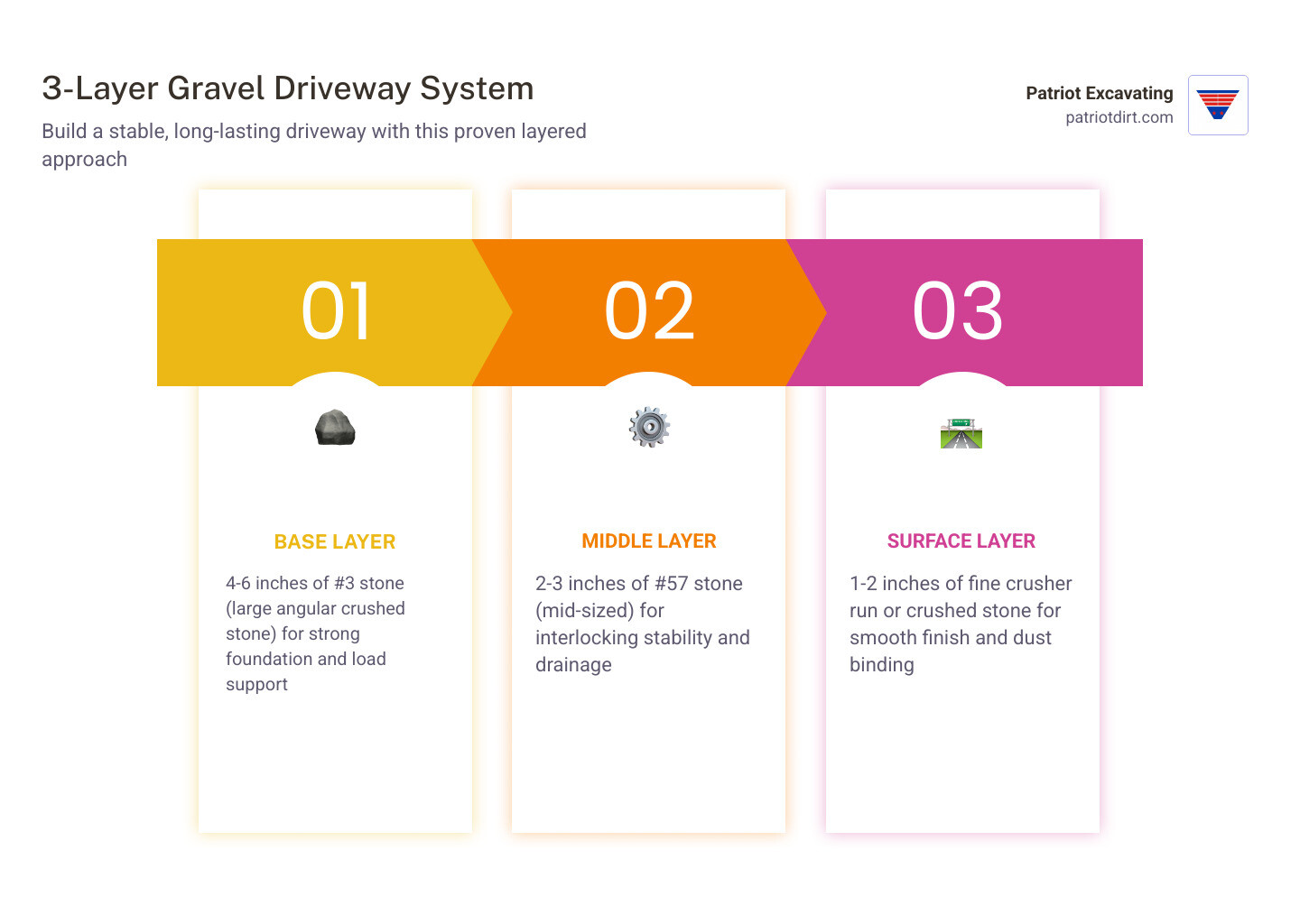
A durable driveway is built using a graduated “layer cake” system. We do not simply dump 10 inches of the same stone; instead, we use three distinct layers to ensure stability and drainage:
- The Base Layer (4-6 inches): Utilizing large #3 stone, this layer serves as the structural skeleton of the driveway. It provides the strength to support heavy vehicles and allows for deep drainage.
- The Middle Layer (2-3 inches): We use #57 stone to fill the larger gaps in the base rock, creating a transition layer that prevents the surface stone from migrating downward.
- The Surface Layer (1-2 inches): We apply a material with “fines,” such as crusher run. The stone dust acts as a binding agent, locking the top stones into a smooth, walkable, and drivable surface that resists displacement.
For guidance on stone selection and drainage details when putting in a gravel driveway, Contact Patriot Excavating to schedule an on-site review.
Professional Installation: From Grading to Compaction
At Patriot Excavating, the secret to a driveway that remains smooth and rut-free is mechanical compaction. We do not rely on the weight of delivery trucks to pack the stone. Instead, we install the gravel in “lifts”—usually 4 inches at a time—and use a heavy vibratory plate compactor or a drum roller on each individual lift. This ensures that every inch of the driveway is densely packed from the bottom up.
Proper moisture content is also a critical factor during installation. If the stone is too dry, the particles will not settle into their tightest possible fit; if it is too wet, the material can turn into a slurry. Our operators aim for the “optimum moisture content” that allows the fines to lubricate the larger stones, facilitating maximum density. To keep the gravel from migrating into the surrounding lawn or landscape, we often install edging restraints, such as pressure-treated timber or concrete borders. Following a detailed gravel driveway grading guide ensures that each lift is perfectly leveled and sloped before the next layer is applied.
Advanced Drainage Solutions for Putting in a Gravel Driveway
In many cases, simple grading is insufficient, particularly on sloped properties in areas like Trafalgar, Morgantown, or the rolling hills of Brown County. For these projects, we integrate advanced sewer, water, and drainage services to protect the driveway from erosion. This may include:
- Crowning: Creating a high point in the center of the driveway so water sheds evenly to both sides.
- French Drains: Installing buried perforated pipes wrapped in gravel to whisk subsurface water away from the driveway base.
- Culvert Installation: Placing large-diameter pipes under the driveway where it crosses a ditch or low spot to prevent washouts during heavy rain events.
- Rip-Rap Stabilization: Using large stones at drainage outlets to prevent soil erosion and maintain the integrity of the driveway’s edges.
To ensure that putting in a gravel driveway is done with the correct moisture control, lift thickness, and compaction, contact Patriot Excavating to plan your installation approach.
Long-Term Maintenance and Performance
A Patriot Excavating professionally installed gravel driveway is exceptionally durable, but it is also a flexible system that benefits from periodic professional attention to maintain peak performance. Over time, even properly compacted stone can experience minor displacement from turning tires, heavy service vehicles, and seasonal weather. In central Indiana, the combination of spring rains and winter freeze-thaw cycles makes drainage and surface shape especially important year after year.
At Patriot Excavating, we provide professional maintenance to preserve the crown, correct minor low spots before they become potholes, and keep water moving away from the surface and base layers. Every few years, our team can replenish the top layer with additional crusher run to restore the fines that naturally migrate or wash away over time. Keeping the surface tight and well-shaped helps resist displacement, improves traction, and reduces the chance of water infiltrating into the structural layers.
Potholes are the primary enemy of any gravel surface, but they are best handled with proper correction rather than temporary surface smoothing. At Patriot Excavating, we handle potholes by removing failed material, rebuilding the area with appropriate aggregate, and compacting it so the patch becomes part of the driveway structure. For more details, see our guide on how to repair a pothole in gravel driveways.
By having land leveling and grading experts handle both the installation and any corrective grading, you ensure the driveway is built and maintained for Indiana conditions. Gravel is a strong choice for our region because it accommodates frost movement better than rigid surfaces that can crack under the same conditions. If your driveway is developing ruts, holding water, or washing out at the entrance, contact Patriot Excavating to schedule a professional evaluation and a plan to restore long-term performance.
Frequently Asked Questions
How much gravel does Patriot Excavating use for a standard driveway?
The total amount of gravel required depends on the driveway’s length, width, target depth, and the material selected for each layer. For a standard two-car driveway of about 20′ x 50′, we calculate material needs across the full three-layer system so the finished surface performs as intended after compaction. At Patriot Excavating, we measure each site carefully and account for grade, drainage features, and compaction so the driveway is built to the correct depth from the start.
Can gravel be installed over existing topsoil?
We strongly advise against placing driveway stone over topsoil or organics. Topsoil retains moisture and breaks down over time, which leads to instability, pumping, and settlement as weather conditions change in Indiana. Removing the organic layer and reaching stable subsoil is essential for long-term driveway performance. Professional site preparation is the difference between a driveway that remains reliable and one that quickly develops soft spots, ruts, and drainage issues.
When is it necessary to hire Patriot Excavating for a driveway project?
If your driveway is long, crosses uneven terrain, has recurring drainage issues, or connects to a public road, professional excavation and grading are essential. Putting in a gravel driveway correctly requires the right equipment, site knowledge, and drainage expertise to make sure water moves away from the surface and foundation layers. At Patriot Excavating, we coordinate utility locates, address erosion concerns, and can incorporate related site services when conditions demand it. When you want a gravel driveway built for long-term performance, seeking out the best driveway grading services near me is a smart first step.
If you are ready to move forward, contact Patriot Excavating for a professional estimate and expert guidance tailored to your property in central Indiana.
Conclusion
At Patriot Excavating, we are a family-owned company dedicated to providing high-quality site preparation services across central Indiana. From Indianapolis and Shelbyville to Zionsville and beyond, we understand the geological and climatic challenges of our region. We don’t just spread rock; we provide comprehensive driveway development, including excavation, utility coordination, stabilization, and precision grading, so your entrance performs reliably through heavy rain, freeze-thaw cycles, and daily traffic.
When putting in a gravel driveway, long-term success comes down to fundamentals: stable subgrade, engineered stone layers, proper compaction, and drainage that moves water away from the driveway instead of through it. Our team brings the equipment and experience to handle everything from new residential driveways to complex access roads for larger sites.
Contact Patriot Excavating today to discuss your project, schedule a site assessment, and receive a professional estimate. Let’s build a driveway foundation that lasts in central Indiana.