
What You Need to Know About Concrete Septic Tank Installation Before Digging
What Goes Into Concrete Septic Tank Installation and System Planning?
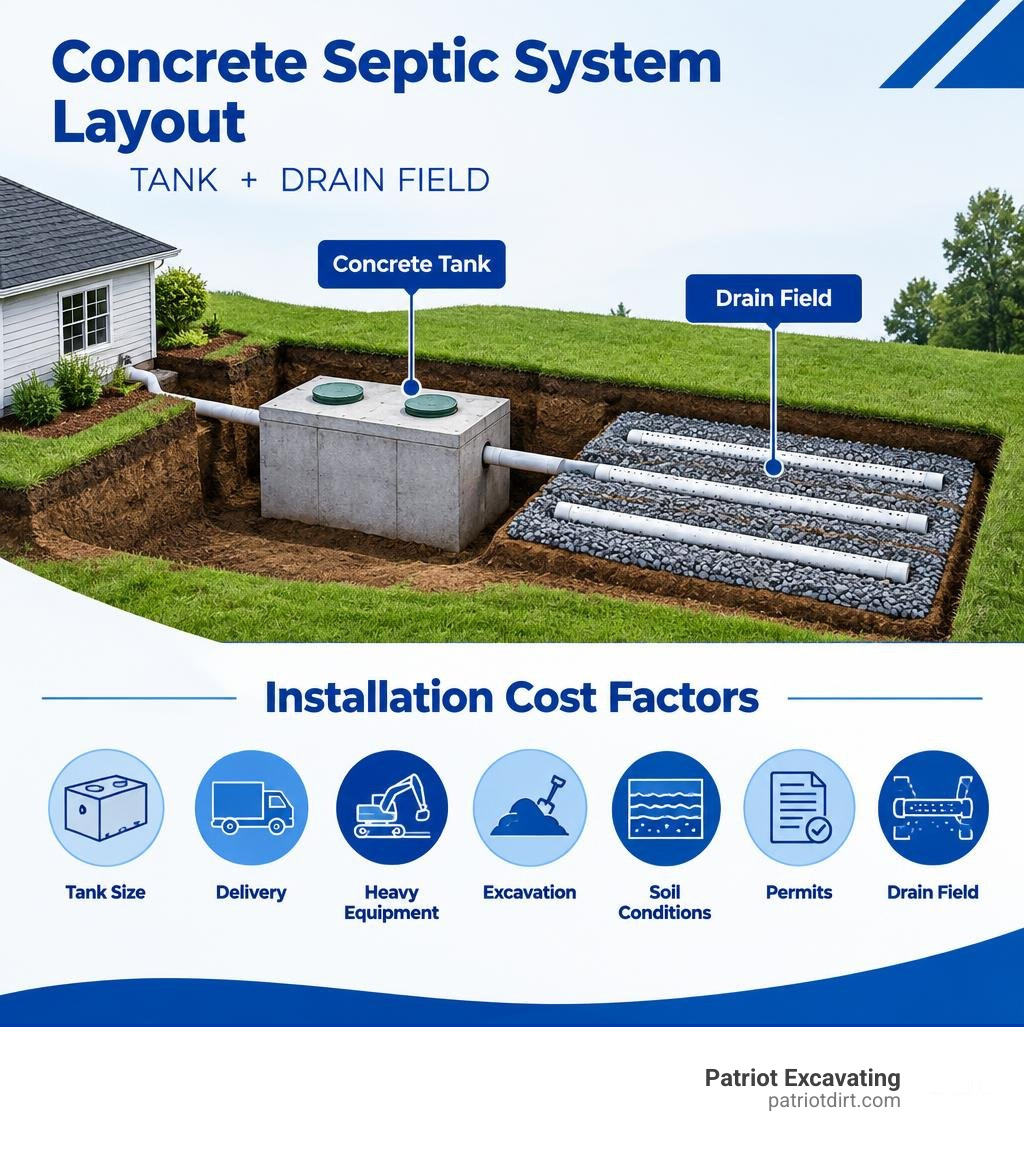
Concrete septic tank installation planning depends on tank capacity, soil conditions, equipment access, and drain field design. A complete project includes precast vessel dimensions, specialized transport, machinery mobilization, structural excavation, soil evaluation, local health permits, and drain field installation. Planning begins with assessing site factors, from subsurface soil strata to parcel access routes. For property owners across central Indiana, structural planning, long-term durability, and overall concrete septic tank system requirements are primary considerations. The structural performance of precast concrete makes it a dependable investment, and thorough planning helps owners prepare for professional excavation, materials, and system installation. Understanding the complete engineering scope of work helps property owners prepare for an underground system that will reliably serve the property for decades.
In central Indiana, regional soil profiles, property boundaries, seasonal high water tables, and equipment access dictate project execution. Patriot Excavating is a family-owned commercial and residential excavation company serving Indianapolis and surrounding communities with site excavation, precision grading, hydro excavation, erosion control, and water and sewer infrastructure work. Our heavy equipment fleet and experienced operators manage excavation and installation to ensure underground wastewater components meet engineering specifications and Indiana State Department of Health standards.
I am Clay Hamilton, president of Patriot Excavating. With more than two decades of field experience in site development, heavy equipment operation, and underground utility management, I guide property owners through site preparation and system layout. Our crews coordinate trenching, aggregate leveling, backfilling, and finish grading. If you are preparing for new construction or upgrading an aging system, contact Patriot Excavating today to schedule your on-site assessment and request an estimate.
Property owners can work with our qualified team of Enviro-Septic installers to explore advanced dispersal options designed for difficult terrain. Reviewing our comprehensive guide to septic system installation will also help you prepare your property before excavation begins.
Concrete Septic Tank Capacity and Installation Planning
Designing a residential wastewater system begins with assessing daily water volumes, structure size, plumbing fixture loads, and site access. A precast concrete vessel separates solids into sludge and buoyant oils into scum, allowing clarified effluent to flow through an outlet baffle toward the absorption field. For homeowners evaluating concrete septic tank cost, household capacity, site conditions, and excavation requirements are key planning factors.
Selecting Concrete Septic Tank Capacity and Size
Tank capacity is determined by county health regulations, bedroom count, and fixture discharge to ensure proper retention time. Undersizing pushes solids into drain lines, risking premature clogging and lateral field failure. Proper retention ensures that anaerobic bacteria have sufficient time to break down organic solids before liquid moves onward to secondary treatment.
While auxiliary outbuildings may use 500-gallon tanks, primary residences require larger capacities. Two to three-bedroom homes typically use 1,000 gallons, four-bedroom homes need 1,250 gallons, and larger residences require 1,500-gallon or dual-compartment setups where secondary chambers provide fine settling. Patriot Excavating evaluates floor plans and fixture counts across central Indiana to determine proper holding capacities.
Selecting the correct size during initial residential septic tank installation protects the system during peak demand periods and ensures long-term operational performance.
| Tank Capacity (Gallons) | Typical Home Size | Approximate Dimensions (L x W x H) | Site & Installation Considerations |
|---|---|---|---|
| 500 Gallons | 1 Bedroom / Auxiliary Building | 5′ x 4′ x 5′ | Compact footprint; restricted to secondary structures |
| 1,000 Gallons | 2 to 3 Bedrooms | 8′ x 5′ x 5’6″ | Standard residential profile; requires stable road access |
| 1,250 Gallons | 3 to 4 Bedrooms | 8′ x 5’8″ x 6′ | Common mid-size choice; requires deeper excavation depth |
| 1,500 Gallons | 4 to 5+ Bedrooms | 10′ x 6′ x 6′ | Heavy structural footprint; requires high-capacity excavation equipment |
What Professional Concrete Septic Tank Installation Involves
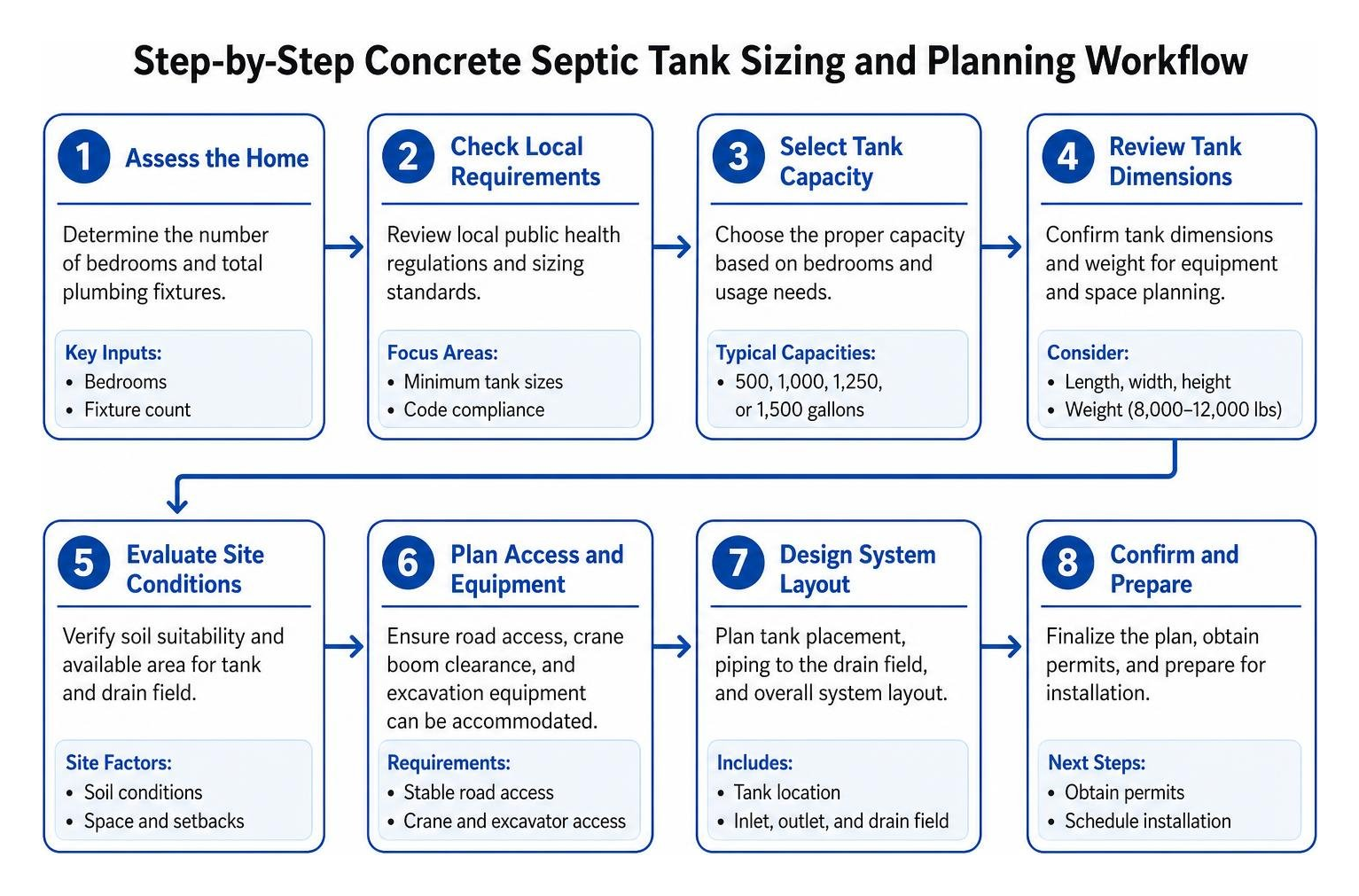
Installing precast concrete units requires heavy machinery, precision laser leveling, and skilled operators. Because residential tanks weigh 8,000 to 12,000 pounds, placement demands stable access, safe rigging, and accurate elevation control.
The installation sequence performed by Patriot Excavating includes:
- Excavating a stable pit with side-slope benching to prevent sidewall collapse in dense clay.
- Placing and compacting a level bed of washed aggregate to prevent uneven settlement and pipe shear.
- Rigging and lowering the structure with excavators or boom trucks for exact alignment.
- Sealing pipe penetration boots with watertight rubber gaskets to prevent groundwater intrusion.
- Applying butyl sealants along tongue-and-groove seams and securing access risers to finished grade.
- Backfilling the perimeter in mechanically compacted soil lifts using approved granular fill.
Our detailed overview of everything homeowners must know about septic system installation provides valuable insight into project coordination and layout preparation. Contact Patriot Excavating today to discuss your project requirements and schedule an on-site consultation.
Precast Concrete Durability and Structural Performance
Selecting precast concrete for underground wastewater containment supports long-term ground stability, structural integrity, and dependable performance across central Indiana’s heavy clay soils. Patriot Excavating utilizes commercial-grade excavation equipment and rigorous site preparation practices to ensure every tank installation remains stable over decades of continuous operation.
Durability, Lifespan, and Structural Integrity
Precast concrete remains the industry standard for underground wastewater containment. High-strength concrete formulations delivering 4,000 to 5,000 PSI compressive strength provide a 40 to 50 year service life in accordance with ASTM International engineering standards. Steel-reinforced concrete walls withstand lateral earth pressure, expansive clay movement, and backfill compaction without deflecting.
A key advantage of precast concrete is its substantial ballast weight. In areas with seasonal high water tables, lightweight structures are vulnerable to hydrostatic uplift, which can force an empty vessel upward and rupture sewer lines. Precast concrete units anchor firmly into the ground naturally without auxiliary tie-downs. When installed near driveways or parking areas, concrete tanks can be engineered to meet H-20 traffic load ratings to handle heavy axle loads without structural compromise.
Engineering Specifications and Long-Term Performance
Precast concrete tanks deliver structural resilience under deep soil cover, accommodating complex landscape plans and heavy grading configurations. High-density concrete mix designs resist lateral earth loads while preventing deflection under variable soil moisture conditions common in Indiana winters and springs.
| Engineering Feature | Precast Concrete Specification | On-Site Performance Advantage |
|---|---|---|
| Structural Lifespan | 40 to 50+ Years | Endures decades of subsurface soil pressure and biological exposure |
| Vessel Mass (1,000 Gal) | 8,000 to 10,000 lbs | Provides natural ballast against hydrostatic uplift and buoyant forces |
| Water Table Stability | Self-Anchoring Design | Resists shifting or floating without auxiliary anchors or secondary ballast |
| Drive-Over Capacity | H-20 Traffic Rated Options | Withstands vehicle axle loads under driveways or parking areas |
| Backfill Tolerance | High Structural Strength | Accommodates mechanical compaction and native backfill without wall deflection |
| Structural Rigidity | Steel-Reinforced Core | Maintains chamber geometry and watertight integrity under deep burial depths |
The professional crews at Patriot Excavating inspect soil conditions to ensure your precast vessel rests on a solid aggregate foundation. Contact Patriot Excavating to evaluate your site and receive a project estimate.
Key Site Factors That Affect Installation
Property layout, underlying geology, and proximity to existing infrastructure determine equipment staging, excavation depth, and labor planning on every central Indiana job site. Patriot Excavating conducts detailed site evaluations across Marion, Johnson, Hamilton, Hendricks, Morgan, and surrounding counties to anticipate subsurface conditions before equipment arrives.
Soil Conditions, Bedrock, and Water Table Depth

Subsurface geology dictates excavation stability and drainage feasibility. Central Indiana features varied soil profiles, ranging from gravelly loam along river terraces to dense glacial till and impermeable clay layers.
Clay holds moisture, creating ground pressure on buried structures and requiring high-tonnage excavators to dig efficiently. Sites with shallow bedrock may require hydraulic breaker attachments to achieve design depths. In areas with high water tables, dewatering pumps and trench protection systems maintain drier trenches during pipe placement. Partnering with a dedicated site excavation contractor ensures your site is prepared using heavy excavators, hydro excavation tools, and proper shoring techniques tailored to regional ground conditions.
Our operators evaluate trench integrity during excavation. When unstable ground or high groundwater is identified, we employ engineered trench stabilization techniques, specialized bedding stone, and targeted sub-base drainage to prevent settling beneath the tank.
Accessibility, Yard Obstacles, and Heavy Equipment Mobilization
Moving heavy precast concrete vessels and aggregate requires accessible travel routes. Patriot Excavating manages site mobilization by:
- Coordinating 811 utility locates and using precision hydro excavation to safely expose buried utility lines.
- Placing composite ground mats to protect residential driveways, curbs, and established lawns from heavy machinery.
- Clearing low branches and brush to provide stable outrigger positioning for boom trucks.
- Calculating boom reach to place precast tanks safely over landscape barriers.
- Segregating excavated topsoil from subsoil layers to support clean backfilling and final grading.
- Implementing erosion control measures, including silt fencing, to protect slopes and manage runoff.
For a thorough site evaluation, contact Patriot Excavating to review access logistics and request an estimate for your property.
Complete System Planning: Drain Fields and Secondary Treatment
A precast concrete septic tank represents the initial stage of on-site wastewater management. Clarified liquid effluent must discharge into an engineered soil absorption field for complete biological purification.
Absorption Field and Leach Bed Construction
The absorption field relies on naturally occurring aerobic soil microbes to neutralize pathogens and break down remaining organic matter before purified moisture re-enters the water table, adhering to EPA septic guidelines.
Traditional absorption fields utilize perforated PVC distribution pipes placed over washed crushed stone aggregate within dedicated trenches. Modern configurations also incorporate gravelless chambers and engineered geotextile filtration networks. Effluent leaves the concrete tank through a solid sewer pipe and enters a distribution box, which balances flow across lateral lines for uniform absorption throughout the dispersal footprint.

Patriot Excavating shapes surface grades and installs erosion control measures to direct storm runoff, gutter downspouts, and sump pump outlets away from the absorption area, keeping the field functional during heavy rain events common throughout central Indiana.
Advanced Treatment and Alternative Dispersal Options
When soil percolation tests reveal slow-draining clay, restrictive layers, or shallow bedrock, advanced secondary treatment systems are engineered to achieve proper purification:
- Mound Systems: Elevated sand beds constructed over native ground that utilize timed pressure dosing to distribute effluent evenly across the treatment zone.
- Sand Filter Systems: Dedicated media filtration beds that strip suspended particles and organic compounds before liquid enters the soil.
- Aerobic Treatment Units (ATUs): Oxygenated treatment chambers that enhance microbial activity to treat wastewater before dispersal.
- Alternative Geotextile Technology: Specialized configurations installed by our Presby certified installers that utilize geotextile-wrapped conduit for efficient treatment in compact yards.
Property owners can review regional standards in our Franklin IN septic installation guide. Reach out to Patriot Excavating to determine the optimal dispersal setup for your soil profile and request a project estimate.
Long-Term Maintenance, Pumping, and Repair Considerations
Precast concrete septic systems deliver decades of reliable service when supported by routine inspections, scheduled pumping, and proactive care from qualified wastewater professionals.
Routine Pumping Schedules and Inspections
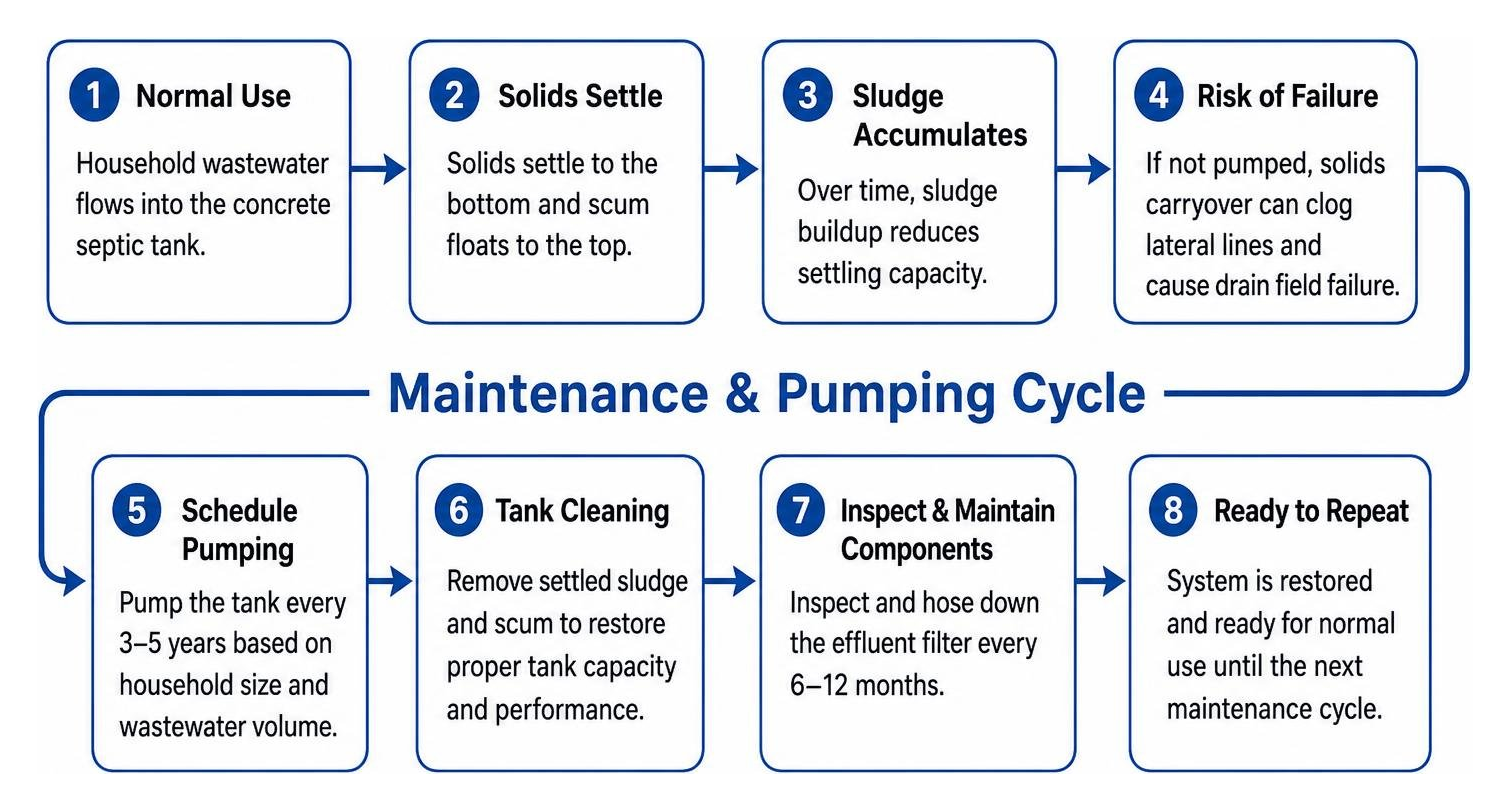
Over years of regular household use, non-biodegradable solids and settled sludge accumulate at the base of the tank. Excessive sludge buildup reduces the effective retention volume, allowing suspended debris to enter the lateral field and clog soil pores.
Residential precast tanks should be inspected and pumped every three to five years depending on household size and daily water volume. Professional inspections assess the physical integrity of concrete baffles, measure sludge and scum accumulation, and verify that tank joints and seals remain watertight.
Essential system maintenance practices include:
- Scheduling timely septic tank cleaning to remove settled solids before they enter distribution lines.
- Rinsing and cleaning the reusable effluent filter in the outlet baffle every six to twelve months to protect the drain field.
- Installing concrete or heavy-duty composite risers with sealed lids to keep access points at finished grade for inspection.
- Restricting heavy vehicles, trailers, and excavation machinery from driving over the drain field to avoid pipe crushing and soil compaction.
- Preventing oils, greases, chemical solvents, and sanitary wipes from entering household plumbing to protect internal bacterial ecosystems.
Evaluating Municipal Sewer Connection vs Private Septic
Properties located near growing utility service boundaries often evaluate private on-site systems versus municipal sewer main connections. Connecting to municipal sewer involves deep trenching to public mains, directional boring, hydro excavation near existing utilities, and ongoing municipal service requirements. A private precast septic system provides independent wastewater management directly on your property. Learn more about evaluating these configurations in our septic vs sewer analysis. Contact Patriot Excavating to evaluate your property’s utility connection options and request an estimate.
Frequently Asked Questions About Concrete Septic Tanks
How long does a precast concrete septic tank last?
A properly installed precast concrete septic tank provides a service lifespan of 40 to 50 years or longer. Reinforced concrete withstands significant soil pressure and shifting subsurface conditions, outlasting mechanical components such as effluent pumps, float switches, and check valves. Avoiding harsh chemical cleaners preserves the concrete interior walls and maintains beneficial biological digestion inside the chamber.
Can a concrete septic tank crack or float out of the ground?
Concrete tanks resist flotation because of their substantial weight. While lightweight alternatives require mechanical anchoring in wet ground, precast concrete structures stay anchored in high water tables through natural ballast. Cracking is rare when the vessel rests on a compacted, laser-leveled aggregate base. Structural issues generally result from unrated surface traffic, uncompacted bedding voids, or improper backfill procedures.
How do I know what size concrete septic tank my home requires?
Tank sizing is determined by county health regulations based on bedroom count and plumbing fixture volume:
- 1 to 3 Bedrooms: 1,000-Gallon Minimum Capacity
- 4 Bedrooms: 1,250-Gallon Minimum Capacity
- 5+ Bedrooms: 1,500-Gallon Minimum Capacity or Dual-Chamber Configurations
Selecting your system size based on bedroom capacity ensures adequate retention time and helps prevent overloading during high-volume periods. Contact Patriot Excavating to review your central Indiana property layout and request a complete system estimate.
Conclusion
Installing a precast concrete septic system provides dependable, long-term wastewater infrastructure for residential and commercial properties. From initial soil testing and site design to heavy excavation, precision leveling, crane placement, and drain field grading, every stage demands specialized equipment and skilled field execution.
Patriot Excavating is a family-owned commercial and residential excavation contractor serving Indianapolis, Greenwood, Franklin, Bargersville, Whiteland, New Whiteland, Carmel, Fishers, Noblesville, Mooresville, Martinsville, Plainfield, Avon, Brownsburg, and surrounding central Indiana communities. Our experienced crews handle complete septic installation and repair, advanced hydro excavation, sewer repair, erosion control, and comprehensive earthmoving.
Whether you are breaking ground on new construction, planning an addition, or upgrading an existing wastewater system, partner with an experienced team that understands central Indiana site conditions. Contact Patriot Excavating today to schedule your on-site consultation and project estimate.