
Stop Yard Flooding: When to Choose a Perimeter French Drain
Understanding How Foundation and Yard Drainage Systems Work
A perimeter French drain is the definitive subsurface solution when chronic standing water, a rising water table, or severe hydrostatic pressure threatens your foundation walls and low-lying yard areas. Every drainage challenge across central Indiana begins with the unique way water interacts with our regional soils. Across Indianapolis, Carmel, Greenwood, and surrounding communities, properties sit on heavy glacial till and dense clay. When seasonal rains fall, moisture quickly saturates the topsoil because dense clay prevents rapid downward percolation. As the soil fills with trapped water, the local water table rises, producing intense hydrostatic pressure. This hydraulic force pushes relentlessly against foundation footings, basement walls, and concrete slabs. Water naturally searches for the path of least resistance, finding microscopic pores, mortar joints, and cold seams in structural masonry.
Controlling these powerful subsurface forces requires looking at the property as a complete, integrated system. The crew at Patriot Excavating approaches groundwater management through comprehensive site preparation, laser grading, and dedicated site-work. Reviewing the principles of drainage systems basics helps show how subsurface collection works hand in hand with surface topography. Rather than allowing water to pool against your structural walls, a subsurface collection system provides an intentional, low-resistance escape route. It relieves hydrostatic force, captures rising groundwater before it breaches your floor, and conveys it safely away using steady gravitational pitch. This fundamental dynamic plays a central role in overarching stormwater management basics across residential lots and commercial developments throughout central Indiana.
Core Components of a Perimeter French Drain System
A durable, long-lasting drainage system depends entirely on industrial-grade materials engineered for heavy subterranean loads. Low-grade options quickly crush under earth weight or clog with fine clay silt. Professional installations by Patriot Excavating rely on premium components designed to maintain structural integrity and open flow channels for decades:
- Perforated Rigid SDR 35 PVC Pipe: Unlike thin, flexible corrugated tubes that sag, trap silt, and attract root intrusion, rigid smooth-wall PVC maintains a true grade and provides an unobstructed interior flow channel.
- Non-Woven Geotextile Filter Fabric: A heavy-duty, needle-punched polypropylene fabric lines the entire trench, preventing Indiana clay particles from migrating into the rock envelope while letting groundwater enter freely.
- Washed Angular Crushed Stone: Clean three-quarter-inch crushed limestone creates open void spaces that encourage swift water migration toward the pipe perforations.
- Maintenance Cleanout Risers: Integrated vertical access sweeps placed at upper terminal ends and key turns allow easy inspection and high-pressure maintenance flushing.
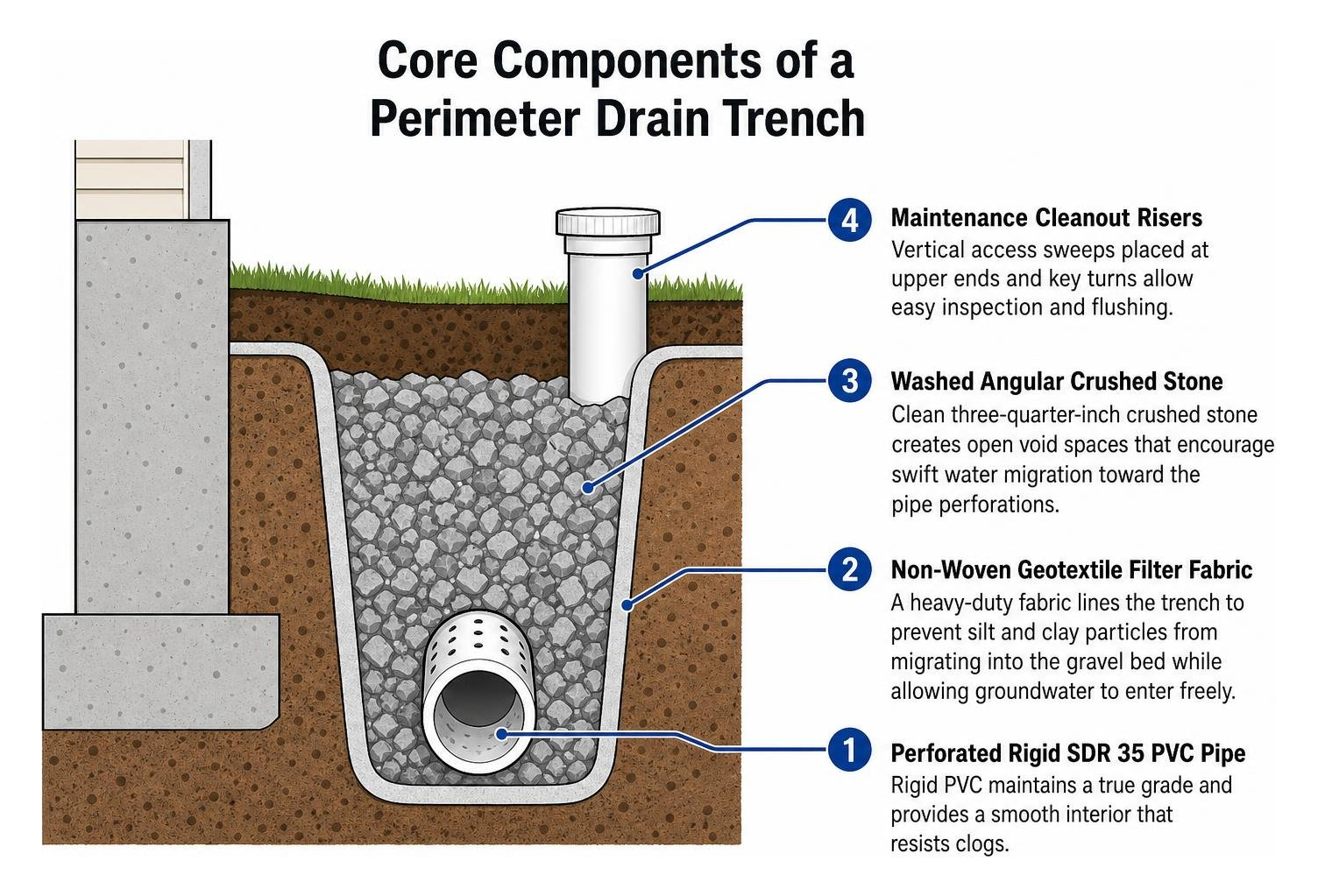
Engineering these elements correctly prevents premature failure. Following professional design rules detailed in how to design a French drain: pipe size, gravel, and slope ensures the trench volume matches the water demand of your specific property.
Curtain Drains vs. Foundation Perimeter Drains
Property owners often confuse curtain drains with foundation perimeter drains, but they serve two distinct hydrological purposes. A curtain drain acts as an upslope interceptor. Placed between a hillside and a building, it cuts off shallow surface sheet-flow and upper-soil moisture before the volume ever reaches the structure.
A foundation perimeter drain is installed adjacent to the concrete footings deep below the surface. Its primary mission is structural depressurization, capturing deep groundwater before hydrostatic pressure forces water through cold joints or sub-slab areas.
| System Characteristic | Curtain Drain (Interceptor) | Foundation Perimeter Drain |
|---|---|---|
| Primary Target | Surface sheet-flow and shallow groundwater | Deep hydrostatic groundwater at footing depth |
| Typical Depth | 18 to 24 inches | 4 to 8+ feet (aligned with footing level) |
| Standard Location | Upslope in the yard or along landscape contours | Directly adjacent to exterior foundation footings |
| Primary Protection | Turf health, landscape beds, and surface runoff | Basement walls, crawlspace subgrades, and footings |
| Material Envelope | Geotextile fabric, crushed rock, perforated pipe | Geotextile, angular stone, rigid PVC, wall membrane |
Key Warning Signs Your Property Needs Subsurface Drainage
Subsurface drainage issues usually reveal themselves through noticeable signs around your property. When heavy central Indiana storm runoff and rising groundwater overwhelm your soil, structural and landscape warnings start to appear.
Watch for these primary indicators of poor foundation drainage:
- Chronic Standing Water: Puddles lingering along the foundation line longer than 24 hours after a storm indicate soil saturation and poor water shedding.
- Soggy Turf and Spongy Soil: Lawns that stay wet for days prevent healthy grass growth and create messy conditions along your perimeter.
- Efflorescence on Foundation Walls: White, powdery mineral deposits on interior concrete or masonry show that water is actively migrating through the wall and evaporating inside.
- Persistent Musty Odors: Damp, humid conditions in crawlspaces or basements foster mold, mildew, and pest intrusion.
- Basement Floor and Wall Fractures: Hydrostatic pressure can create structural movement, leading directly to cracked concrete foundation issues that worsen over central Indiana freeze-thaw cycles.
- Active Soil Loss: Heavy water flows can wash away protective backfill, making proactive erosion control methods necessary to protect foundation stability.
Recognizing these symptoms early allows our team to design a targeted excavation and drainage plan that stops water intrusion before foundation damage escalates.
Engineering and Installing a Perimeter French Drain for Lasting Protection
Proper installation begins with a thorough site assessment. The technicians at Patriot Excavating evaluate property elevations, soil types, and discharge paths to plan the correct trench depth and layout. Modern laser levels ensure an accurate gradient of at least 1 percent, which equals 1 inch of drop for every 8 feet of pipe run.
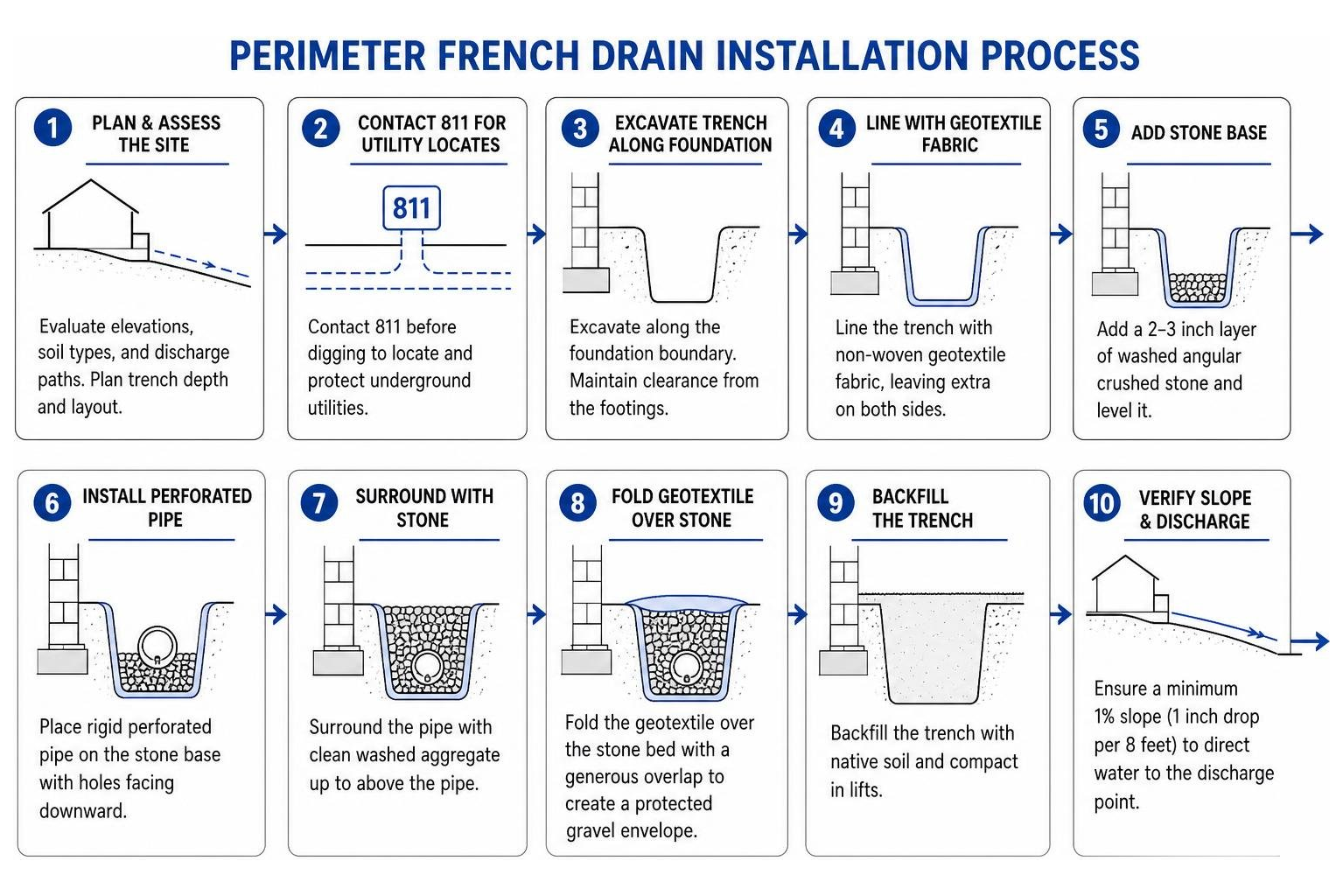
Before breaking ground, contacting 811 for utility locates is a mandatory safety measure to protect underground power, gas, and communications lines. When working near sensitive utility networks or tight residential structures, our crew uses specialized hydro excavation to safely expose underground infrastructure without damaging lines. Our heavy excavators dig the trench along the foundation boundary, maintaining clearance from the footings to prevent settling. We line the excavated channel with non-woven geotextile fabric, leaving enough material on both sides to fold over the top. A 2 to 3-inch base of washed angular crushed stone is laid and leveled, followed by rigid perforated pipe positioned with the holes facing downward.
We surround the pipe with additional clean washed aggregate, fold the geotextile over the stone bed with a generous overlap to create a protected gravel envelope, and backfill the trench with native soil. Executing correct drainage work around foundation structures keeps water flowing away from structural footings, matching the industry benchmarks highlighted in perimeter drain systems: how they work, maintenance and more.
Exterior vs. Interior Perimeter French Drain Systems
Choosing between an exterior and interior system depends on property layout, landscape features, and accessibility:
| Comparison Metric | Exterior Perimeter French Drain | Interior Perimeter French Drain |
|---|---|---|
| Installation Location | Outside along the foundation footing | Inside beneath the basement concrete floor |
| Excavation Scope | Exterior trenching around the building footprint | Concrete slab removal along interior walls |
| Water Management | Stops water before it touches the foundation | Catches water after it enters, routing it to a sump |
| Wall Protection | Pairs with exterior waterproofing membranes | Pairs with interior vapor barriers and weep holes |
| Disruption Area | Exterior landscaping, patios, and walkways | Finished basement rooms and sub-floor areas |
| Discharge Method | Gravity daylight outlet or exterior pump basin | Interior sump pump basin with dedicated discharge |
Discharge Solutions: Gravity Daylight Outlets vs. Sump Basins
Collecting subsurface water is only half the job; the system must also discharge it safely away from the property. When the yard slopes away from the home, a gravity daylight outlet is the most dependable, low-maintenance option. The perforated collection pipe transitions into a solid SDR 35 pipe that carries water downhill until it daylights through an open pop-up emitter or grated headwall fitted with a rodent guard.
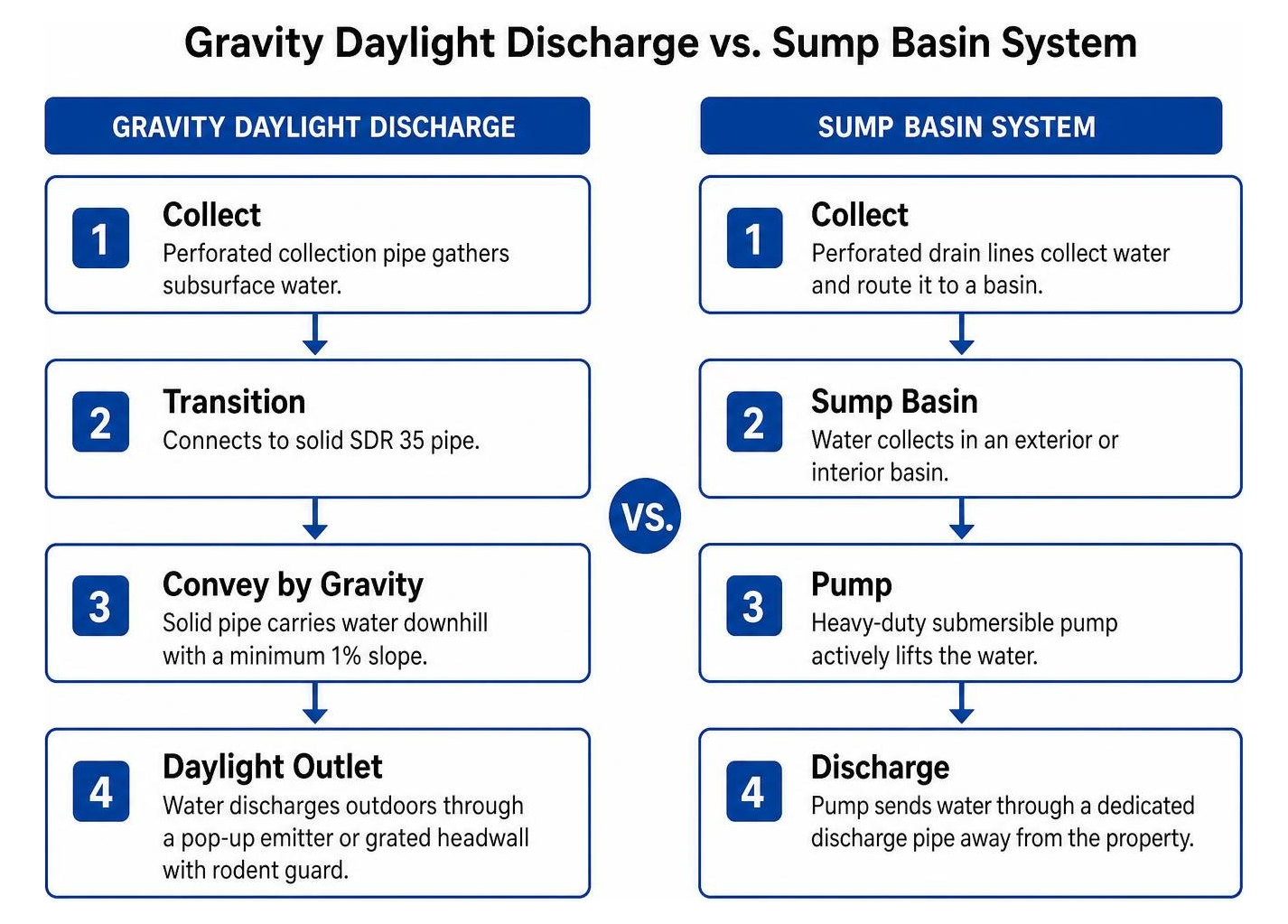
If the property is flat or sits in a low-lying area, a gravity daylight outlet may not be feasible. In these conditions, the drain lines route to an exterior or interior collection basin equipped with a heavy-duty submersible sump pump. The pump actively lifts the gathered water and sends it through a dedicated discharge pipe. Setting up a reliable sump pump discharge line installation protects against basement backflows, keeps water away from your foundation, and complies with local municipal stormwater rules that prohibit discharging runoff into municipal sanitary sewers.
Avoiding Critical Failures and Maintaining Drainage Efficiency
Subsurface drainage systems fail when improper materials are selected or when professional excavation techniques are overlooked. Installing flexible corrugated black pipe often leads to dips and low spots where standing water gathers, catches silt, and forms stubborn blockages. Using unwashed stone introduces fine limestone dust that plugs the drainage fabric pores, while skipping geotextile fabric altogether allows surrounding Indiana clay to fill the rock voids within just a few seasons.

Biological factors can also impact drainage performance. In central Indiana soils rich in iron, naturally occurring iron bacteria oxidize dissolved minerals into iron ochre, a thick, rust-colored slime that coats pipes and filter fabric.
To prevent and manage these issues, Patriot Excavating implements strict installation standards:
- Use Rigid Smooth-Wall Pipe: Smooth SDR 35 PVC walls prevent sediment buildup and resist crushing under heavy soil weight.
- Install Accessible Cleanout Ports: Threaded cleanout sweeps at high points give our operators direct access for routine inspections and maintenance.
- Conduct Annual Water-Flow Tests: Flushing the system with high-volume water each autumn confirms that lines move freely to the outlet before heavy winter and spring rains arrive.
- Use Professional Hydro-Jetting When Needed: If iron ochre or fine sediment starts to build up, high-pressure jetting through cleanout ports clears the line safely without requiring property excavation.
Addressing these failure points with comprehensive stormwater drainage solutions keeps your subsurface system clear, open, and operating reliably for years to come. Contact Patriot Excavating to inspect your current system or plan a new installation.
Site Grading and Professional Drainage Integration
A subsurface drain works best as part of an integrated, whole-property water management plan. While subsurface lines relieve groundwater pressure, proper surface grading prevents massive volumes of rainwater from reaching the foundation in the first place.
Correct land grading shapes the terrain so topsoil slopes continuously away from the building, dropping at least 6 inches over the first 10 feet. Exploring the principles of land grading shows how shaping property slopes and broad swales directs heavy surface sheet-flow safely around your yard.
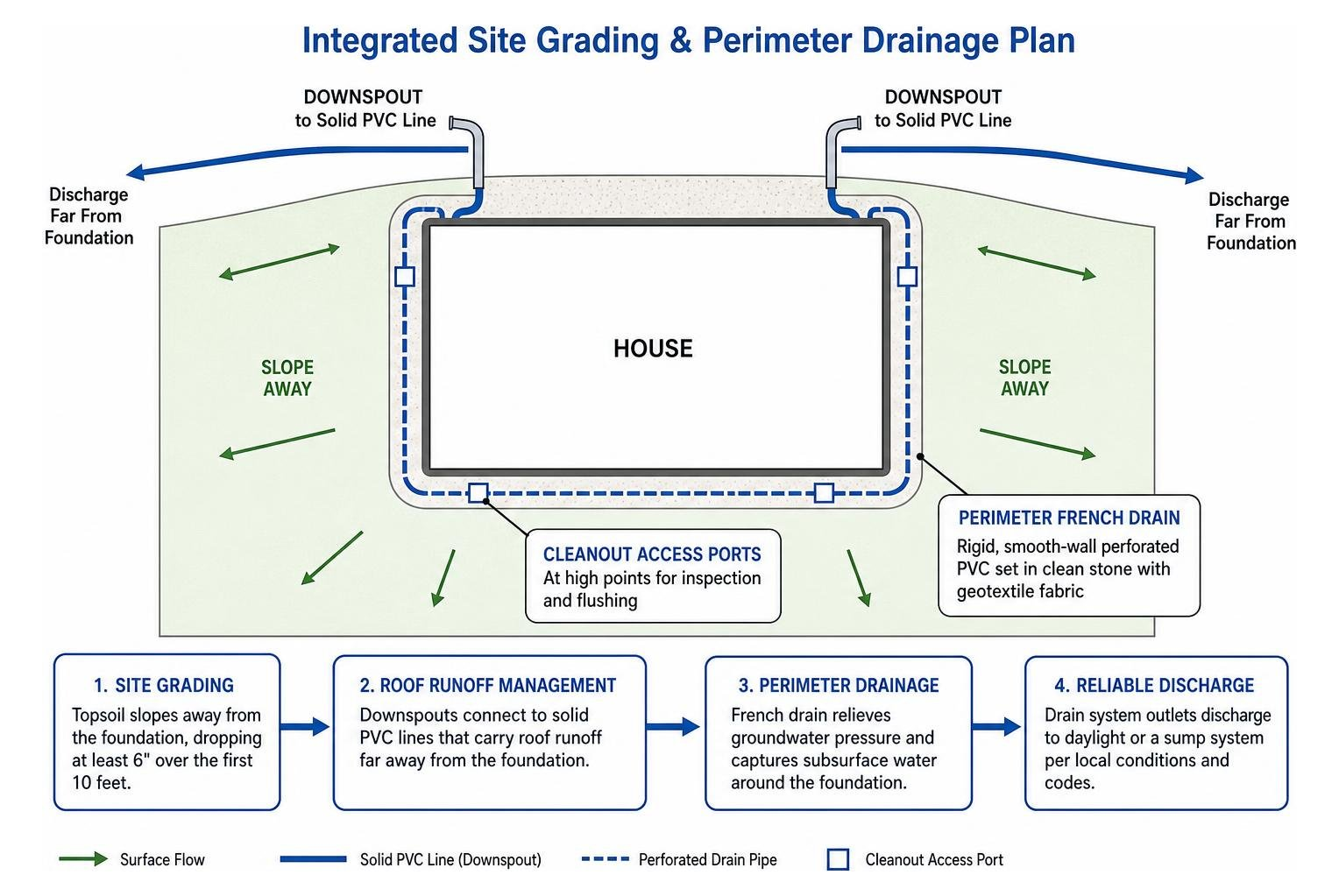
Roof runoff is another critical factor. A single inch of rain falling on a 2,000-square-foot roof produces roughly 1,100 gallons of water. If downspouts dump this volume straight onto the ground next to your foundation, it quickly saturates the soil and overworks your subsurface lines. Downspouts should be connected to separate, solid PVC lines that carry roof runoff far away from the foundation rather than dumping directly into the perforated French drain.
Combining expert land contouring with targeted residential drainage services in Indianapolis gives your property reliable, multi-layered flood protection. Tying these elements into comprehensive sewer water and drainage infrastructure protects both your foundation and the surrounding site from severe water damage. Reach out to Patriot Excavating to evaluate your site grading and downspout management.
Frequently Asked Questions About Perimeter Drainage
Which way should the perforated pipe holes face in a perimeter drain?
The perforated pipe holes should always face downward, positioned at roughly the 4 o’clock and 8 o’clock angles along the bottom of the trench. When the holes face down, groundwater rising through the gravel bed enters the pipe from underneath and drains away immediately. Facing the perforations upward forces the trench to fill completely before water enters the pipe, which keeps the base saturated and allows settling silt to fall directly into the pipe openings.
How long does a properly installed perimeter drain system last?
A professionally built drainage system utilizing rigid SDR 35 PVC pipe, clean angular washed aggregate, and high-quality non-woven geotextile filter fabric typically lasts 30 to 50 years. In contrast, systems built with flexible corrugated tubing or installed without filter fabric often fail within 5 to 10 years due to root intrusion, pipe crushing, and sediment clogging. Routine cleanout flushes help preserve maximum flow capacity over the system’s lifetime.
Do I need a permit to install a perimeter drainage system in central Indiana?
Permit requirements vary depending on your local municipality and the scope of work. Simple surface curtain drains discharging onto your own property often do not need formal permits. However, deep foundation-depth excavations, projects connecting to public stormwater mains, or work in regulated drainage easements across Marion, Hamilton, Hendricks, and Johnson counties frequently require municipal utility permits and code inspections. Patriot Excavating manages necessary permits, utility locates, and local regulatory requirements for our clients.
Conclusion
A well-designed perimeter drainage system protects your home from standing water, relieved hydrostatic pressure, and seasonal flooding. By pairing rigid PVC materials, clean stone, and durable geotextile fabrics with proper surface grading, you protect your foundation footings and maintain a dry yard throughout every season.
Patriot Excavating is a family-owned commercial and residential excavating company serving Indianapolis and central Indiana communities, including Greenwood, Carmel, Noblesville, Fishers, Westfield, Plainfield, and surrounding counties. We provide complete site preparation, hydro excavation, grading, erosion control, and sewer and water line services tailored to your property’s specific needs.
If you are dealing with chronic yard ponding, foundation moisture, or seasonal water buildup, our experienced excavation team is ready to help. Contact the drainage and excavation team at Patriot Excavating today to schedule a comprehensive site evaluation and receive a professional estimate for your project.